

The landscape of industrial project delivery is undergoing a fundamental shift. For decades, the Engineering, Procurement, and Construction (EPC) model was the default choice for large-scale process plant installations. However, as projects grow in complexity and owners demand greater financial transparency, the Engineering, Procurement, and Construction Management (EPCM) model has emerged as a superior strategic alternative.
At L-Vision Engineering Pte Ltd, we have observed this transition firsthand since our inception in 2001. Managing industrial projects across Singapore, Malaysia, Indonesia, China, and India requires a nuanced understanding of how to balance risk, cost, and technical precision. By moving from a "turnkey" mindset to a professional services management approach, organizations can achieve significantly better alignment with their long-term operational goals.
In a traditional EPC contract, the contractor takes on the entire risk of the project for a lump-sum price. While this offers the owner a perceived sense of security, it often results in higher costs due to the "risk contingency" padding: sometimes as high as 30%: that contractors build into their bids. Furthermore, the owner often loses control over the selection of vendors and the granular details of the Plant Engineering Design.
EPCM Services redefine this relationship. In this model, the EPCM firm acts as the owner’s agent. Instead of a single massive contract, the project is broken down into various packages. The EPCM contractor provides the Detailed Engineering Design, manages the procurement process, and oversees the construction site, but the owner enters into direct contracts with suppliers and trade contractors.
This shift transforms the project manager from a vendor into a partner. For a detailed breakdown of these differences, you can explore our analysis on EPCM, EPC, and PMC models.

One of the primary drivers behind the adoption of EPCM in industrial project management is financial clarity. Because the owner pays for the actual cost of materials and labor plus a management fee, there is no hidden markup on equipment or subcontracts.
Research indicates that EPCM can deliver projects up to six months faster because engineering and procurement can begin simultaneously on day one, rather than waiting for a finalized lump-sum bid from a general contractor.
Large-scale process plant installations are rarely static. As a project progresses from the Front-End Engineering Design (FEED) to the Detailed Engineering Design phase, technological advancements or market shifts may necessitate changes in scope.
Under an EPC contract, change orders are notoriously expensive and adversarial. Because the contractor’s profit is tied to the original lump sum, any deviation is viewed as a disruption. Conversely, the EPCM model is inherently flexible. Since the EPCM firm is compensated for their expertise and management time, they can adapt the design to meet the owner’s evolving requirements without the friction of heavy contractual penalties.
This flexibility is vital for ensuring that the final installation meets modern safety and efficiency standards, such as those discussed in our latest industry news updates.
 Prompt: A wide-angle cinematic shot of a large-scale industrial process plant under construction, showing intricate piping networks and structural steel at sunset, 2:1 aspect ratio.
In the realm of edible oil refineries and chemical processing, project boundaries are often defined as ISBL (Inside Battery Limits) and OSBL (Outside Battery Limits). Understanding the distinction is key to successful industrial project management.
At L-Vision Engineering, our core expertise lies in OSBL services. This includes the critical infrastructure that supports the core process:
For projects that involve both ISBL and OSBL scopes, coordination between process specialists and supporting infrastructure teams is critical. While process licensors and specialist technology providers focus on the core production units, L-Vision ensures the supporting facility systems: from incoming raw material handling to storage, utilities, and product transfer: are engineered for reliability, operability, and regulatory compliance.
Since 2001, L-Vision has built a reputation for navigating the complex regulatory environments of the Asia-Pacific region. Whether it is complying with SCDF regulations in Singapore or managing large-scale installations in the diverse industrial landscapes of Indonesia and India, our approach remains grounded in technical excellence.
Effective EPCM requires a deep dive into Detailed Engineering Design. This involves:
By acting as the project manager/agent, we ensure that every vendor and contractor adheres to these stringent specifications, maintaining the integrity of the original Plant Engineering Design.
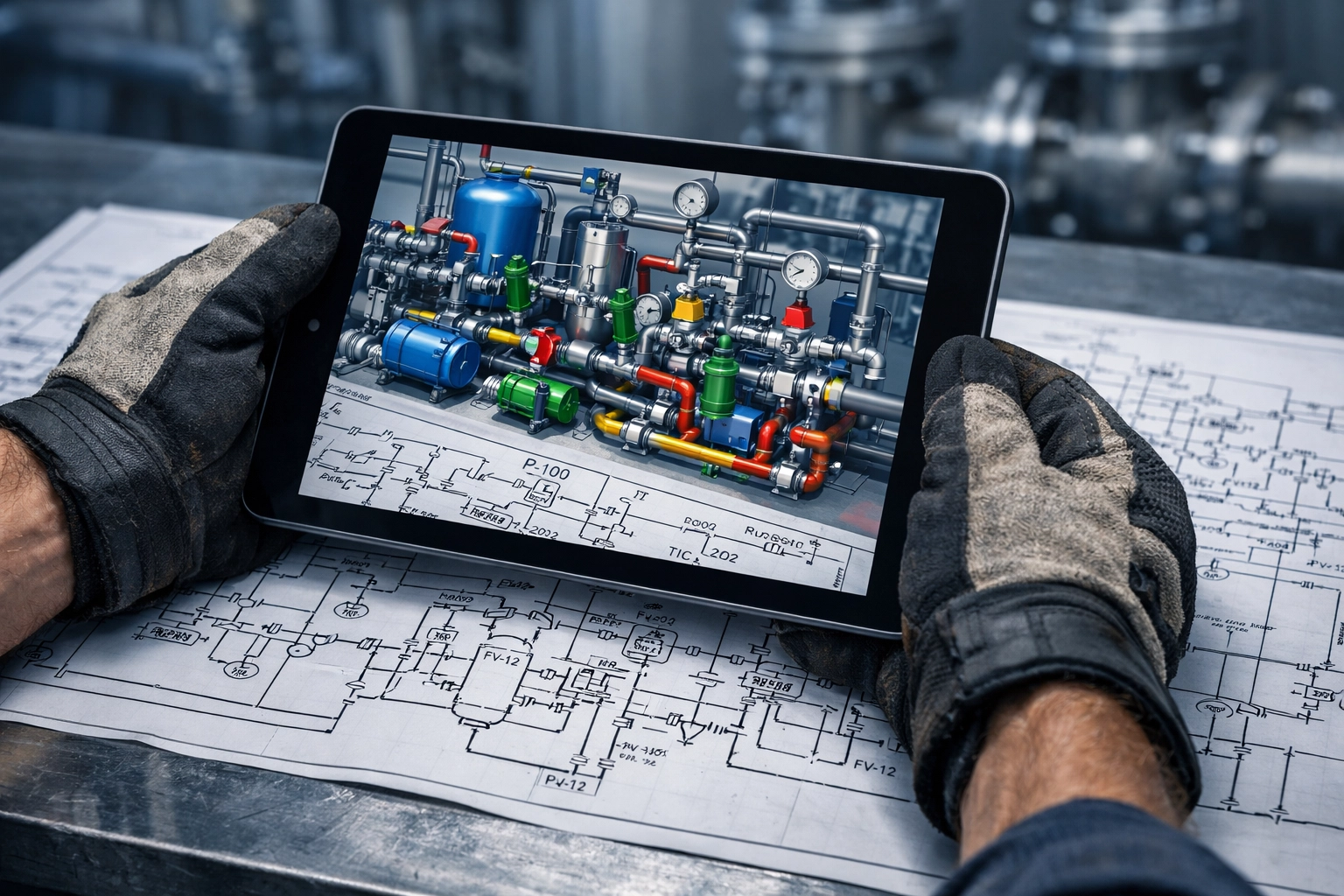 Prompt: Close-up of professional engineers discussing a highly detailed technical blueprint layout for an industrial utility system, authoritative and professional atmosphere, 2:1 aspect ratio.
For facility managers and project owners in the process industries, the choice of project delivery model is a strategic one. If your priority is absolute price certainty (at the cost of a higher overall price) and you are willing to relinquish control over design details, EPC may suffice.
However, if you seek transparency, cost efficiency, and the ability to influence the quality of your plant’s components, EPCM is the clear winner. It allows you to leverage the expertise of firms like L-Vision to manage the "Outside Battery Limits" complexities while ensuring your core process is delivered by specialists.
For more information on our project history and technical capabilities, you can view our project showcase or read our recent technical articles.
The future of process plant installation is not just about building a plant; it is about managing a complex ecosystem of technology, safety, and finance. EPCM provides the framework to do exactly that. By choosing a management-led approach, you ensure that your facility is built to last, optimized for your specific needs, and delivered with the transparency your stakeholders demand.
Discover expert factory and construction engineering services with L-Vision Engineering Pte Ltd in Singapore. We offer process engineering, industrial plant design, process plant installation, equipment fabrication, and project management.
Posted by L-Vision Engineering Pte Ltd on 11 Apr 26

 Singapore