

Maintaining compliance in a hazardous chemical warehouse Singapore requires a detailed understanding of the overlapping jurisdictions of the Singapore Civil Defence Force (SCDF) and the Ministry of Manpower (MOM). Central to this is the recent update to SS 532:2024, the Code of Practice for the storage of flammable liquids. This standard provides the technical baseline for engineering controls and operational safety.
Direct Answer: How to ensure DG storage compliance in Singapore?
Compliance is achieved by aligning facility design with SS 532:2024, the SCDF Fire Code 2023, and the Workplace Safety and Health (WSH) Act. Key requirements include obtaining a P&FM licence Singapore, implementing a chemical bund with 110% capacity, and ensuring mechanical ventilation is sized to the specific risk of the occupancy. While a design rate of approximately 6 air changes per hour (ACH) is commonly adopted for many indoor flammable liquid stores, higher rates may be required based on formal risk assessments and process hazards.
| Key Compliance Checklist |
|---|
| • Valid SCDF Petroleum & Flammable Materials (P&FM) Licence |
| • Design based on SS 532:2024 & SS 586-1 (GHS) |
| • Fire compartment walls per SCDF Fire Code 2023 classification |
| • Chemical bunding: 110% of largest tank or 25% of total volume |
| • Ventilation: Risk-based (typically ≥6 ACH for flammable stores) |
| • Hazardous Area Classification (HAC) per IEC 60079 |
| • Ex-rated electrical equipment (ATEX/IECEx certified) |
| • Current Emergency Response Plan (ERP) submitted to SCDF |
| • GHS labelling and SDS management per SS 586-2 |
The regulatory landscape for hazardous material storage is primarily governed by the Fire Safety Act (SCDF) and the WSH Act (MOM). L-Vision Engineering Pte Ltd provides technical support to help operators navigate these requirements during the Plant Engineering Design phase.
SCDF regulates the storage of Petroleum and Flammable Materials (P&FM) to prevent fire incidents. MOM focuses on protecting personnel from chemical exposure and explosion risks. SS 532:2024 serves as the technical "bridge," detailing how to design a chemical storage facility that satisfies both authorities.
| Requirement | Typical Engineering Basis |
|---|---|
| Fire Walls | Rating per SCDF Fire Code 2023 (typically 2-hour for Class 3) |
| Bund Capacity | Max(110% largest tank, 25% total stored volume) |
| Ventilation | Mechanical exhaust (typically ~6 ACH, risk-dependent) |
| Electrical | Explosion-protected per HAC (IEC 60079) |
| Licensing | P&FM Storage Licence based on UN Class and quantity |
| Labelling | Globally Harmonized System (GHS) per SS 586 |
| Foam System | Transitioning toward PFAS-free firefighting foam |
Strategic layout is the first step in industrial warehouse engineering. Facilities must be designed to minimize the impact of a potential incident on adjacent properties. This involves calculating separation distances from "lot boundaries" and "protected places" as defined in SS 532:2024.
For warehouses storing flammable liquids, the layout must prioritize accessibility for emergency responders. This often includes clear fire engine accessways and strategically placed hydrants. Internal layouts should focus on the fire compartment, ensuring that hazardous areas are isolated from administrative or low-risk zones through rated barriers.

Proper ventilation is essential for preventing the accumulation of flammable vapours. Mechanical ventilation rates depend on the hazard classification, occupancy, and SCDF Fire Code requirements. While a rate of approximately 6 ACH is a common starting point for flammable liquid storage Singapore, engineers must perform a risk assessment to determine if higher rates are necessary to keep vapour concentrations below 25% of the Lower Flammable Limit (LFL).
Exhaust inlets should be positioned near floor level for vapours heavier than air, which is common for many industrial solvents. This ensures that any "pooling" vapours are effectively removed. Our HVAC Engineering Services specialize in designing these safety-critical systems for hazardous environments.

A chemical bund is a liquid-tight containment barrier designed to prevent hazardous liquids from escaping during leaks or spills. SS 532:2024 specifies that the bund must be able to contain 110% of the largest tank's volume or 25% of the total volume of all tanks/drums within the area, whichever is greater.
For portable containers, the standard provides guidance for certain approved non-metallic containers, though their use is subject to chemical compatibility, fire safety, and regulatory requirements. All bunded areas must be constructed from materials resistant to the chemicals stored, such as epoxy-coated concrete or specialized FRP Fabrication.
In a dangerous goods warehouse, electrical systems are a primary potential ignition source. All electrical installations within a hazardous zone must comply with the relevant hazardous area classification.
Grounding and bonding systems are necessary to prevent the accumulation of static electricity during the transfer of flammable liquids. These systems should be inspected and tested periodically according to the facility's maintenance programme and risk assessment to ensure electrical continuity. This is a critical component of Equipment Fabrication and installation for chemical process plants.
Singapore adopts the Globally Harmonized System (GHS) of Classification and Labelling of Chemicals via SS 586. Every container in a hazardous material storage area must have a visible GHS label indicating:
Safety Data Sheets (SDS) must be readily accessible to all personnel and emergency responders, providing detailed information on chemical properties and first-aid measures.

Hazardous area classification is the process of analyzing the environment where explosive atmospheres may occur. According to IEC 60079:
All electrical equipment used in these zones must carry ATEX or IECEx certification. This explosion protection ensures that equipment such as motors, switches, and lighting does not provide an ignition source.
Storing incompatible chemicals together can lead to violent reactions, toxic gas release, or fires. A dangerous goods warehouse must implement a segregation matrix. For example:
Even with robust Process Plant Installation, facilities must prepare for accidents. Every DG store requires a customized Emergency Response Plan (ERP) that includes:

Fire protection requirements are dictated by the SCDF Fire Code and SS 532. This typically includes a combination of:
Successful chemical storage design Singapore goes beyond basic compliance. Professional engineers must consider:
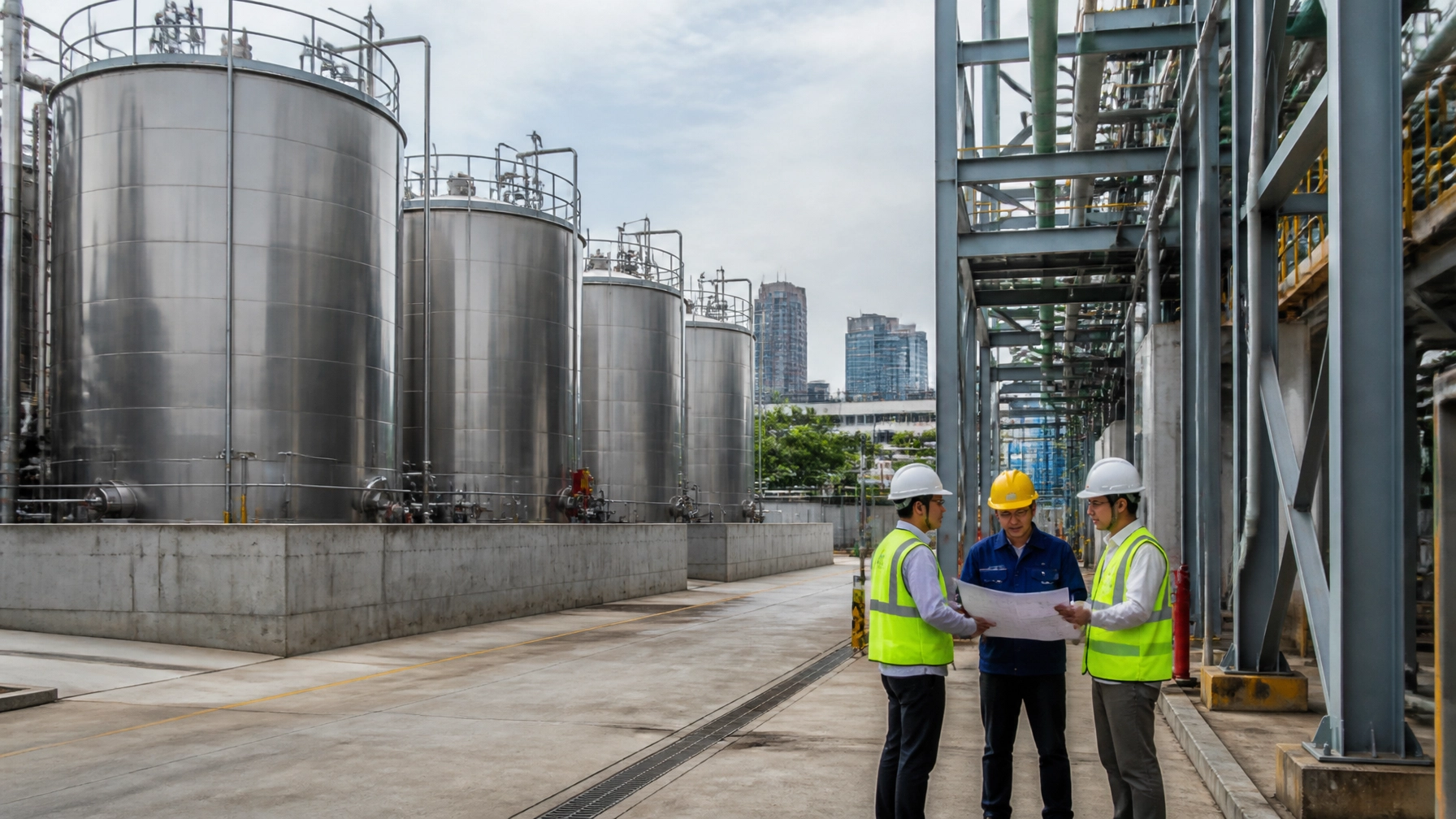
L-Vision Engineering Pte Ltd provides multi-disciplined engineering services for the chemical and edible oil industries. Our expertise in Storage Tank Design and Industrial Project Management in Malaysia and Singapore ensures that your facility meets the highest safety standards. We manage the entire lifecycle from Procurement Strategy to final installation, ensuring a reliable and compliant operation. For specialized projects like pharmaceutical warehouse design and GMP warehouse conversions, our team integrates regulatory needs with efficient material flow.
Navigating SCDF and MOM requirements for DG storage is a technical challenge that requires a proactive approach to engineering and risk management. By adhering to SS 532:2024 and implementing robust hazardous area classification, companies can ensure both legal compliance and the safety of their personnel.
For assistance with your next project or to discuss your Industrial Procurement needs, Contact Us today.
What are the biggest changes in SS 532:2024? The 2024 update reflects the industry's transition toward fluorine-free firefighting foams, provides new guidance for approved non-metallic containers under specific conditions, and refines requirements for tank overfill protection and portable container storage.
What is the required bund capacity for DG storage? A bund is a liquid-tight containment barrier surrounding tanks or drums that prevents hazardous chemicals from escaping into the environment during leaks or spills. The required capacity is 110% of the largest tank's volume or 25% of the total volume of all tanks within the bunded area, whichever is greater.
How much ventilation is required for a hazardous material store? Mechanical ventilation rates depend on the hazard classification, occupancy and SCDF Fire Code requirements. A design rate of approximately 6 air changes per hour (ACH) is commonly adopted for many indoor flammable liquid stores, though higher rates may be required based on risk assessment and process hazards.
Discover expert factory and construction engineering services with L-Vision Engineering Pte Ltd in Singapore. We offer process engineering, industrial plant design, process plant installation, equipment fabrication, and project management.
Posted by L-Vision Engineering Pte Ltd on 10 Jul 26

 Singapore