Blum Hinges: Small Components That Quietly Shape the Entire Kitchen Experience
A hinge is one of the most overlooked parts of a kitchen, yet it is also one of the most frequently used.
Homeowners may not talk about hinges often, but they interact with them every single day — when opening a pantry door in the morning, closing a cabinet after meal prep, or reaching for tableware at night. Over the life of a kitchen, this happens thousands upon thousands of times. That is why hinge choice is not a minor technical detail. It directly affects how refined, stable, safe, and comfortable the kitchen feels in daily living.
At Carte Kitchen, we do not see hinges as “just hardware.” We see them as part of the kitchen’s movement language. A good hinge determines whether a door closes harshly or gently, whether it stops at the right angle or crashes into a wall, whether a tall front feels controlled or unstable, and whether a premium cabinet continues to feel premium years after installation.
Blum’s hinge system is strong because it is not one-size-fits-all. Blum’s official catalogue separates hinges by application: standard opening, wide-angle opening, profile or thick doors, thin doors, glass doors, angled applications, and inward-opening furniture doors. That matters because different cabinet situations need different hinge behavior. A kitchen designed properly should not force one hinge to solve every problem. It should choose the right hinge for the right living condition.
A well-planned hinge application affects how softly the door closes, how wide it opens, whether nearby drawers can still operate comfortably, whether adjacent walls and handles are protected, and whether the cabinet feels quiet and controlled instead of noisy and abrupt. Blum’s own guidance also shows that opening-angle stops are used to prevent doors from colliding with walls, handles, or neighboring furniture, which reinforces an important point: hinge planning is not only about the hinge itself, but about how the entire cabinet interacts with the surrounding kitchen.
107° hinge: a practical hinge for standard cabinet doors with a more controlled opening behavior
The lifestyle effect is subtle but real: the door feels natural and predictable. It opens enough for normal access, but does not behave excessively. In a kitchen, this kind of restraint can actually improve usability because the cabinet feels disciplined rather than overextended.
Hinges with spring: when the hinge itself helps pull the door closed
A hinge with spring is useful when you want the door to naturally pull back toward the cabinet and complete its closing motion in a controlled way. When this is paired with BLUMOTION in suitable hinge families, the result is a soft, quiet closing experience rather than a harsh impact.
This matters in everyday life because a self-closing feel makes the kitchen more forgiving. You do not need to deliberately guide every cabinet door all the way shut. The cabinet helps finish the movement properly. That becomes especially valuable in busy homes where people are moving quickly, multitasking, cooking with wet hands, or simply not paying full attention every time they close a door.
Unsprung hinges: important for push-to-open and special furniture applications
An unsprung hinge becomes especially relevant in handle-less furniture where a mechanical push-to-open system such as TIP-ON may be used. If the hinge constantly tries to pull the door shut, it can work against the intended push-open behavior. That is why spring and unsprung selection is not just a technical choice — it affects how the cabinet is meant to be opened in real life.
A homeowner should not be expected to memorize hinge engineering. But the designer should know when a hinge must assist the motion and when it must stay neutral so the opening system can behave correctly. The good news is that at Carte Kitchen, we take care all these for you.
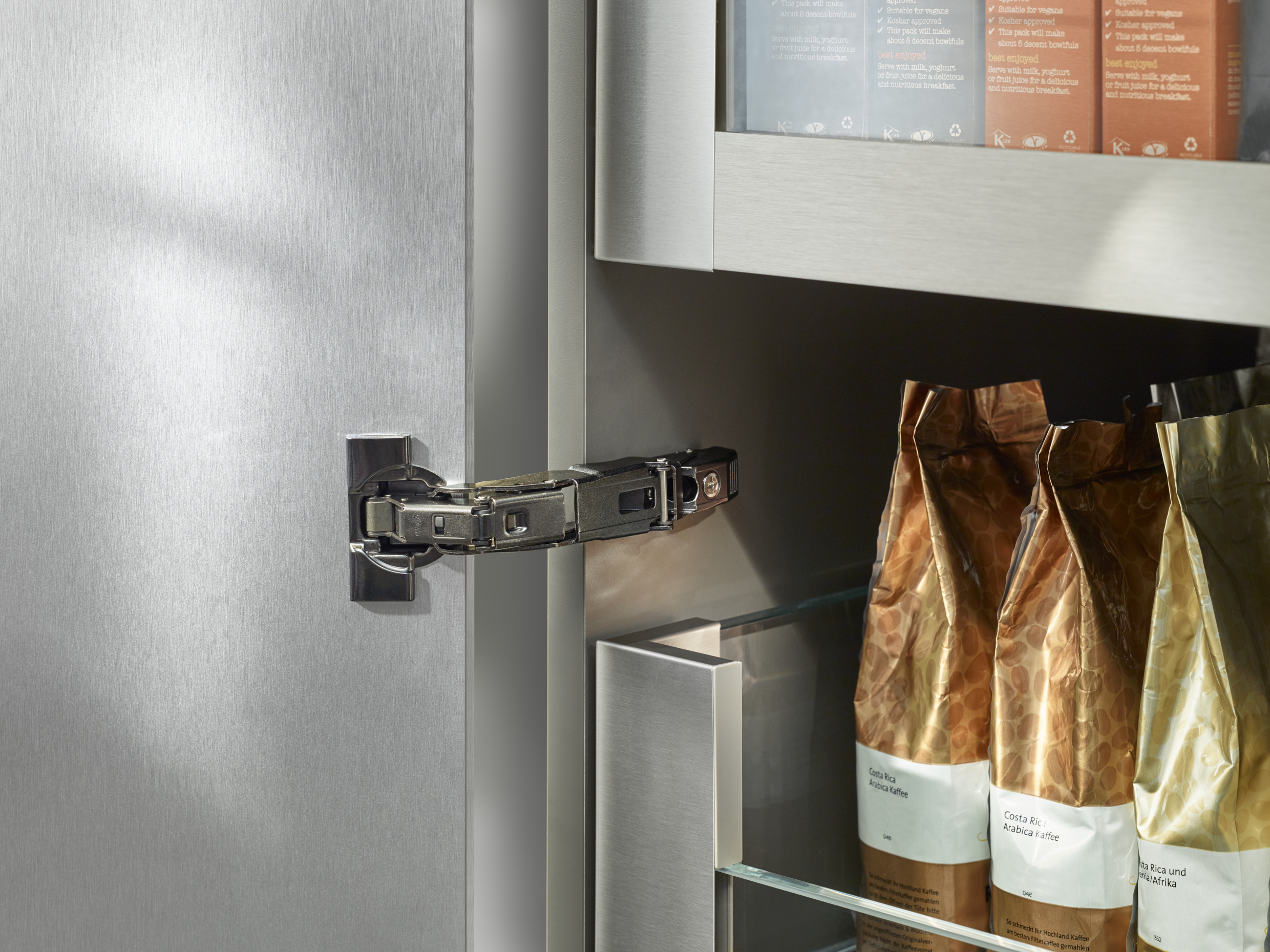
155° hinge: wide-angle access for cabinets that need better visibility and easier reach
This is a very important hinge type in high-function kitchens.
A 155° hinge is useful when the cabinet door needs to move far enough out of the way to support better access, especially where there may be inner pull-outs, internal drawers, or deeper storage configurations behind the door. “0-protrusion” matters because when the door is open, it is designed not to obstruct the internal pull-out path in the same way a more projecting hinge geometry might. In practical terms, this allows internal storage to work more freely and comfortably.
110° hinge: inward opening door, a simple yet practical hidden door
Inward-opening doors or hidden doors should not be treated casually. They need the correct hinge solution, the right front width limits, and proper planning around access and safety. That is why an experienced kitchen specialist matters. It is not enough to make the door “somehow open.” It needs to open in a way that remains stable, safe and practical over time.





 Malaysia
