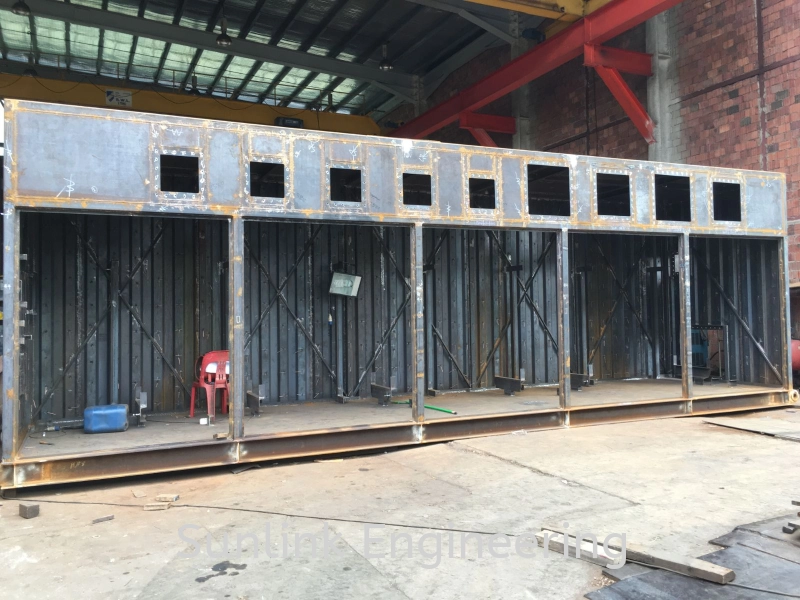
Steel skids and enclosures are essential components in industrial systems such as generators, pumps, compressors, control panels, and packaged equipment units. While skids provide structural support and transportability, enclosures protect equipment from environmental exposure, noise, and unauthorised access.
Fabricating both elements together requires careful planning to ensure structural strength, functional performance, durability, and compliance.
Below are the key considerations when fabricating steel skids and enclosures for industrial applications.
The steel skid must support:
Equipment weight
Dynamic operational loads
Transport and lifting loads
Additional accessories (fuel tanks, panels, piping)
Improper load design can cause deflection, vibration issues, or long-term structural fatigue.
For enclosures, structural rigidity is equally important to prevent panel distortion, misalignment, and door fitting problems.
Skids and enclosures must be designed as a coordinated system:
Proper mounting points for enclosure panels
Alignment between frame structure and outer casing
Access openings positioned accurately
Space allocation for ventilation and maintenance
Poor coordination can result in costly site modifications or installation delays.
Industrial skid systems are often transported and relocated. Important features include:
Lifting lugs rated for full assembly weight
Forklift pockets
Tie-down points
Structural reinforcement to prevent distortion during lifting
The enclosure must also be designed to withstand lifting stresses without deformation.
For generator or mechanical equipment packages, airflow management is critical:
Proper air intake and exhaust openings
Louvers or ventilation panels
Heat dissipation planning
Noise attenuation (if required)
A structurally sound skid is ineffective if the enclosure traps heat and affects equipment performance.
Rotating equipment requires:
Flat and level mounting surfaces
Accurate bolt hole positioning
Integration with vibration isolation systems
Reinforced base plates
Enclosure panels must also accommodate vibration without rattling or fatigue over time.
Material and finishing choices depend on operating conditions:
Indoor dry environment → Painted mild steel
Outdoor environment → Hot-dip galvanised steel
Coastal or marine exposure → Galvanised or stainless steel
Noise-sensitive areas → Acoustic lining within enclosure
Proper surface treatment significantly extends service life and reduces maintenance.
Maintenance planning should include:
Hinged or removable panels
Lockable access doors
Service clearance around equipment
Cable and piping entry points
Designing with maintenance in mind improves operational efficiency and reduces downtime.
Industrial projects may require:
Weld procedure specifications (WPS)
Material traceability
Structural load verification
Inspection and quality control records
Working with an experienced fabricator ensures compliance requirements are built into the fabrication process.
Fabrication should consider:
Transport dimensions and road restrictions
Site lifting constraints
Assembly sequence
Integration with electrical and piping systems
Early coordination prevents delays and redesign during installation.
Steel skids and enclosures should be fabricated as an integrated system rather than separate components. Proper attention to structural design, ventilation, lifting provisions, vibration control, and environmental protection ensures long-term reliability and performance.
Well-planned fabrication reduces operational risk, improves safety, and enhances equipment lifespan — delivering real value beyond the initial build.
Sunlink Engineering Pte Ltd
Sunlink Engineering Sdn Bhd
📧 [email protected]
📞 +65 9387 5463 (Call or WhatsApp) – Singapore
📞 +60 17 2140 411 (Call or WhatsApp) – Malaysia (JB)
🌐 https://www.sunlinkmetal.com/contactus/

 Philippines