Abstract
Clogging of dust collection filter cartridges is a frequent failure in industrial dust removal systems, directly causing spikes in system pressure drop, reduced airflow, increased energy consumption, and diminished dust removal efficiency; it can even lead to premature cartridge failure and non-compliance with environmental standards. This paper systematically analyzes the root causes of cartridge clogging across five dimensions: dust characteristics, cartridge selection, system operation, cleaning efficiency, and operating conditions. Addressing practical on-site issues, it proposes long-term protective strategies—covering material upgrades, structural optimization, airflow management, enhanced cleaning, pre-treatment protection, and intelligent operation and maintenance—to provide technical support for the stable operation, cost reduction, and efficiency improvement of industrial dust removal systems.
Keywords
Dust collection filter cartridge; causes of clogging; long-term protection; cleaning optimization; operational adaptability
I. Introduction
Thanks to advantages such as high filtration precision, a compact footprint, and ease of installation, cartridge dust collectors are widely used across industries including mining, metallurgy, machining, spray coating, construction materials, and chemicals. However, in actual operation, cartridge clogging remains a critical issue limiting system performance. Minor consequences include rising pressure differentials, a surge in cleaning frequency, and increased O&M costs; severe outcomes involve cartridge caking and failure, system paralysis or downtime, and excessive dust emissions.
Cartridge clogging is not caused by a single factor but results from the complex interplay of multiple variables: dust properties, cartridge suitability, operating parameters, cleaning capabilities, and environmental conditions. Conventional reactive cleaning and frequent cartridge replacement address symptoms rather than root causes. Only by tracing the origins of the problem and establishing a comprehensive protection system—encompassing proactive prevention, real-time control, and post-operation maintenance—can the clogging issue be fundamentally resolved, cartridge service life extended, and the long-term, stable, and efficient operation of the dust collection system ensured.
II. In-depth Analysis of the Root Causes of Dust Collector Cartridge Clogging
(A) Inherent Dust Characteristics: The Primary Trigger for Clogging
The physicochemical properties of the dust itself are the decisive factors regarding the likelihood of clogging, with distinct mechanisms associated with different types of dust:
High-humidity / Hygroscopic dust: When dust moisture content exceeds 60% or ambient humidity exceeds 80%, a water film forms on the particle surfaces, causing a sharp increase in stickiness. The particles readily adhere to filter media fibers and agglomerate, creating a wet, sticky, caked layer that seals the filter pores. If the temperature drops below the dew point, water vapor condensation exacerbates this caking, leading to irreversible "blinding" or paste-like clogging.
Highly adhesive / Oily dust: Dust generated in processes such as spraying, die-casting, asphalt processing, or involving oil mist contains grease, gums, and resins. These form a composite oil-and-dust layer on the cartridge surface. Due to its high adhesiveness, this layer resists removal by cleaning airflows and gradually penetrates the filter media, causing deep-seated clogging.
Ultrafine dust (particle size < 5μm): Ultrafine dust—such as that from metal grinding, pulverized coal, or cement—can penetrate the surface layer of the filter media and lodge deep within the fiber pores. Long-term accumulation leads to deep embedding that conventional cleaning methods cannot reach, ultimately resulting in a total loss of cartridge air permeability.
High-concentration dust: When inlet dust concentrations consistently exceed 500 g/m³, the rate of dust layer accumulation on the cartridge surface far outpaces the rate of removal during cleaning. This rapidly forms a thick dust cake that compressed air struggles to penetrate, causing the pressure differential to spike within a short period.
(II) Mismatch in Filter Cartridge Selection and Structure: Inherent Risks of Clogging
Mismatches between the filter cartridge's material, filtration precision, or structure and the actual operating conditions are significant human-induced causes of clogging:
Mismatched filter media material: Using standard polyester media in high-humidity or oil-laden environments—which lack hydrophobic and oleophobic properties—allows dust to easily adhere and penetrate the media; using media with insufficient heat resistance in high-temperature conditions causes fiber softening, shrinkage, and pore deformation, thereby accelerating dust accumulation.
Unreasonable filtration precision: Selecting low-precision cartridges for ultrafine dust leads to deep-layer penetration and clogging; selecting high-precision cartridges for high-concentration coarse dust results in excessive initial resistance and rapid surface dust buildup.
Defects in pleat structure design: Excessively dense pleating (spacing < 5mm) impedes internal airflow, causing dust to become trapped in crevices and creating "dead zones" for accumulation; excessively sparse pleating results in insufficient effective filtration area and excessive dust load per unit area; sharp pleat tips create stress concentration points, making the media prone to cracking and dust leakage during cleaning.
Imbalanced length-to-diameter ratio: Excessively long cartridges (ratio > 10:1) suffer from severe pressure drop in the pulse-cleaning airflow by the time it reaches the lower section; this results in clean upper sections but compacted dust accumulation in the lower sections, creating an uneven "clean top, clogged bottom" pattern.
(III) Uncontrolled System Operating Parameters: A Primary Driver of Clogging
When operating parameters deviate from design specifications, dust adhesion and accumulation intensify, accelerating the clogging process:
Excessive filtration velocity: Actual velocity exceeds design values (standard conditions >1.2 m/min; high-adhesion conditions >0.5 m/min). High-velocity airflow forces dust into the pores of the filter media and strengthens the adhesion between dust and the media, making dust removal significantly more difficult.
Uneven airflow distribution: Dust-laden air blowing directly onto the face of the filter cartridge causes a sudden spike in dust load and rapid caking on the intake surface. Airflow short-circuiting between cartridges creates localized high-velocity zones where dust accumulates heavily, leading to localized clogging that gradually spreads.
Poor compressed air quality: If the air source contains moisture or oil and has not been dried or purified, these contaminants adhere directly to the filter cartridge surface during the pulse-jet cleaning process. Mixing with dust to form oily sludge, this secondary contamination exacerbates clogging and acts as a hidden culprit behind cartridge blockage.
(IV) Insufficient Cleaning System Performance: A Key Cause of Clogging
The cleaning system provides the primary force for dislodging dust; insufficient performance prevents effective dust removal, leading to gradual accumulation and clogging:
Improper pulse-jet pressure: Excessively low pressure (<0.3 MPa) results in insufficient airflow impact to dislodge stubborn dust; excessively high pressure (>0.5 MPa) forces oily sludge and fine dust deep into the filter media, exacerbating deep-seated clogging.
Improper cleaning cycle or pulse width: An excessively long cycle (>15 min) allows dust to accumulate into a thick, hardened layer; an overly short cycle subjects the filter cartridge to frequent airflow impacts, leading to fatigue and damage; an excessively narrow pulse width (<0.1 s) results in incomplete airflow coverage and localized dust accumulation.
Pulse-jet device malfunction or design defects: Damaged pulse valves, misaligned blowpipes, or clogged nozzles cause cleaning failure or off-target jets; failure of the airflow to cover the full height of the filter cartridge results in uneven cleaning and severe dust accumulation at the bottom.
(V) Operational Conditions and Deficiencies in O&M Management: Factors Accelerating Clogging
Significant temperature fluctuations: Sudden cooling during high-temperature operation or heating during low-temperature operation causes thermal expansion and contraction of the filter media and deformation of its pores; simultaneously, moisture condensation exacerbates dust agglomeration.
Inadequate O&M management: Failure to regularly monitor differential pressure, temperature, and dust-cleaning parameters, resulting in a lack of timely intervention during the early stages of clogging; failure to regularly clean dust hoppers or inspect seals, leading to air and dust leakage that increases the system load; and improper filter cartridge installation or poor sealing, causing short-circuiting of the dust-laden airflow and localized overloading.
III. Long-term Protective Technical Measures for Dust Collection Filter Cartridges
(1) Upgrading Filter Media: Blocking Dust Adhesion and Penetration at the Source
Select functionalized filter media tailored to specific dust characteristics to enhance resistance to adhesion, penetration, temperature, and oil:
High-humidity/ambient-temperature oily conditions: Select PTFE-laminated polyester media; the smooth surface (friction coefficient ≤0.1) is hydrophobic and oleophobic, increasing the dust release rate by 30% and preventing oil-sludge caking. For light oil mist, modified oil-repellent polyester offers a more cost-effective alternative.
Medium-to-high-temperature oily flue gas conditions (120–190°C): Select PPS media, which offers temperature and oil resistance as well as hydrolysis resistance, making it suitable for high-temperature oily fumes and light tar content. For high-velocity, high-impact conditions, select aramid media for high strength and abrasion resistance.
Ultrafine/highly adhesive dust conditions: Select PTFE composite media; the surface filtration mechanism captures ultrafine dust (0.1–5 μm) within the micropores, preventing deep-bed clogging and ensuring effective dust cleaning.
Flammable and explosive dust conditions: Select anti-static media (incorporating carbon fibers or conductive coatings) with a volume resistivity of ≤10⁹ Ω·cm to eliminate static accumulation; flame-retardant treatment is also applied to reduce safety risks.
(II) Optimization of Filter Cartridge Structure: Enhancing Dust Holding Capacity and Cleaning Efficiency
Structural innovations address issues such as dust accumulation in dead zones, uneven cleaning, and localized overloading:
Composite Pleat Design: Utilizes pleats with variable spacing and heights; moderate spacing (6–8 mm) in the upper section ensures sufficient filtration area, while wider spacing (8–10 mm) in the lower section widens airflow channels and minimizes dust accumulation dead zones. Rounded transitions at pleat tips reduce stress concentration.
Optimized Length-to-Diameter Ratio: For high-dust operating conditions, short, wide cartridges (length-to-diameter ratio ≤ 6:1) are preferred to ensure uniform cleaning airflow pressure; long cartridges employ a segmented cleaning design to match airflow distribution.
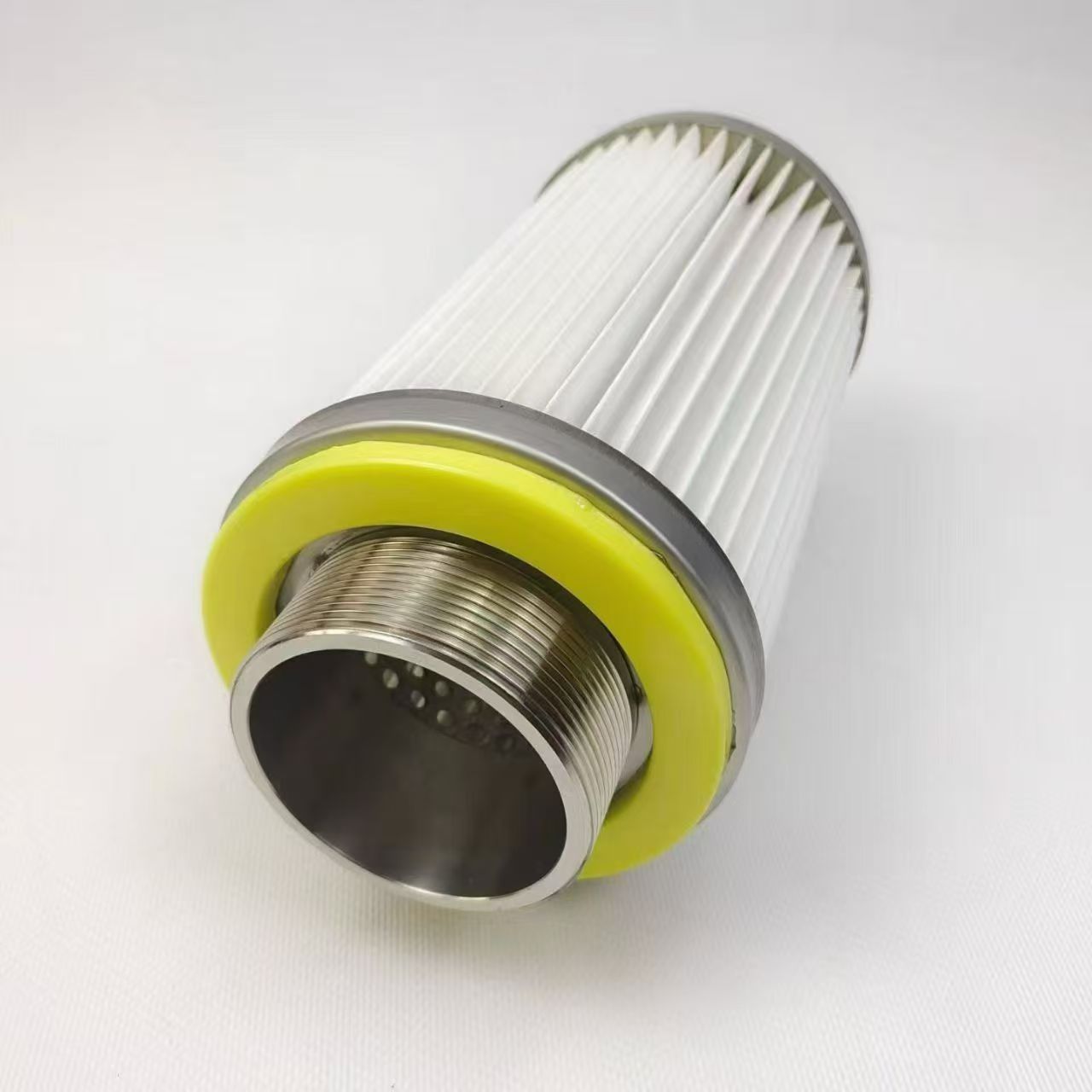
Reinforced Support and Sealing: Features a thickened galvanized metal core and denser support ribs to prevent cartridge collapse or deformation. End caps are secured via a dual-fastening method (adhesive bonding plus mechanical compression) and incorporate an internal wear-resistant rubber seal to eliminate air and dust leakage.
Addition of Wear-Resistant Flow-Guiding Structures: A flow-guiding buffer shroud is installed on the dust-facing side to decelerate and redistribute high-velocity airflow, intercept coarse particles, and reduce the load on the cartridge. A metal protective sleeve is fitted to the bottom 30 cm section to withstand eddy current erosion and minimize wear at the base.
(III) Airflow System Control: Optimizing distribution, reducing air velocity, and stabilizing operating conditions.
Control of filtration air velocity: Set air velocity strictly according to dust characteristics—0.8–1.2 m/min for standard dust, 0.6–0.8 m/min for fine dust, and ≤0.5 m/min for highly adhesive or oily dust. If the velocity exceeds limits, increase the number of filter cartridges to expand the filtration area rather than simply reducing airflow.
Airflow distribution design: Install honeycomb flow straighteners and flow-splitting baffles at the dust collector inlet to break up concentrated airflow and ensure uniform cross-sectional air velocity (deviation ≤±10%). Properly space the filter cartridges (≥150 mm) to prevent airflow short-circuiting and cartridge collisions.
Compressed air purification: Install a dryer and a three-stage oil-water separator at the air supply source; maintain the compressed air dew point at ≤-20°C to remove moisture and oil, thereby preventing secondary contamination of the filter cartridges.
Temperature stability control: Implement thermal insulation for high-temperature operations to avoid condensation caused by rapid cooling; preheat the housing for low-temperature operations to maintain the inlet air temperature 5–10°C above the dew point, preventing water vapor condensation.
(IV) Enhancement of the Cleaning System: Precision Pulsing, Efficient Dust Removal, and Damage Prevention
Optimization of cleaning parameters:
Pulse pressure: 0.4–0.45 MPa for standard operating conditions; 0.3–0.35 MPa for highly adhesive or oily dust (to prevent high-pressure air from driving dust deep into the filter media).
Cleaning cycle: 10–15 minutes for standard conditions; 3–6 minutes for highly adhesive or high-concentration dust (to prevent dust solidification).
Pulse duration: 0.15–0.2 seconds, ensuring the cleaning airflow covers the entire surface of the filter cartridge.
Upgrade of pulse-jet components: Utilize adjustable pulse valves and specialized nozzles for precise control of pulse volume; conduct regular inspections of pulse valves and blowpipes to ensure nozzles are accurately aligned with the center of the filter cartridge, free from misalignment or blockages.
Intelligent switching of cleaning modes: Implement differential pressure-triggered cleaning (rather than timer-based cleaning); automatically initiate cleaning when the differential pressure reaches 1,200 Pa and stop when it drops below 800 Pa to avoid ineffective or excessive cleaning.
(V) Multi-stage Pre-treatment Protection: Upstream Load Reduction to Ease Filter Cartridge Strain
Install pre-treatment devices upstream of the filter cartridges to intercept coarse particles, oil mist, and moisture, thereby alleviating pressure on the cartridges at the source:
Mechanical Pre-separation: Install a settling chamber or inertial separator upstream to remove coarse particles (>10 μm) and reduce inlet dust concentration by 30%–50%; for oily applications, add baffle plates or primary oil-mist filters to capture large oil droplets.
Moisture Pre-treatment: For high-humidity conditions, install a pre-heating/drying unit to lower intake humidity, or apply a hydrophobic powder coating (such as limestone powder) to the filter cartridge surface to prevent direct contact between moisture and dust.
Graded Filtration (Coarse & Fine): Employ a two-stage filtration system consisting of a "primary filter cartridge + main filter cartridge"; the primary cartridge captures large particles and heavy oil contaminants, while the main cartridge handles fine dust, thereby extending the service life of the main cartridge.
(VI) Intelligent O&M Management: Real-time monitoring, proactive intervention, and scheduled maintenance
Real-time parameter monitoring: Install differential pressure sensors, temperature sensors, and dust concentration detectors to monitor inlet/outlet differential pressure, intake air temperature, and inlet dust concentration in real time; trigger automatic alarms for data anomalies (e.g., differential pressure > 1500 Pa or temperature fluctuations exceeding ±10°C).
Maintenance record-keeping: Log differential pressure, dust cleaning frequency, and filter cartridge replacement dates; analyze clogging patterns to enable proactive intervention; conduct weekly inspections of pulse valves, seals, and blow-tubes; perform monthly cleaning of dust hoppers and checks for air leaks; and carry out quarterly offline inspections of the filter cartridge surfaces.
Standardized installation and replacement: Ensure a tight seal between the filter cartridge and the tube sheet during installation, with no looseness or gaps; handle cartridges with care during replacement—avoiding impacts, bending, or deformation—to prevent damage to the filter media.
IV. Targeted Protection Solutions for Different Operating Conditions
(1) High-humidity, sticky dust (building material grinding, wet-process dust)
Filter media: PTFE-laminated polyester (hydrophobic and anti-stick).
Structure: Wide-pitch pleats (8–10 mm) with rounded tips.
Cleaning: Low pressure (0.3 MPa), short cycle (3–5 min).
Pre-treatment: Upstream drying unit + hydrophobic pre-coating.
(2) High-temperature, oily flue gas (die casting, heat treatment, asphalt processing)
Filter media: PPS/Aramid + PTFE lamination (temperature-resistant, oil-resistant, and anti-stick).
Structure: Low length-to-diameter ratio, reinforced support cage, high-temperature resistant end caps.
Cleaning: Medium pressure (0.35–0.4 MPa), adapted cycle.
Pre-treatment: Oil baffle + high-temperature flow-guiding buffer hood.
(III) Ultrafine, high-concentration dust (metal grinding dust, pulverized coal, cement dust)
Filter media: High-precision PTFE composite media (captures ultrafine dust).
Structure: Optimized pleat density; increased filtration surface area.
Dust cleaning: Differential pressure-triggered cleaning; pulse duration of 0.2s.
Pre-treatment: Inertial separator + two-stage filtration.
(IV) Ambient-temperature, high-oil-mist applications (cold heading, emulsified oil, machine tool processing)
Filter media: Polypropylene / Modified oil-repellent polyester (oil-resistant and hydrophobic).
Structure: Wide-spaced pleats; design eliminates dead zones where oil might accumulate.
Cleaning: Low-pressure, high-frequency pulses to prevent oil sludge solidification.
Pre-treatment: Three-stage oil-water separator + oil-blocking mesh.
V. Conclusions and Outlook
Clogging in dust collection filter cartridges results from the interplay of multiple factors—including dust properties, cartridge suitability, operating parameters, cleaning efficiency, and O&M management—making it difficult to resolve effectively through any single measure alone. Only by establishing an integrated, six-pronged long-term protection system—comprising anti-adhesion material selection, structural optimization to eliminate dead zones, airflow control to reduce load, enhanced cleaning to facilitate dust detachment, upstream pretreatment to alleviate burden, and intelligent O&M for early intervention—can the pathways to clogging be blocked at the source. This approach significantly lowers clogging probability, extends cartridge service life (by 50%–80%), reduces O&M costs, and ensures the long-term, stable, and efficient operation of dust collection systems.
Looking ahead, advancements in new materials and intelligent control technologies will see the widespread adoption of superhydrophobic/oleophobic composite filter media, adaptive intelligent cleaning systems, and AI-driven operational warning models. These innovations will further drive the evolution of filter cartridge protection toward greater intelligence, precision, and durability, providing more efficient and cost-effective solutions for industrial environmental protection.
.jpg)
Guanxian Xinhuida Filter Co., Ltd. in China specializes in industrial filter cores with 15 years of experience, delivering reliable filtration solutions worldwide.
Posted by Guanxian Xinhuida Filter Co., Ltd. on 4 Jul 26


 Malaysia


