

A press line that measures 98 to 104 dBA at the operator position is not just a comfort problem. It affects communication, hearing conservation, maintenance visibility, and often the working relationship between production and EHS. Effective press machine noise reduction starts by treating the press as part of a system, not as a single loud asset.
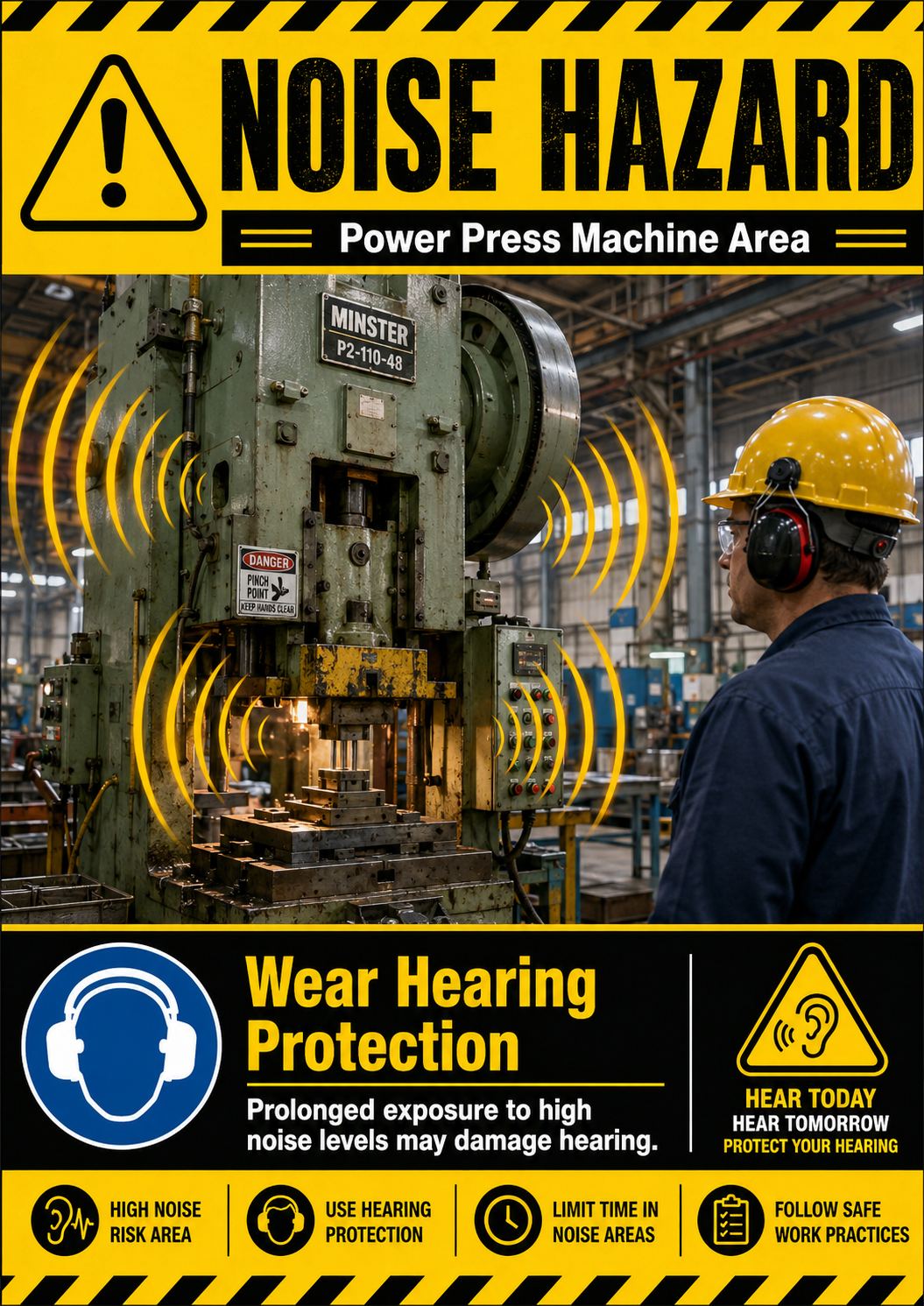
Why is the Press Machine's noise reduction
often misjudged
A common mistake is to focus only on the press's rated noise level. In real facilities, the measured problem is usually the combined result of the machine, the supporting structure, nearby reflective surfaces, and the work cycle. A mechanical press with sharp impact peaks behaves differently from a hydraulic press with sustained pump and fluid noise. A straight-side press installed on a rigid slab behaves differently from one coupled into a platform or mezzanine.
Production conditions also change the acoustic profile. Tooling wear, misalignment, loose guards, poor lubrication, and inconsistent stock feeding can cause intermittent noise that is not captured in the brochure data. That is why a meaningful assessment needs operating data taken during normal production, preferably across multiple cycles and shifts.
For industrial buyers, this has a direct implication. The right question is not, "How loud is the press?" The right question is, "What are the dominant noise sources, how do they travel, and where do we need control?"
Source-path-receiver analysis for press machine noise reduction
This is the most reliable framework for industrial noise control because it keeps the project tied to physical causes.
At the source level, the goal is to identify the source of acoustic energy. On press equipment, this can include ram impact, drive train noise, hydraulic pump noise, air blow-off, scrap discharge, and panel resonance. Some of these are airborne noise sources. Others excite machine surfaces or the building structure, which then radiate noise secondarily.
At the path level, the focus shifts to how the sound reaches people or the property boundary. Noise may pass directly through open machine sides, leak through access gaps, reflect off hard walls and ceilings, or travel through steel structures and floor slabs. This is where acoustic enclosures, barriers, doors, louvers, damping treatments, and vibration isolation become relevant.
At the receiver level, the concern is exposure. The operator station, adjacent work areas, control rooms, maintenance walkways, and plant perimeter may all have different criteria. A project intended to reduce operator exposure may not solve a community noise complaint, and a perimeter-focused treatment may leave maintenance staff exposed during servicing. Good engineering keeps those endpoints separate and measurable.
Start with the press type and duty cycle
Not all presses should be treated the same way. Mechanical stamping presses often produce high peak noise from impact and rapid cyclic motion. Hydraulic presses may have lower peak impact but stronger continuous noise from pumps, motors, valves, and fluid flow. Forging and heavy-forming applications can introduce very-low-frequency energy, which is more difficult to contain and more likely to excite surrounding structures.
Duty cycle changes the design approach. A press running at high stroke rates may justify a more comprehensive enclosure design because the exposure is persistent and predictable. A large press used intermittently may need a different balance between partial enclosure, local barriers, and operator shielding. In both cases, access for die change, ventilation, visibility, and maintenance cannot be treated as secondary issues. If noise control interferes with production, it will eventually be bypassed.
The most effective controls are usually layered
Press machine noise reduction rarely comes from a single product. The strongest results usually come from combining source treatment with path control.
If compressed air is used for blow-off or part ejection, silencing those discharge points can yield meaningful reductions at relatively low cost. If sheet metal guards or machine panels are ringing, damping treatment or panel reinforcement may reduce radiated noise. If the hydraulic power unit is a major contributor, a dedicated acoustic enclosure around the HPU can be more efficient than trying to over-treat the full press.
When the press body itself dominates the sound field, a full or partial acoustic enclosure is often the most effective path control. The enclosure has to be engineered, not improvised. Panel construction, internal absorptive lining, structural support, access doors, cable and conveyor penetrations, and ventilation silencing all affect final performance. A poorly sealed enclosure with untreated air openings can lose much of its expected insertion loss.
This is also where trade-offs matter. A full enclosure can deliver stronger attenuation, but it increases the complexity of maintenance access, heat management, and material handling. Partial enclosures and local barriers are easier to integrate, but they may leave important leakage paths untreated. The best option depends on target reduction, operating practice, and available footprint.
Structural vibration is often the hidden issue
Some of the most stubborn press noise problems are not airborne at the origin. They start as vibration. If the press frame, base, nearby platforms, or connected steelwork are excited, the surrounding structure can radiate sound over a much larger area than expected.
This is why vibration isolation and structural assessment should be considered early. Isolation mounts, inertia bases, or decoupling details may reduce transmission, but they must be carefully selected to accommodate machine loads, stroke forces, anchoring requirements, and alignment tolerances. Overlooking these conditions can create operational instability or maintenance issues.
In older facilities, secondary radiation from wall cladding, mezzanines, cable trays, or ductwork can make the press room sound louder than the machine alone would suggest. Treating only the visible press, without addressing the structure-borne path, often yields disappointing results.
Ventilation, access, and safety cannot be afterthoughts
Acoustic performance is only one part of an industrial design. Presses need airflow, visibility, and service access. Hydraulic systems add heat. Operators need clear lines of sight. Maintenance teams need doors and removable panels that are practical rather than decorative.
That is why engineered acoustic enclosures for press applications often include silenced ventilation, acoustic doors, observation windows, and removable access sections. Each element introduces an acoustic penalty if not designed correctly. Louvers reduce noise only if the airflow path is treated properly. Windows need a suitable acoustic specification and framing. Doors require seals and hardware that remain effective in daily use.
Safety integration is equally important. Noise-control systems must work around guarding, lockout access, fire safety requirements, and machine egress. If the project team has to choose between acoustic treatment and safe operation, acoustic treatment will lose every time, as it should.
What realistic performance looks like
There is no universal reduction figure for all press applications. In some cases, targeted source treatment and air-exhaust silencing may provide a useful single-digit reduction, improving communication and lowering exposure. In other cases, a properly engineered enclosure system can achieve much larger reductions, provided the leakage paths, ventilation openings, and structural transmission routes are controlled.
What matters is defining success correctly. Sometimes the goal is getting below an occupational exposure threshold at the operator station. Sometimes it is reducing noise spill into adjacent production areas. Sometimes it is meeting a boundary criterion or supporting a permitting requirement. Those goals are related but not identical.
For that reason, acoustic projects should be evaluated with pre-installation measurements, defined design criteria, and post-installation verification. Industrial clients do not need generic promises. They need performance that can be checked against a stated target.
When to involve a specialist
If the press is central to production, if complaints are recurring, or if compliance is becoming a risk, it is worth involving a noise-control engineer before purchasing hardware. The earlier the intervention, the easier it is to avoid common failures such as undersized ventilation silencers, inaccessible enclosure layouts, or treatments that address the wrong source altogether.
For companies like ISTIQ Noise Control, the value is not just in supplying acoustic products. It is in translating plant conditions into a system that fits the machine, the building, and the operating objective. That engineering discipline is what separates a short-term patch from a durable solution.
Press noise is rarely solved by adding material around a machine and hoping for the best. It is solved by understanding where the energy starts, how it moves, and which control measures will still make sense after months of real production. That is the standard worth aiming for.
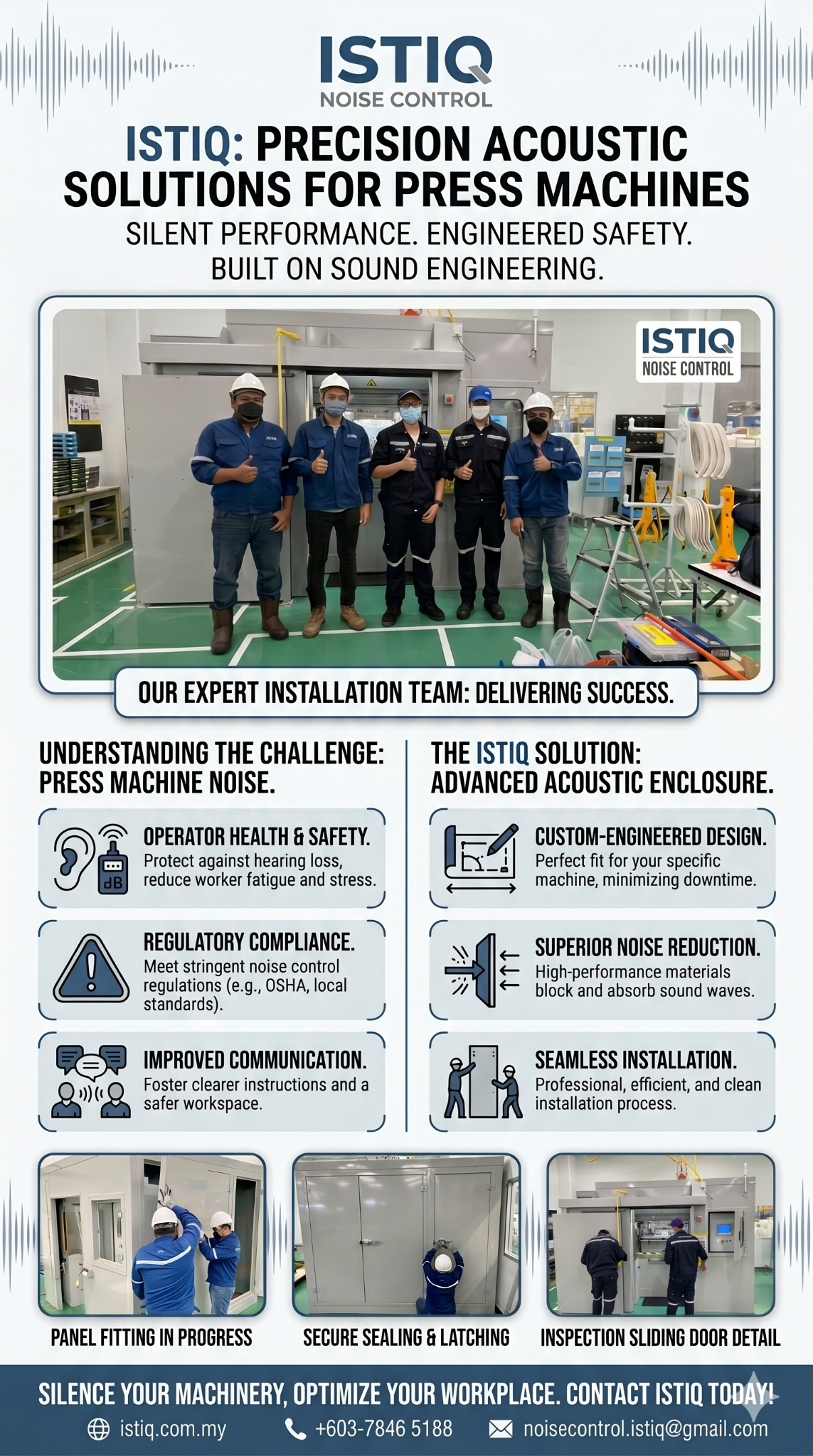
We specialize in industrial noise control, oil & gas industry noise control, architectural acoustics, traffic noise control and audiometric test room.
Posted by ISTIQ Noise Control Sdn Bhd on 20 May 26

 Malaysia