Energy Efficiency & Motor Performance Analytics
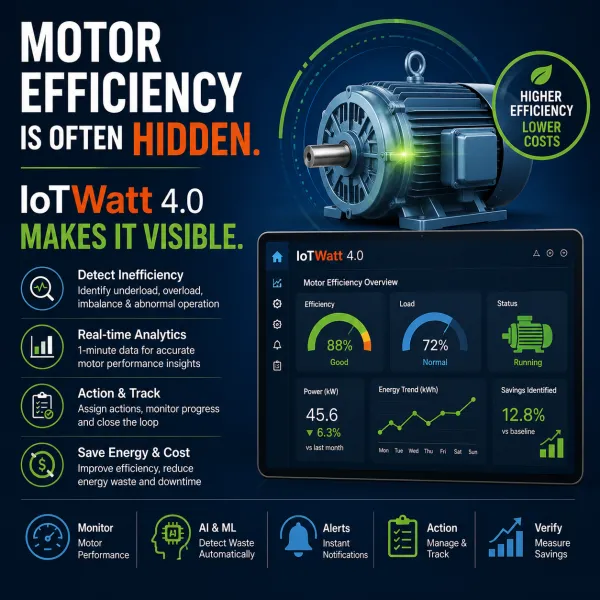
Motor Efficiency Is Often Hidden. IoTWatt 4.0 Makes It Visible.
Motors are among the largest and most common electrical loads in industrial facilities. Pumps, fans, conveyors, compressors, mixers and production machines often run for long hours, and small inefficiencies can become significant energy cost over time.
IoTWatt 4.0 helps convert motor energy data into practical insights by tracking loading patterns, run hours, abnormal behaviour, wasted operation and savings opportunities.
Motor Loading Run Hours No-Load Operation Overload Events Energy Waste Action Tracking
Why Motor Efficiency Matters
A motor may be running, but that does not mean it is running efficiently. Motors can operate underloaded, overloaded, continuously during non-production periods, or with poor control strategy.
In many plants, the motor energy cost is not visible at equipment level. The site only sees the total electricity bill, not which motors are wasting energy or running at the wrong time.
Motor efficiency improvement starts with one simple question: is the motor running at the right time, at the right load, for the right purpose?
The Key Message: Do Not Only Monitor kWh
A motor energy programme should look beyond consumption. It should understand loading, runtime, operating state, duty cycle, abnormal behaviour and the action needed to reduce waste.
- Run hour profile
- Motor loading pattern
- No-load operation
- Short cycling
- Overload condition
- Abnormal runtime
Common Motor Energy Waste Patterns
Running When Not Needed Motors continue operating during breaks, idle shifts, low production or after-hours periods.
Underloaded Operation Motors operate far below useful load, creating poor efficiency and unnecessary running cost.
Overloaded Operation Motors operate beyond healthy loading range, increasing heat, stress and failure risk.
Wrong Control Method Throttling, bypassing or fixed-speed operation may waste energy where VSD or better control is suitable.
Repeated Start / Stop Frequent cycling may indicate control issues, process instability or improper equipment sizing.
Hidden Process Loss Motor power increase may indicate mechanical wear, blocked filters, pump issues or process restriction.
How IoTWatt 4.0 Supports Motor Efficiency
IoTWatt 4.0 uses metered electrical data and operating patterns to classify motor behaviour and highlight where energy is being wasted.
Motor State Analytics Classify OFF, no-load, partial-load, normal-load and overload operating bands.
Run Hour Analysis Track daily, weekly and monthly runtime against production schedule or expected operating hours.
Savings Action Tracking Convert findings into DEES tickets and track Potential, Achieved and Missed savings in WattSave.
Motor Efficiency Assessment Workflow
1
Measure Collect motor electrical data from meters, MCCs or gateways.
2
Profile Build runtime, loading and operating state patterns.
3
Detect Identify no-load, abnormal load, overload and wasted runtime.
4
Act Create assigned actions for site teams or equipment owners.
5
Verify Track achieved savings and missed opportunities.
Motor Data Required
- kW demand
- kWh energy
- Current
- Voltage
- Power factor
- Run status
- Operating schedule
- Motor rating
- Process or equipment name
- Expected duty cycle
Motor Applications Covered
- Pumps
- Fans
- Blowers
- Conveyors
- Mixers
- Compressors
- Cooling towers
- Production machines
- HVAC motors
- Generic motor loads
What the Site Can Improve
- Reduce unnecessary runtime
- Switch off idle motors
- Correct operating schedules
- Review oversized motors
- Improve control strategy
- Identify VSD opportunities
- Reduce overload stress
- Improve maintenance planning
- Track recurring issues
- Verify savings after action
Why This Matters for Energy Management
Motor efficiency is not only about motor nameplate efficiency. In real plants, the bigger savings often come from operating discipline, correct loading, better control, reduced idle runtime and maintenance-related improvements.
IoTWatt 4.0 helps make these issues visible and actionable, so energy teams can focus on where energy is actually being wasted.
Management View
- Which motors waste energy?
- Which motors run too long?
- Which loads are abnormal?
- Which action is delayed?
- What saving was identified?
- What saving was achieved?
Expected Deliverables
- Motor energy profile
- Run hour analysis
- Loading band summary
- No-load operation detection
- Abnormal runtime alerts
- Overload visibility
- Energy-saving action tickets
- Potential savings
- Achieved savings
- Missed savings
- Management dashboard
- Energy audit reporting support
Ready to Improve Motor Energy Efficiency with Real Data?
IoTWatt 4.0 helps your site detect wasted motor runtime, abnormal loading, overload events and savings opportunities — then turns findings into action tickets and verified savings tracking.
Request Motor Efficiency Review


 Malaysia