
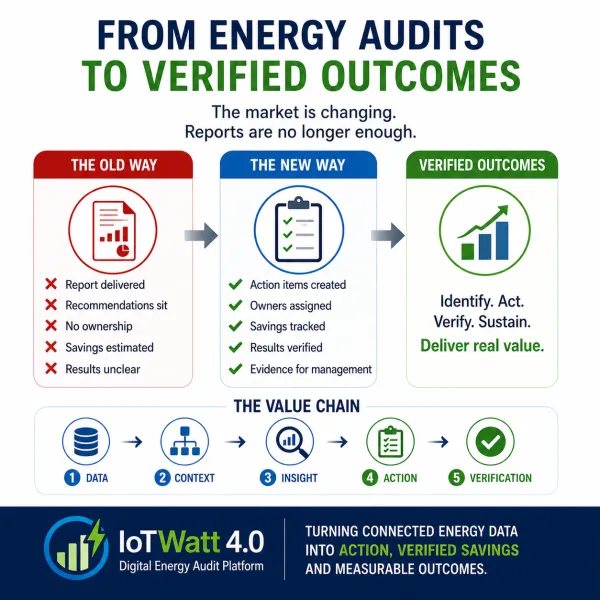
The report is no longer enough. Customers now need a way to prove what was acted on, what was achieved, and what value was missed.
Many industrial sites already have energy audit reports. The recommendations are there. The potential savings are there. But when asked which savings were actually achieved, the answer is often not clear.
This is not because energy audits are useless. It is not because engineers are not competent. It is not because customers do not care.
The issue is more structural. The market has treated energy audits as the end point, when they should be the starting point.
The Old Energy Audit Model
For many years, the energy audit model was straightforward. A consultant visits the site, collects data, reviews equipment, analyses bills, prepares a report, lists recommendations, calculates estimated savings and submits the final document.
That model has value. It gives visibility, creates awareness, identifies waste and supports management decisions.
But it also carries one major weakness. It assumes that once the report is delivered, action will naturally follow.
Old Model: Report Delivery
The audit is treated as the final output.
- Recommendations sit inside a report
- Action ownership is unclear
- Savings remain estimated
- Follow-up depends on internal discipline
- Results are difficult to prove later
New Model: Verified Outcomes
The audit becomes the start of an operating cycle.
- Findings become action items
- Owners and deadlines are assigned
- Savings are tracked and verified
- Missed savings are visible
- Evidence is ready for management review
Estimated Savings Are No Longer Enough
Estimated savings are still useful. They help build the business case. They allow management to compare options and decide whether an action is worth pursuing.
But estimated savings are not the same as achieved savings.
Customers are now asking better questions:
What action was taken?
Was the recommendation converted into a real task, assigned to a person or department, and closed with evidence?
What was the baseline?
Was there a clear pre-improvement condition that allows the result to be compared fairly?
Was the saving verified?
Was the result measured, adjusted where needed, and supported by a clear evidence trail?
Was the saving sustained?
Did the improvement continue, or did the site drift back to the old operating condition?
Why the Market Is Changing
The energy efficiency market is changing because energy efficiency itself is changing.
In the past, energy efficiency was often treated as an engineering exercise: identify inefficient equipment, recommend upgrades, calculate payback and submit a report.
Today, energy efficiency sits inside a wider business environment. Energy cost is now a management issue. Sustainability reporting requires evidence. Carbon reduction needs a reliable data trail. Regulatory compliance is becoming more structured. Finance teams want credible savings, not only assumptions.
Energy Cost Pressure
Management needs to know which savings are real, which are delayed and which are not being captured.
ESG Evidence
Sustainability and carbon reporting require proof, not only estimated improvement claims.
Compliance Readiness
Energy management, audits and reporting need structured records and repeatable evidence.
Management Visibility
Customers need to see which sites, departments or actions are improving — and which are not.
The Audit-to-Outcome Gap
Finding savings and delivering savings are different capabilities.
Finding savings requires technical knowledge. Delivering savings requires a system.
It needs baseline data, measurement points, action ownership, issue tracking, verification, management visibility and follow-up discipline.
This is where some energy audits produce good reports but weak results. The technical opportunity exists, but the delivery mechanism is weak.
The Future of Energy Audits Is Continuous
Energy audits cannot remain only as one-time events. Industrial energy performance changes every day.
Production changes. Operating hours change. Equipment condition changes. Operators override systems. Leaks return. Filters clog. Motors run unnecessarily. Chillers drift. Compressors short-cycle. New loads are added. Old assumptions become invalid.
A one-time audit captures a condition at a point in time. But energy waste is continuous. So the response must also become continuous.
Audit findings become action items. Action items have owners. Savings have baselines. Results are verified. Missed savings are visible. Management reviews progress.
Saturn Pyro’s Point of View
At Saturn Pyro, our view has been shaped by years of working around industrial energy systems, power monitoring, audits, metering, electrical studies, field data and customer operations.
We have seen the same issue many times. The technical opportunity exists, but the delivery mechanism is weak.
That is why we believe the market must move from energy audits to verified outcomes.
The old question was: Where can we save energy?
The better question is: How do we continuously identify, assign, act, verify and sustain energy savings?
How IoTWatt 4.0 Supports This Shift
IoTWatt 4.0 was developed around one practical problem: energy data by itself does not deliver savings. Data must be analysed. Findings must be converted into action. Actions must be owned. Savings must be tracked. Results must be verified.
IoTWatt 4.0 is positioned as a Digital Energy Audit platform that helps connect the missing pieces between energy data, audit findings, action ownership, savings verification and reporting.
The objective is not another dashboard. The objective is an operating loop: Analyse. Act. Verify.
Potential, Achieved and Missed Savings
One of the most important changes in thinking is to separate savings into three categories.
This separation changes the management conversation. Instead of only seeing a list of recommendations, management can see conversion.
The Market Will Reward Proof
In the next phase of energy efficiency, proof will matter more.
This is not about making energy audits less important. It is about making them more useful.
Conclusion: The Report Is Not the Result
Energy audits will remain important. They provide structure, identify opportunities, guide decisions and help organisations understand where energy is used and where waste exists.
But the market is moving beyond the report. The result is not the PDF. The result is the saving that was acted on, verified and sustained.
From energy audits to verified outcomes. From recommendations to action. From potential savings to achieved savings.

 Malaysia