

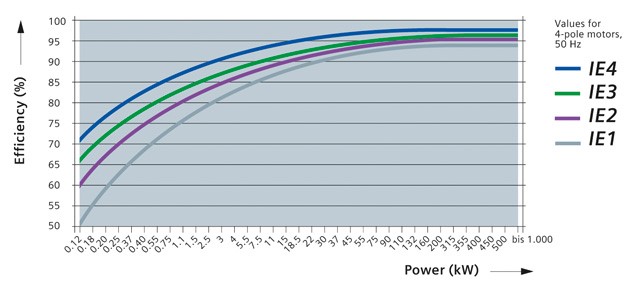
Electric motors are among the largest energy users in industrial facilities. Understanding motor efficiency classes such as IE1, IE2, IE3, IE4 and IE5 helps plants select better motors, reduce energy cost and improve long-term operating performance.
Higher efficiency motors reduce electrical losses and improve lifecycle cost. For pumps, fans, compressors, conveyors and process equipment running many hours per day, the savings impact can be significant.
IE3 and IE4 motors are now common in many industrial specifications. IE5 represents the next step in ultra-high efficiency motor technology and is often associated with advanced motor designs, permanent magnet motors, synchronous reluctance motors and variable-speed motor systems.
| Item | Summary |
|---|---|
| IEC 60034-30-1 | Defines efficiency classes for line-operated single-speed motors, commonly covering IE1 to IE4. |
| IEC TS 60034-30-2 | Provides efficiency classes for variable-speed AC motors and includes IE5 minimum efficiency levels. |
| Typical Power Range | Low-voltage motors from 0.12 kW to 1000 kW, depending on motor type and applicable standard. |
| Typical Applications | Pumps, fans, compressors, conveyors, chillers, cooling towers, HVAC equipment and process machines. |
| Important Note | Always confirm the applicable standard, motor datasheet, VSD compatibility, duty cycle and local regulation before selection. |
IE5 motors can provide further efficiency improvement, but they should not be selected by efficiency class alone. Application load profile, operating hours, VSD suitability, process requirement and lifecycle cost must be checked.
| Class | Typical Positioning | Best Fit |
|---|---|---|
| IE3 | Premium efficiency and common minimum requirement in many modern projects. | General industrial motors, pumps, fans and process equipment. |
| IE4 | Super premium efficiency with lower losses compared with IE3. | Long-running motors, high electricity cost areas and ESG-driven projects. |
| IE5 | Ultra premium efficiency, usually linked to advanced motor and drive technologies. | High run-hour applications, variable-speed systems and lifecycle-cost focused projects. |
Older articles often mention EU Regulation 640/2009. This has been replaced by Commission Regulation (EU) 2019/1781, which covers ecodesign requirements for electric motors and variable speed drives in the European market.
Although EU regulation may not directly apply to every Malaysian installation, it is useful as a reference for global motor efficiency direction. Many multinational companies and industrial facilities now prefer IE3, IE4 or IE5-ready technologies as part of energy efficiency, ESG and lifecycle cost improvement.
Replacing a motor based only on nameplate efficiency may not always deliver the expected saving. Actual savings depend on operating hours, loading, control method, process requirement, duty cycle and maintenance condition.
IoTWatt 4.0 can support motor and pump energy monitoring by collecting power data, run-hour data and operating patterns from meters, sensors, EMS, BMS, SCADA or IoT gateways. This helps identify inefficient operation, excessive runtime, abnormal loading and savings opportunities.
Saturn Pyro and 3Wire can support motor energy monitoring, IoTWatt 4.0 analytics, energy audit reporting and practical energy-saving action tracking for industrial facilities.
Request Energy AssessmentSuggested SEO Title:
IEC Motor Efficiency Classes IE1 IE2 IE3 IE4 IE5 & Energy Saving Malaysia
Suggested Meta Description:
Learn about IEC motor efficiency classes IE1, IE2, IE3, IE4 and IE5, high-efficiency motors, VSDs, motor energy monitoring, IoTWatt 4.0 and industrial energy savings.
Suggested Meta Keywords:
IEC 60034-30-1, IEC TS 60034-30-2, IE1 motor, IE2 motor, IE3 motor, IE4 motor, IE5 motor, ultra premium efficiency motor, motor efficiency Malaysia, energy efficient motor, industrial motor energy saving, VSD energy saving, pump motor monitoring, IoTWatt 4.0, motor energy audit, EECA reporting
Suggested Blog URL Slug:
iec-motor-efficiency-classes-ie1-ie2-ie3-ie4-ie5-energy-saving-malaysia
Suggested Image Alt Text:
IEC motor efficiency classes IE1 IE2 IE3 IE4 IE5 energy saving Malaysia

 Malaysia


