
3Wire RS2WLAN is an industrial-grade WiFi / LAN IoT gateway designed to connect serial and Ethernet-based devices such as PLCs, power meters, sensors, controllers and field instruments to cloud-based IoT platforms.
For IoTWatt 4.0 projects, RS2WLAN helps bring existing Modbus RTU meters, DTL-645 meters and Ethernet devices into a practical WiFi / LAN data collection layer. It supports MQTT, HTTP POST / GET, JSON data conversion and Modbus gateway functions for energy dashboards, digital energy audit evidence, EECA reporting and energy intelligence workflows.
Many sites need to collect data from serial devices such as Modbus RTU meters, PLCs, sensors and controllers, but wired Ethernet access may not always be practical. RS2WLAN bridges this gap by supporting both Ethernet and WiFi access for field data collection and remote device access.
The gateway can actively poll selected device data, convert DTL-645 and Modbus RTU parameters into JSON format, and transmit the data to IoT platforms using MQTT or HTTP POST / GET. It can also support SCADA, BMS and EMS remote access through TCP / UDP, Modbus gateway and Virtual COM functions.
RS2WLAN is best positioned as an industrial WiFi / LAN gateway for energy monitoring, automation, SCADA / BMS access, MQTT data publishing and IoTWatt 4.0 retrofit data collection projects.
IoTWatt 4.0 depends on reliable and frequent meter data. RS2WLAN helps connect existing field devices to the IoTWatt 4.0 platform through WiFi / LAN where wired Ethernet or cellular gateways are not the best option.
Links serial and Ethernet devices to IEEE 802.11b/g WiFi networks with simultaneous access over Ethernet and WiFi.
Publishes selected device data to IoT platforms using MQTT or HTTP POST / GET.
Polls DTL-645 and Modbus RTU parameters and converts selected values into JSON format.
Operates in STA mode to connect to a wireless router or AP mode for direct WiFi device connection.
Supports WEP, WPA and WPA2 security for protected wireless data access.
Supports fast roaming for quick automatic switching between access points.
Provides 1500V optical isolation on RS485 / RS422 data lines and 2kV surge protection on Ethernet.
Supports direct TCP/IP and Virtual Serial Port operation for remote serial access.
Heartbeat and Keep Alive functions help maintain reliable WiFi / LAN communication.
| Mode / Function | Purpose | Typical Use |
|---|---|---|
| MQTT Publishing | Sends selected device data to MQTT brokers and IoT platforms. | IoTWatt 4.0, cloud dashboards, EMS platforms and data hubs. |
| HTTP POST / GET | Supports HTTP-based data transmission to platform endpoints. | IoT platform integration where MQTT is not preferred. |
| Modbus TCP Gateway | Allows Modbus TCP systems to access Modbus RTU serial devices. | SCADA, EMS, BMS and Ethernet-based Modbus systems. |
| TCP Server / TCP Client | Supports serial data access through TCP/IP communication. | Remote serial access, host polling and gateway communication. |
| UDP / UDP Multicast | Supports UDP communication and multicast use cases. | Lightweight or broadcast-type network communication. |
| Bridge / Paired Mode | Supports serial extension across WiFi / LAN networks. | Remote access where direct serial cabling is not practical. |
| Virtual COM | Creates a virtual serial port over IP. | Legacy software access to remote serial devices. |
| Parameter | RS2WLAN Specification |
|---|---|
| Product Type | Industrial WiFi / LAN IoT gateway and serial device server |
| Serial Interface | RS232 / RS485 / RS422 x 1; RXD, TXD, GND, CTS and RTS |
| RS485 / RS422 Connection | Terminal block |
| RS232 Connection | DB9 connector |
| Ethernet | 10 / 100 Mbps Ethernet with 2kV surge protection |
| WiFi | IEEE 802.11b/g |
| Wireless Modes | STA mode and AP mode |
| Wireless Security | WEP, WPA and WPA2 |
| IoT Protocols | MQTT and HTTP POST / GET |
| Data Conversion | DTL-645 and Modbus RTU parameters can be polled and converted to JSON format |
| Network Protocols | Ethernet, IP, TCP, UDP, HTTP, ARP, ICMP, DHCP and DNS |
| Operating Modes | TCP Server, TCP Client, UDP, UDP Multicast, Modbus TCP Master, Modbus TCP Slave, Paired Mode and Bridge Mode |
| TCP Server Capacity | Supports up to 30 TCP clients |
| TCP Client Destinations | Supports up to 7 destination IP addresses |
| Serial Slave Capacity | Up to 256 slaves on RS485 / RS422 bus |
| Baud Rate | 1200 bps to 115200 bps |
| Data Bits | 5 bits to 9 bits |
| Parity | None, Odd, Even, Mark and Space |
| Flow Control | RTS / CTS, XON / XOFF or None |
| Configuration | 3Wire Device Management software and web browser configuration |
| Net Communication | Direct TCP/IP and Virtual Serial Port |
| Power Supply | 9-48V DC with dual voltage input via screw terminal or DC jack |
| Power Consumption | 80mA @ 12V, 40mA @ 24V, 20mA @ 48V |
| Wiring | Plug-in screw terminal, accepts AWG12 to AWG30 wires |
| Operating Temperature | -40°C to +85°C |
| Storage Temperature | -45°C to +125°C |
| Humidity | 5% to 95% RH |
| Dimensions | 94mm (L) x 65mm (W) x 25mm (H) |
Connect Modbus RTU meters and field devices to IoTWatt 4.0 using WiFi / LAN connectivity.
Send meter and equipment data to EMS, dashboards, cloud platforms and monitoring systems.
Allow BMS and SCADA systems to access serial and Ethernet devices remotely over WiFi or LAN.
Poll meter data through Modbus RTU or DTL-645 and transmit the data to central systems.
Convert device data into IoT-ready JSON payloads for cloud monitoring, analytics and reporting.
Useful where wired Ethernet is difficult but WiFi coverage is available near the electrical panel or equipment.
RS2WLAN is useful in IoTWatt 4.0 Digital Energy Audit and Energy Intelligence projects where existing meters or controllers are available over RS485 / RS232 / RS422, and WiFi / LAN is the preferred path for data connectivity. It helps reduce the need for heavy network cabling while still enabling structured meter data collection.
| IoTWatt 4.0 Use | How RS2WLAN Supports It |
|---|---|
| Energy Dashboard | Polls Modbus RTU meters and publishes data through WiFi / LAN using MQTT or HTTP. |
| Digital Energy Audit | Provides access to load profile and equipment data for audit evidence and analytics. |
| EECA Reporting | Supports reliable meter data collection for regulatory reporting workflows. |
| Retrofit Projects | Allows existing serial meters and devices to be reused where wired LAN installation is not practical. |
| SCADA / BMS Coexistence | Supports local systems and IoTWatt 4.0 integration through a practical WiFi / LAN gateway layer. |
Use RS2WLAN when existing meters are already available at site and WiFi / LAN is the fastest way to bring their data into IoTWatt 4.0 for dashboards, digital energy audit reports, EECA reporting and savings visibility.
The diagram below shows the RS2WLAN WiFi / LAN IoT gateway operation concept, including serial device access, MQTT / HTTP publishing, Modbus gateway use and cloud connectivity.
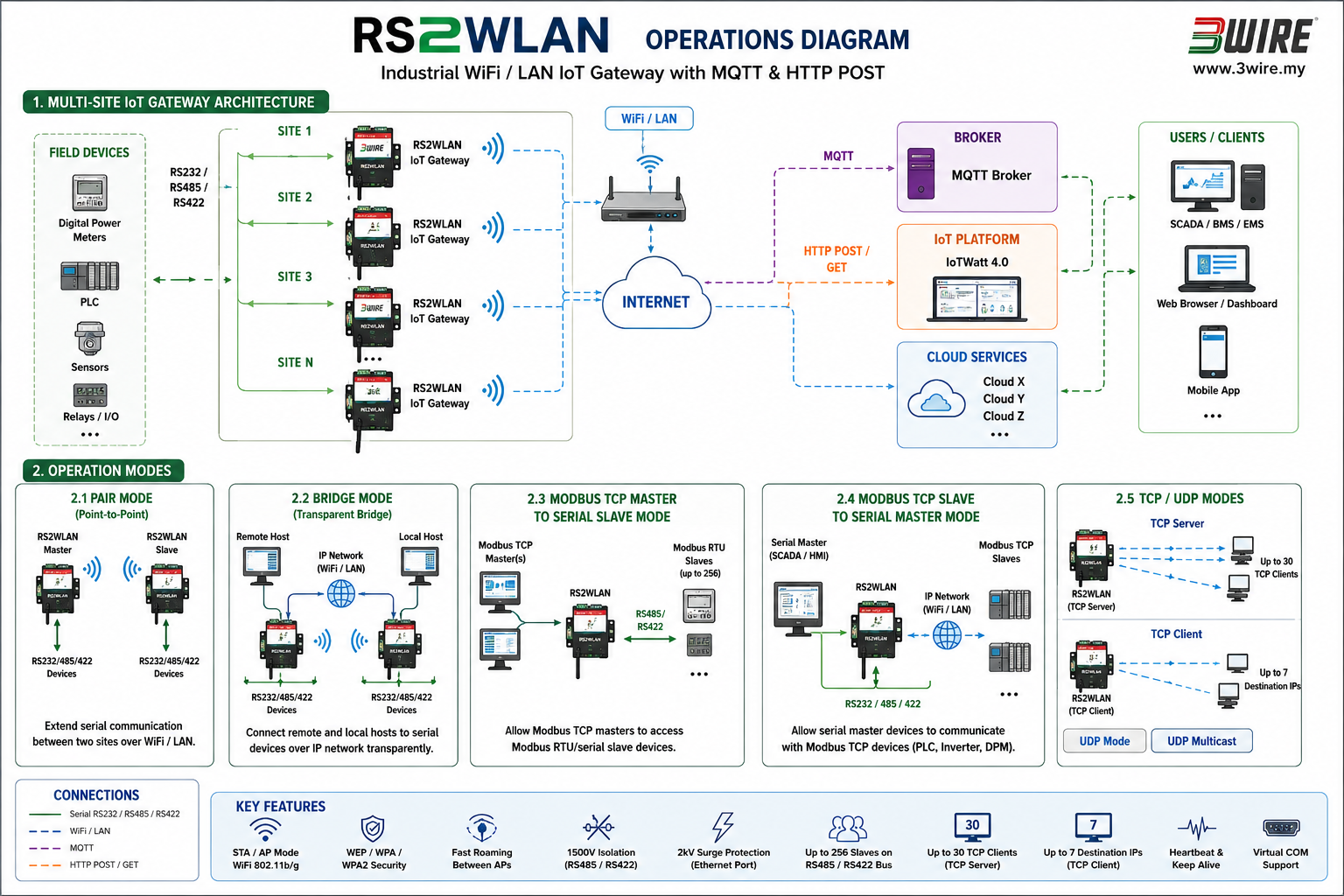
RS2WLAN WiFi / LAN IoT gateway operation diagram
Saturn Pyro supports 3Wire RS2WLAN gateways for WiFi / LAN data communication, RS485 / RS232 / RS422 integration, MQTT / HTTP publishing, Modbus gateway applications, BMS / EMS / SCADA connectivity, IoTWatt 4.0 digital energy audit projects and EECA reporting data collection in Malaysia.

 Malaysia


