

How Much Does It Cost to Ship from China to Malaysia in 2026? Complete Guide to Sea Freight, Air Freight and Full Container Rates
Shipping costs from China to Malaysia cannot be determined by weight alone.
The final cost depends on the shipping method, cargo volume, packed dimensions, actual weight, delivery location, cargo characteristics, handling requirements and whether additional protection such as wooden crating or palletisation is required.
Small shipments may be more suitable for parcel sea freight or air freight. Commercial cargo exceeding 0.3 cubic metres is generally shipped under large-volume sea freight. When the cargo volume is close to the capacity of a full container, both LCL and FCL options should be compared before making a decision.
This guide explains the current reference rates, calculation methods, transit times and common additional charges for shipping cargo from China to Malaysia.
Important pricing notice: The rates stated in this article are reference rates available at the time of publication in 2026. Ocean freight, air freight, fuel surcharges, exchange rates, customs-related costs and Malaysian last-mile delivery charges may change over time. The latest official quotation issued by our customer service team shall be treated as the final applicable rate.
.png)
1. How Much Is Large-Volume Sea Freight from China to West Malaysia?
The current reference rate for commercial sea freight to major cities and standard delivery areas in West Malaysia is:
First 0.3 CBM: RM126
Additional volume: RM4 per 0.01 CBM
Minimum chargeable volume: 0.3 CBM
This is equivalent to:
RM420 per CBM
This service is suitable for:
Large-volume sea freight is normally charged according to the amount of shipping space occupied by the cargo, rather than by weight alone.

2. How Is Sea Freight Volume Calculated?
Cargo volume is calculated using the external packed dimensions.
The formula is:
Length × Width × Height ÷ 1,000,000 = CBM
All dimensions must be measured in centimetres.
For example, if one carton measures:
100 cm × 50 cm × 40 cm
The calculation is:
100 × 50 × 40 ÷ 1,000,000
= 0.20 CBM
For a shipment containing several packages, the volume of each package is calculated separately and then added together.
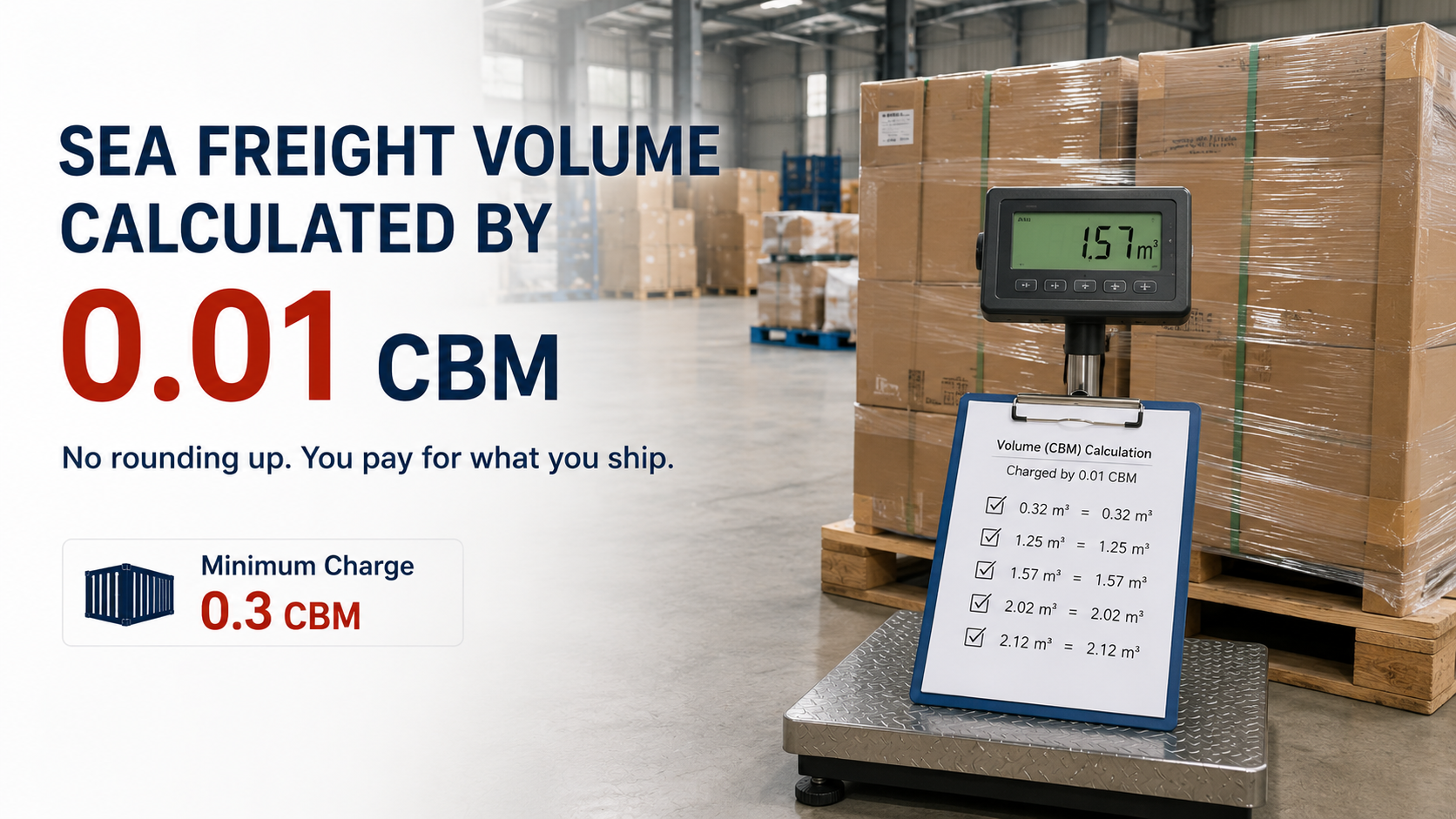

3. Precise Billing in Increments of 0.01 CBM
Our commercial sea freight is calculated in increments of 0.01 CBM.
The actual measured volume is used for billing without unnecessarily rounding the shipment up to a larger volume bracket.
For example:
0.32 CBM is charged as 0.32 CBM.
1.25 CBM is charged as 1.25 CBM.
1.57 CBM is charged as 1.57 CBM.
2.02 CBM is charged as 2.02 CBM.
2.12 CBM is charged as 2.12 CBM.
A shipment measuring 1.57 CBM will not automatically be rounded up to 1.60 CBM, while a shipment measuring 2.02 CBM will not be rounded up to 2.10 CBM.
This calculation method is more cost-effective for shippers, particularly for larger commercial shipments where unnecessary rounding can result in a noticeable increase in freight costs.
However, the minimum chargeable volume remains 0.3 CBM. Any shipment below 0.3 CBM will still be charged at the minimum rate.
4. Large-Volume Sea Freight Calculation Example
Assume that a customer has three packages.
Package A
25 cm × 35 cm × 60 cm
25 × 35 × 60 ÷ 1,000,000
= 0.0525 CBM
Package B
17 cm × 60 cm × 75 cm
17 × 60 × 75 ÷ 1,000,000
= 0.0765 CBM
Package C
100 cm × 50 cm × 25 cm
100 × 50 × 25 ÷ 1,000,000
= 0.125 CBM
The total volume is:
0.0525 + 0.0765 + 0.125
= 0.254 CBM
Because the total volume is below the minimum chargeable volume of 0.3 CBM, the shipment will be charged as 0.3 CBM.
The reference sea freight charge is therefore:
RM126
Customers purchasing from several suppliers may send all their goods to the same China warehouse for consolidation. If the total cargo volume remains within 0.3 CBM, the basic freight charge will not increase.
For this reason, customers with smaller shipments may obtain better value by consolidating enough cargo to make fuller use of the 0.3 CBM minimum charge.
5. Does the Sea Freight Rate Include Door-to-Door Delivery?
The standard large-volume sea freight rate generally applies to door-to-door delivery within major cities and standard service areas in West Malaysia. The exact scope of service, however, must always be confirmed against the official quotation.
A typical door-to-door arrangement may include:
Not every shipment can be handled under the same conditions.
Commercial cargo, regulated products, branded goods, oversized shipments, remote-area deliveries and shipments requiring special customs procedures may require additional assessment and separate charges.
Customers should provide the complete delivery address and postcode when requesting a quotation. Providing only the state or city is usually not sufficient to confirm the final delivery rate.
6. East Coast and Remote-Area Delivery Charges
The RM420 per CBM reference rate mainly applies to major cities and standard delivery areas in West Malaysia.
Additional charges may apply to East Coast states, highland areas, islands, remote industrial locations or addresses outside the normal delivery network.
East Coast Areas
For areas such as Kelantan and Terengganu, the current reference surcharge is:
RM50 per CBM
The estimated total rate would therefore be:
RM420 + RM50
= RM470 per CBM
Remote or Highland Areas
For remote or highland locations such as Cameron Highlands, the current reference surcharge is:
RM180 per CBM
The estimated total rate would therefore be:
RM420 + RM180
= RM600 per CBM
The final remote-area charge will depend on:
Some highland or remote addresses cannot be reached directly by a standard large delivery truck. In such cases, the cargo may need to be transferred to a smaller vehicle at a local warehouse or transit point.
7. How Long Does Large-Volume Sea Freight Take?
The estimated transit time from China to West Malaysia is:
12 to 25 working days
The transit period generally begins after the cargo has been consolidated, loaded into the container and formally dispatched.
It does not begin from the day the supplier sends the goods to the China warehouse.
The following periods are normally excluded from the estimated international transit time:
Shipments required for exhibitions, shop openings, installation projects, weddings, events or fixed commercial deadlines should be arranged well in advance.
International freight cannot be guaranteed to arrive on an exact date unless a specific guaranteed service has been formally agreed in writing.
8. How Much Is Parcel Sea Freight from China to Malaysia?
Parcel sea freight is suitable for customers with smaller shipments who are not in a hurry and prefer a lower-cost shipping method.
The current reference rate is:
First 5 kg: RM25
Minimum chargeable weight: 5 kg
Additional weight: RM3.80 per kg
For example, if the chargeable weight is 8 kg:
First 5 kg: RM25
Additional 3 kg: RM11.40
Estimated freight charge:
RM36.40
Parcel sea freight is generally suitable for:
9. Why Is Volumetric Weight Used for Parcel Sea Freight?
Although parcel sea freight is charged by kilogram, the carrier must also consider how much space the package occupies.
Some products are light in actual weight but take up a large amount of container and delivery space. Common examples include:
The volumetric weight formula is:
Length × Width × Height ÷ 6000 = Volumetric Weight
The dimensions must be measured in centimetres, and the resulting volumetric weight is expressed in kilograms.
For example, if a package measures:
60 cm × 50 cm × 40 cm
The volumetric weight is:
60 × 50 × 40 ÷ 6000
= 20 kg
If the actual weight is 10 kg but the volumetric weight is 20 kg, the shipping channel may charge based on 20 kg.
Customers should therefore check the final packed carton dimensions rather than relying only on the net weight of the product.
10. How Long Does Parcel Sea Freight Take?
The estimated transit time is:
12 to 25 working days
The estimated period does not include delays caused by:
Parcel sea freight is usually more economical than air freight, but it is not recommended for urgently required goods.
11. How Much Is Air Freight from China to Malaysia?
Air freight is suitable for urgent shipments, samples, replacement parts, smaller commercial orders and higher-value goods that cannot wait for sea freight.
The current reference rate for general cargo delivered through GDEX in West Malaysia is:
First 1 kg: RM23
Additional weight: RM12 per 0.5 kg
Air freight is normally billed in increments of 0.5 kg.
For example, if the chargeable weight is 2.1 kg, the shipment may be billed at the 2.5 kg weight bracket.
12. How Is Air Freight Volumetric Weight Calculated?
The volumetric weight formula for air freight is:
Length × Width × Height ÷ 6000
The carrier compares:
Under standard air freight rules, the higher figure is normally used as the chargeable weight.
Certain air freight channels may offer a 20 kg volumetric-weight exemption or reduced volumetric-weight arrangement for qualifying shipments.
However, eligibility may depend on:
A shipment should not be assumed to qualify based only on its total weight. Customers should provide the cargo description, number of packages, packed dimensions, gross weight and photographs for confirmation before dispatch.
13. What Is the Difference Between GDEX and ABX?
GDEX is a widely used Malaysian courier and last-mile delivery provider with broad coverage across West Malaysia.
The estimated delivery time for standard GDEX air freight is:
3 to 7 working days
Customers who are more price-sensitive may consider an ABX delivery option where available.
ABX may offer a lower rate for certain shipments, but delivery may take approximately one to two working days longer than GDEX.
The most suitable delivery provider depends on:
Not every type of cargo is suitable for every courier or air freight channel.
14. How Much Does a 20-Foot Full Container Cost?
A 20-foot full-container shipment cannot be quoted accurately using one fixed rate.
Before providing an FCL quotation, the freight forwarder normally needs to confirm:
The current general reference range for a 20-foot container from China to Malaysia is approximately:
RM15,000 to RM25,000
This figure is for preliminary budgeting only and should not be treated as a confirmed quotation.
A standard 20-foot container may accommodate approximately:
28 to 33 CBM
However, the actual loadable volume depends on:
Some shipments may reach the container’s weight limit before the available cubic capacity is fully used.
15. At What Volume Should a Shipper Consider FCL?
Cargo volume alone should not determine whether FCL is the better option.
When the shipment approaches the practical capacity of a 20-foot container, it is reasonable to compare both LCL and FCL costs.
However, even a shipment of 28 to 30 CBM does not automatically mean that FCL will be cheaper.
A full-container shipment may involve:
The correct comparison is based on the total door-to-door cost of both options, rather than only the ocean freight rate or cost per CBM.
16. What May Cause Additional Shipping Charges?
Standard rates normally apply to general cargo with ordinary packaging, normal handling requirements and delivery to a standard address.
Additional charges may apply in the following situations.
Oversized or Overlength Cargo
Cargo that is too long or too large for standard warehouse equipment, forklifts or delivery vehicles may require special handling or transportation arrangements.
Heavy Cargo
A package that cannot be moved manually may require:
Irregularly Shaped Cargo
Machinery, furniture, sculptures, metal frames and goods with protruding parts may occupy more space than their basic product dimensions suggest.
Remote Delivery Locations
Deliveries to highlands, farms, construction sites, islands, remote industrial areas or locations outside the normal distribution route may incur additional delivery and transloading charges.
Special Vehicles
Cargo that cannot be transported by a standard delivery truck may require:
Redelivery
A second delivery attempt may be charged if:
Waiting Time
For FCL or large cargo deliveries, waiting charges may apply if the receiving site has not prepared:
Special Customs Requirements
Products such as food, cosmetics, batteries, liquids, powders, medical products, wireless devices, branded goods and regulated products may require:
Customers should provide complete and accurate cargo information before shipment. The more accurate the information, the lower the risk of unexpected charges after the cargo reaches the warehouse.
17. How Much Does Wooden Crating Cost?
Wooden crating is commonly recommended for:
The current reference charge is:
From RM36, based on approximately 0.1 CBM of crating volume
For cargo measuring approximately 1 CBM, a standard wooden crate may cost around:
RM180, subject to actual assessment
The final cost depends on:
Heavy machinery, stone products, large equipment and irregular cargo may require thicker timber or additional support and will generally cost more than ordinary cartonised goods.
Wooden crating increases the final external dimensions of the shipment. The chargeable sea freight volume may therefore increase after the crate has been completed.
18. Is Basic Warehouse Inspection Charged Separately?
When cargo arrives at the China warehouse, the standard receiving procedure normally includes:
Basic inbound inspection is currently provided without a separate charge.
However, basic inspection is not the same as a professional product inspection.
Additional charges may apply if the customer requests:
The cost will depend on the labour and time required.
19. How Long Can Cargo Be Stored at the China Warehouse?
Cargo may be stored at the China warehouse free of charge for up to:
180 days
This arrangement is useful for customers who are:
If cargo remains in the warehouse for more than 180 days without shipment instructions or an approved storage extension, additional storage charges may apply.
Long-unclaimed cargo may also be treated as abandoned cargo and may be cleared or disposed of in accordance with warehouse terms.
Customers who require extended storage should contact customer service before the free-storage period expires.
20. How Should You Choose the Right Shipping Method?
Parcel sea freight is generally suitable for small, non-urgent shipments.
Large-volume sea freight is normally more suitable for commercial cargo exceeding 0.3 CBM, multiple cartons, furniture, machinery and consolidated supplier orders.
Air freight is suitable for urgent, higher-value or relatively lightweight shipments.
FCL may be considered when the shipment approaches the practical capacity of a container or when the shipper requires:
The shipping method should not be selected based only on the lowest rate per kilogram or per cubic metre.
The full comparison should include:
21. What Information Is Required for an Accurate Quotation?
To obtain a more accurate shipping quotation, customers should provide:
If the final dimensions and weight are not yet available, customers may provide product links, supplier quotations or available packing information for preliminary assessment.
Any preliminary estimate remains subject to the actual dimensions, weight and packaging condition recorded by the warehouse, as well as the latest applicable freight rates at the time of shipment.
Frequently Asked Questions About Shipping from China to Malaysia
1. What Is the Minimum Volume for Large-Volume Sea Freight?
The minimum chargeable volume is 0.3 CBM.
If the actual shipment measures 0.12 CBM or 0.25 CBM, it will still be charged at 0.3 CBM.
Customers with smaller shipments may consider parcel sea freight or consolidate cargo from several suppliers before shipping.
2. How Much Cargo Is 0.3 CBM?
There is no fixed number of cartons.
A volume of 0.3 CBM may consist of three large cartons or several smaller cartons, depending on the external dimensions of each package.
The only reliable method is to calculate the volume using the packed length, width and height of every package.
3. Can the Supplier’s Dimensions Be Used for Final Billing?
Supplier-provided dimensions may be used for preliminary estimation only.
Final billing is based on the external packed dimensions measured after the cargo arrives at the China warehouse.
Suppliers sometimes provide product dimensions, inner-carton dimensions or measurements taken before final packaging. These figures may not represent the actual transport dimensions.
4. Why Are the Warehouse Measurements Sometimes 1 to 3 cm Larger?
Small differences may occur because of:
The warehouse measures the cargo from its outermost points. A difference of approximately 1 to 3 cm may be considered normal for manual measurement.
5. Does Large-Volume Sea Freight Consider Weight?
General large-volume sea freight is mainly charged by CBM, but weight still matters.
Dense cargo such as machinery, steel, stone and hardware may require additional assessment if the weight per package or total shipment weight is unusually high.
Heavy cargo may be subject to:
6. How Many Kilograms Can One Cubic Metre Hold?
There is no standard answer.
One CBM of clothing may weigh less than 100 kg, while one CBM of machinery, steel or stone may weigh several hundred kilograms.
Both cargo volume and gross weight should therefore be provided when requesting a quotation.
7. Does RM420 per CBM Include Every Charge?
RM420 per CBM is the reference basic rate for standard deliveries to major cities and normal service areas in West Malaysia.
The exact inclusions must be confirmed in the official quotation.
Charges for remote delivery, oversized cargo, heavy cargo, special customs procedures, redelivery and special vehicles may not be included in the basic rate.
8. Are There Any Hidden Charges?
A proper quotation should clearly state the basic freight rate and any known surcharges.
However, additional costs may arise if important information was not disclosed before shipment, such as:
A no-hidden-charge arrangement depends on the customer providing complete and accurate information and the actual cargo matching the declared details.
9. Can I Pay After Receiving the Cargo?
Payment terms depend on the shipping service and customer account arrangement.
Most cross-border shipments require payment before:
Commercial shipments and FCL projects may have different payment arrangements, which should be confirmed before shipping.
10. Can the Supplier Deliver Directly to the China Warehouse?
Yes.
The supplier may send the cargo to the nominated China warehouse using:
The warehouse address, customer reference and membership identification must be entered correctly to prevent unidentified cargo.
11. Can You Arrange Pickup from the Supplier in China?
Yes, pickup can be arranged from factories, warehouses, shops or other supplier locations in China.
The pickup quotation depends on:
China domestic pickup charges are separate from the international freight charge.
12. Can Cargo from Several Suppliers Be Combined?
Yes.
Cargo from different suppliers may be delivered to the same China warehouse and consolidated into one shipment.
Consolidation may reduce repeated minimum freight charges. However, additional charges may apply for:
13. Can the Warehouse Open and Consolidate the Cartons?
This can be arranged if requested before the cargo is released for shipment.
Whether consolidation is suitable depends on:
Original packaging should not be removed merely to reduce volume if doing so may compromise cargo protection.
14. Why Does Wooden Crating Increase the Sea Freight Charge?
Sea freight is calculated according to the final external dimensions.
A wooden crate increases the length, width and height of the packed cargo. The chargeable CBM may therefore increase after crating.
For machinery, glass, marble, furniture and fragile products, the additional protection is usually more important than the small saving achieved by avoiding proper packaging.
15. Can You Guarantee Arrival Within 12 Days?
No.
The estimated 12-to-25-working-day transit time is not a guaranteed delivery commitment.
Sea freight may be affected by:
Cargo required by a fixed deadline should be shipped with sufficient contingency time.
16. From Which Date Is the Sea Freight Transit Time Calculated?
The transit time normally begins after the cargo has been loaded and formally dispatched.
The following are generally excluded:
17. Can I Track My Sea Freight Shipment?
Major shipment milestones may be tracked, including:
LCL sea freight does not normally provide the same daily scan-by-scan tracking as an express parcel service.
18. Will the Driver Carry the Cargo Inside the Property?
Standard delivery normally ends at a safe and accessible unloading point that the delivery vehicle can reach.
The driver does not normally provide:
Any special unloading or manpower requirement must be arranged in advance.
19. Can Cargo Be Delivered to a Condominium, Shopping Mall or Office Building?
Yes, but the receiving requirements must be confirmed in advance.
Many condominiums, shopping centres and office buildings impose:
The consignee is responsible for confirming the building’s delivery rules before the delivery date.
20. What If the Delivery Location Does Not Have a Forklift?
Ordinary cartons may not require a forklift.
However, large machinery, wooden cases, pallets and heavy single packages may require:
The lack of unloading equipment must be disclosed before delivery so that a suitable vehicle can be arranged.
21. Are Customs Inspection Charges Included?
Some customs inspections may result in additional charges for:
These charges depend on the type and extent of the inspection and generally cannot be fully predicted in advance.
22. Does Form E Exempt All Malaysian Import Duties?
No.
Form E is a preferential certificate of origin used for qualifying goods traded under the ASEAN–China Free Trade Area.
Whether preferential duty is granted depends on:
Form E does not automatically exempt every product from all duties or taxes. It also does not replace a commercial invoice, packing list or correct customs declaration.
23. Can an LCL Shipment Be Issued with a Bill of Lading?
Yes, shipping documentation may be issued for an LCL shipment, depending on the shipping arrangement.
LCL shipments may involve:
Requirements for original documents, electronic copies or a specific consignee name must be confirmed before booking.
24. Can Branded Goods Be Shipped?
Branded goods must be declared in advance.
Customers may be required to provide:
Counterfeit, infringing or unauthorised goods may be rejected and may be detained by customs authorities.
25. Can Batteries, Liquids and Powders Be Shipped by Sea?
Some channels may accept these products, but they must be declared before shipment.
The freight forwarder may require:
Sensitive or regulated cargo must never be declared as general cargo. Incorrect declaration may result in rejection, return, detention, penalties or additional charges.
26. Can Food Be Shipped from China to Malaysia?
It depends on:
Commercial food imports may require:
Food products should not be dispatched before the import requirements have been checked.
27. Can Machinery Be Shipped Directly to Malaysia?
Yes.
For machinery shipments, customers should provide:
Large machinery should normally be secured in a suitable wooden crate or export-standard case.
The receiving site should also confirm the availability of:
28. Does Furniture Need Wooden Crating?
Not every item of furniture requires a wooden crate.
Ordinary upholstered furniture or durable flat-packed furniture may be suitable for reinforced carton packaging.
However, wooden crating is normally recommended for:
The decision should be based on the product structure and the quality of the original supplier packaging.
29. What Should I Do If the Cargo Arrives Damaged?
The consignee should inspect the external packaging before opening the shipment.
If visible damage is found:
Insurance claims normally require clear supporting evidence.
Cargo shipped without insurance may only be covered under the carrier’s limited-liability terms.
30. Is Cargo Insurance Recommended?
Cargo insurance is strongly recommended for:
Insurance coverage, exclusions, excesses and claim requirements should be confirmed before shipment.
Insurance does not remove the shipper’s responsibility to provide adequate and suitable export packaging.
31. Is the 180-Day Warehouse Storage Always Free?
Standard cargo may generally be stored free of charge for up to 180 days, subject to warehouse terms.
Oversized, hazardous, leaking, contaminated, abnormal or space-intensive cargo may not qualify for standard free-storage conditions.
Customers should confirm the applicable terms for unusual cargo.
32. What Happens After 180 Days?
Additional storage charges may apply after the free-storage period.
If the customer does not provide shipment instructions, respond to notices or request an approved extension, the cargo may be classified as unclaimed or abandoned.
The warehouse may then arrange clearance, disposal or destruction in accordance with its terms and conditions.
33. Should I Choose Parcel Sea Freight or Large-Volume Sea Freight?
Parcel sea freight is generally more suitable for smaller shipments charged by actual or volumetric weight.
Large-volume sea freight is more suitable for:
The best method is to calculate both options and compare the total charge.
34. What Does the 20 kg Air Freight Volumetric-Weight Exemption Mean?
For qualifying shipments, a volumetric-weight exemption may allow the cargo to be charged according to actual weight even when the volumetric weight is higher.
However, a ''20 kg exemption'' does not mean that every shipment below or above 20 kg automatically qualifies.
Eligibility depends on the applicable channel, package dimensions, total weight, weight per package and current carrier rules.
Confirmation should be obtained before the cargo is shipped.
35. Is Air Freight Always Faster Than Sea Freight?
Air freight is normally faster, but delays may still occur because of:
Batteries, liquids, powders and regulated products may require a longer handling period than ordinary general cargo.
36. Why Can Two Air Freight Packages with the Same Weight Cost Different Amounts?
Air freight considers both actual weight and volumetric weight.
A compact 10 kg carton may be charged at 10 kg, while another 10 kg shipment in a much larger carton may have a volumetric weight of 25 kg.
The final rate may also differ because of:
37. Can a 20-Foot Container Always Carry 33 CBM?
No.
Approximately 33 CBM is close to the theoretical internal volume of a standard 20-foot container.
The practical loadable volume is usually lower because of:
The final loadable quantity must be assessed using the actual packing list and loading plan.
38. Why Can 20-Foot Container Quotations Differ by RM10,000?
FCL costs vary significantly depending on:
Two 20-foot containers travelling from different Chinese cities to different Malaysian delivery points may have substantially different total costs.
39. Can the Price Change After a Quotation Has Been Issued?
A quotation normally remains applicable when the actual shipment matches the information provided.
The price may need to be revised if:
Final billing is based on the actual cargo received and the applicable rate at the time of shipment.
40. How Can I Reduce Shipping Costs from China to Malaysia?
Shipping costs may be reduced through better packaging and cargo planning.
Practical measures include:
Cost savings should never come at the expense of adequate cargo protection, particularly for machinery, furniture, glass, marble and fragile products.
Conclusion
The true cost of shipping from China to Malaysia should be assessed based on the total door-to-door cost, rather than only the advertised rate per kilogram or per cubic metre.
Parcel sea freight is suitable for smaller, non-urgent shipments. Large-volume sea freight is generally more economical for commercial cargo exceeding 0.3 CBM. Air freight is suitable for urgent and relatively smaller shipments, while FCL may be considered for cargo volumes approaching the practical capacity of a container.
Before requesting a quotation, customers should provide the cargo description, photographs, packed dimensions, gross weight, quantity and complete delivery address.
Accurate information allows the freight forwarder to recommend a suitable shipping method, calculate the cost more precisely and reduce the risk of additional charges or channel changes after the cargo arrives at the China warehouse.
Final pricing notice: All rates stated above are reference rates available at the time this article was published. Charges may be revised due to changes in ocean freight, air freight, fuel prices, exchange rates, customs requirements, carrier policies and last-mile delivery costs. The latest official quotation issued by our customer service team shall prevail.
 Malaysia
