
3D scanning technology has become an essential tool for modern industries such as manufacturing, automotive, aerospace, product design, and quality inspection. As more companies adopt this technology, understanding the technical specifications of 3D scanners becomes increasingly important. One of the most commonly discussed specifications is 3D scanner resolution.
However, many users often confuse resolution with accuracy or assume that higher resolution always means better scanning results. At Obsnap Instruments Penang, we frequently help customers understand how 3D scanner resolution works and how it impacts inspection quality and measurement performance.
This article explains what 3D scanner resolution means, why it matters, and how to choose the right resolution for your scanning applications.
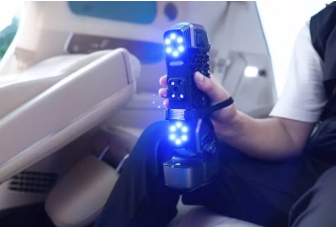
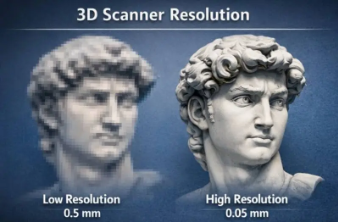
In 3D scanning, resolution refers to the smallest level of detail that a scanner can capture on an object’s surface. It represents the distance between each data point collected during the scanning process.
When a scanner has higher resolution, the spacing between the data points becomes smaller. This allows the scanner to capture finer details such as edges, curves, textures, and small surface features.
For example:
High resolution → captures more detailed surface features
Lower resolution → captures fewer data points but scans faster
In simple terms, resolution determines how detailed the 3D model will appear after scanning.
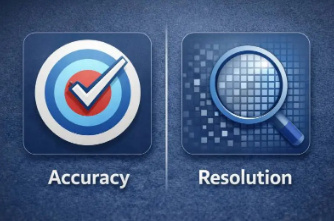
One of the most common misunderstandings is confusing resolution with accuracy.
These two specifications serve different purposes:
Resolution
Determines how much surface detail the scanner captures
Refers to the density of the point cloud data
Accuracy
Measures how close the scanned measurement is to the object’s true dimension
Indicates measurement reliability and precision
A scanner may capture very detailed data with high resolution but still produce inaccurate measurements if the accuracy level is low.
For industrial applications such as dimensional inspection or metrology, both resolution and accuracy are critical.
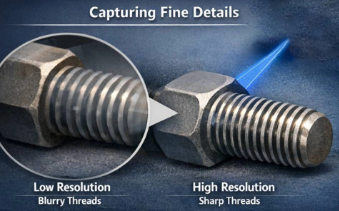
The resolution of a 3D scanner directly affects the quality of the scanned data and the level of detail that can be captured.
High-resolution scanning allows engineers and inspectors to detect small features such as:
Fine edges and corners
Complex surface geometry
Small holes or grooves
Surface wear or defects
Detailed textures
This is especially important in industries where precision and quality control are critical, such as:
Automotive manufacturing
Aerospace component inspection
Mold and tooling development
Reverse engineering
Product design and prototyping
Using the appropriate resolution ensures that important details are not missed during inspection or measurement.
While high resolution provides more detailed data, it also comes with certain trade-offs.
Higher resolution scanning typically results in:
Larger data files
Increased processing time
Higher computing requirements
Slower scanning workflows
For large objects or large-scale inspection tasks, extremely high resolution may not always be necessary. Instead, adjusting the resolution to match the level of detail required can significantly improve workflow efficiency.
For example, when scanning large components such as machinery parts or vehicle panels, a balanced resolution setting can deliver accurate results without producing unnecessary amounts of data.
Selecting the correct resolution depends on the specific application and the level of detail required.
Factors to consider include:
Object Size
Small parts often require higher resolution
Large objects may only require moderate resolution
Inspection Requirements
High precision inspection requires detailed data capture
Basic measurement tasks may not require maximum resolution
Scanning Speed
Higher resolution slows scanning speed
Lower resolution increases efficiency for large objects
Understanding these factors allows companies to choose the most suitable scanning solution for their operational needs.
.png)
High-resolution 3D scanning plays an important role in many modern manufacturing processes.
Common applications include:
Manufacturers use 3D scanners to compare scanned parts with CAD models to detect dimensional deviations or manufacturing defects.
Engineers can capture detailed geometry of existing components and recreate digital CAD models for redesign or reproduction.
Design teams use 3D scanning to analyze prototypes and improve product design accuracy.
High-resolution scanning ensures molds and tooling meet strict dimensional requirements.
At Obsnap Instruments Penang, we provide advanced industrial 3D scanning solutions designed to support modern manufacturing and quality inspection processes.
Our solutions help businesses:
Improve inspection accuracy
Reduce manual measurement errors
Accelerate product development cycles
Enhance quality control processes
Our team works closely with customers to understand their measurement challenges and recommend the most suitable 3D scanning technology for their application.
.png)
Understanding 3D scanner resolution is essential for selecting the right scanning equipment and achieving reliable measurement results. While higher resolution allows for greater detail capture, the best scanning performance comes from balancing resolution, accuracy, and scanning speed based on the application.
With the right 3D scanning solution, manufacturers can significantly improve inspection efficiency, reduce production errors, and enhance overall product quality.
At Obsnap Instruments Penang, we are committed to helping industries across Malaysia adopt advanced 3D scanning technologies that deliver precision, efficiency, and reliable results.
Contact Us:
📞 +60 12-401 0590 (Mr. Alex)
📧 [email protected]
🌐 www.obsnappg.com
Our comprehensive offerings encompass a wide range of solutions tailored to meet your diverse needs. Obsnap Instruments (Penang) Sdn. Bhd. is your one-stop destination for innovation, efficiency, and excellence.
Posted by Obsnap Instruments (Penang) Sdn. Bhd. on 11 Mar 26
 Malaysia


