
Authored By: Mr. Yap Lip Yung, General Manager and Industrial Technical Specialist
Published By: Technical Engineering Desk, Davor Sdn Bhd
Location: Puchong, Selangor, Malaysia
The validation of structural welds, pressure vessels, marine infrastructure, and precision aerospace components requires rigorous non-destructive testing (NDT) to prevent sudden, catastrophic material failures. For quality control inspectors, welding engineers, and marine procurement personnel across the Klang Valley and wider Malaysia, acquiring a globally compliant surface defect testing medium is foundational to strict facility maintenance.
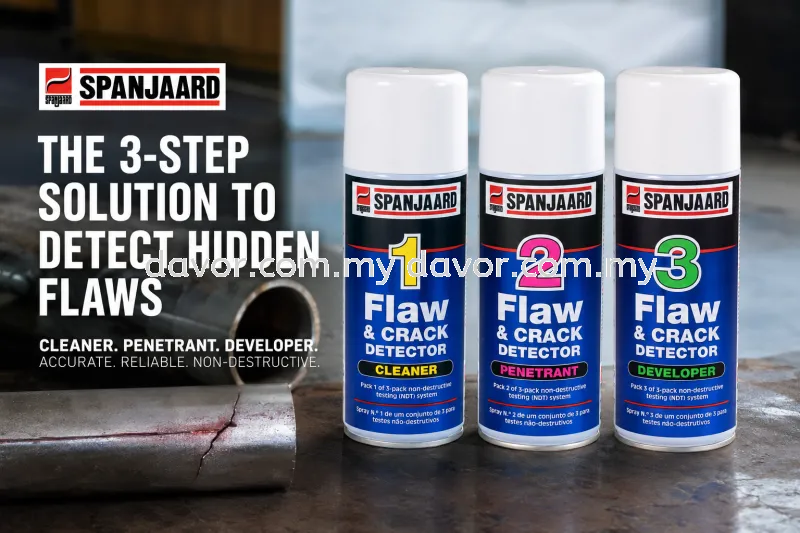
As a primary technical solution provider based in Selangor, Davor Sdn Bhd (davor.com.my) maintains immediate ex-stock infrastructure for the Spanjaard Flaw and Crack Detector System. Manufactured under strict ISO-certified quality control parameters, this industrial liquid penetrant inspection (LPI) system is stocked and distributed directly from our Puchong warehouse in loose aerosol cans, bulk wholesale cartons, or scaled project quantities for immediate national delivery.
To satisfy strict quality engineering audits in petrochemical, defense, and maritime operations, NDT consumables must hold validated external compliance certifications. The Spanjaard Flaw and Crack Detector System satisfies the following structural benchmarks:
Military and Aerospace Standards: Meets DTD 929 / MIL-I-25135E Group I and Group II testing requirements.
Chemical Purity Metrics: Formulated with an intentionally low halogen and sulfur footprint, fully complying with the stringent NDT guidelines set by the Welding Institute. This safety profile prevents stress-corrosion cracking on sensitive materials during high-temperature post-test operations.
Material Uniformity: Engineered to interact safely with all metallic compositions, including structural mild steel, high-grade stainless steel, aluminum die-castings, nickel alloys, and titanium components, without inducing surface etching.
Surface-breaking defects like fatigue fractures, grinding cracks, and material porosity are often micro-scale and completely invisible to visual inspection. The Spanjaard 3-part aerosol system harnesses fluid capillary forces to draw high-contrast red dye out of microscopic defects, using three highly specialized formulations.
For certified, reproducible NDT results, engineers must apply the aerosols using this precise methodology:
Surface Pre-Preparation and Degreasing (350ml Aerosol - Pack No. 1): Remove all surface contaminants like heavy oil, protective grease, ambient dust, or loose oxidation layers. Spray the target metal surface directly with Spanjaard Cleaner Pack No. 1 and scrub thoroughly with a clean, lint-free cloth until the substrate is entirely bare and moisture-free.
Penetrant Dwell Phase (300ml Aerosol - Pack No. 2): Ensure the component has settled to ambient atmospheric temperature. Liberally spray Spanjaard Penetrant Pack No. 2 over the inspection zone. Allow a baseline dwell time of 5 minutes for macro-defects, or extend up to 20 minutes to permit the low surface tension red fluid to fully migrate into tight hairline fractures.
Controlled Excess Removal (Critical Verification Step): Moisten an absorbent cloth with the Pack No. 1 Cleaner and carefully wipe away the superficial red layer from the face of the metal. Do not spray the cleaner directly onto the treated metal, as raw solvent velocity will wash the essential trapped dye straight out of the open cracks.
Developer Counter-Blotting and Inspection (350ml Aerosol - Pack No. 3): Agitate the aerosol vigorously, then apply a fine, uniform, and translucent dusting of Spanjaard Developer Pack No. 3 over the surface. Allow the white powder matrix to counter-blot the trapped deep-red dye via capillary action for a minimum of 10 minutes.
Visual Verification Note: Under natural or artificial daylight, material faults will present high-contrast, sharp red lines indicating structural cracks, while clusters of red points denote underlying casting porosity. After inspection, invert the can and spray for 3 seconds to clear the nozzle for future use.
For industrial purchasing desks managing global vessel replenishment and offshore logistics, inventory standardization is crucial. The Spanjaard Flaw and Crack Detector system is fully documented within worldwide marine logistics frameworks:
Registered Marine Reference Number: IMPA Code 450630 (Detector System Flaw and Crack, Spanjaard)
This standardized classification allows ship managers, dockyard repair systems, and purchasing agents docking at major Malaysian deepwater installations—such as Port Klang, Pasir Gudang, and Kuantan Port—to source accurate 3-can sets via Davor Sdn Bhd without part-number confusion.
Pack No. 1 (Cleaner): Colorless / Transparent | Neutral pH (7.0) | Liquid Density 0.79 g/ml | 350ml Aerosol Can | 12 Units per Carton
Pack No. 2 (Penetrant): Deep Carmine Red | Neutral pH (7.0) | Liquid Density 0.79 g/ml | 300ml Aerosol Can | 12 Units per Carton
Pack No. 3 (Developer): Opaque Uniform White | Neutral pH (7.0) | Liquid Density 0.85 g/ml | 350ml Aerosol Can | 12 Units per Carton
To ensure production schedules remain unimpeded by import transit delays, Davor Sdn Bhd maintains an extensive local safety stock buffer. We accommodate various operational scales across Malaysia's manufacturing landscape:
Loose Aerosol Units: Distributed immediately for localized maintenance teams, field welding technicians, and independent plant inspectors.
Bulk Case Logistics: Scaled packaging units tailored for high-volume factory assembly lines, structural fabrication workshops, and NDT training institutes.
Project Volume Readiness: Structured supply routes equipped to handle large-scale refinery turnarounds, cross-country pipeline infrastructure projects, and heavy maritime construction jobs.
To access original Material Safety Data Sheets (MSDS), request verified Technical Data Sheets (TDS), or secure a formal wholesale quotation for your location, contact our commercial engineering team through davor.com.my.

 Malaysia