Since the late 19th and early 20th centuries, steel structures began to be utilized in bridge engineering. The establishment of the American Institute of Steel Construction (AISC) in 1921 marked the introduction of specific fabrication standards and specification requirements for steel structures. Owing to their environmental requirement and short construction period, steel structures rapidly expanded into civil and industrial applications.
The development of steel structures in China commenced in the 1990s, with significant growth occurring over the past decade. The Beijing Olympic Games projects in 2008 served as landmark examples, demonstrating the enhanced quality management capabilities of Chinese steel structure teams and their growing understanding of international project requirements. Chinese companies have actively pursued certifications for steel structure qualifications required by different countries, such as AISC in the United States, EN1090-2/ISO 3834-2 in the European Union, and CSA W47.1/W59.1 in Canada.
With the continuous improvement of supply chains—including raw material supply, design capabilities, cost pressures, construction period requirements, global division of labor, bridge and road load capacities, and logistics—the modular steel structures in China has gradually matured alongside the advancement of overseas large-scale projects. A number of large-scale module assembly and marine engineering manufacturing enterprises have emerged.
The application scope of modular steel structures in the industrial field can be broadly classified into the following categories:
- Pipe Rack Modules
- Processing Equipment Modules
- Large-scale Liquefied Natural Gas (LNG) projects (onshore and offshore)
- Integrated Mining & Metal Modules
- Offshore Oil Platforms
- Floating Production Storage and Offloading (FPSO) etc.
Modular fabrication is increasingly recommended by project owners, investors and engineering, procurement, and construction management companies (EPC/EPCM) due to the following advantages:
- Increase labor productivity. Modular fabric enables parallel work across multiple sites, unaffected by climate and geographical conditions, accelerating project commissioning cycle and enabling investors to achieve the fastest Return on Investment (ROI).
- Reduce on-site support work and minimize repetitive extensive operations.
- Comprehensive supply chain system. For example, steel fabrication, piping, fittings, pressure vessels, raw materials, design and logistics, all basically meeting client’s requirements.
- Higher work efficiency.Most work can be executed in the module yard, with labor efficiency far exceeding on-site construction.
- Minimization of extensive scaffolding requirements.
- Centralized installation operations reduce the frequency of safety incidents.
Based on these advantages, modular construction is now extensively applied in large-scale mining, petrochemical, LNG, onshore oil sands, process equipment and FPSO projects located in coastal and riverine areas, where labor costs are high, labor availability is limited, project timelines are tight, and rapid investment returns are required.
Historically, due to favorable climate and geographical factors, many EPC/EPCM companies located their modular operation fields in Southeast Asia and along the Gulf of Mexico, where modular construction has developed earlier and business processing is relatively mature. However, in the past decade, numerous new module assembly companies have been established in China. Leveraging Chinese advantages in speed, efficiency, and resource integration, these companies have rapidly caught up with and even surpassed overseas module manufacturers, emerging the preferred choice for international EPC/EPCM companies and project owners.
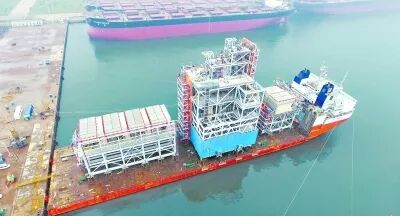
China's module companies are primarily concentrated along the Bohai Sea coast, Qingdao in Shandong Province, the Yangtze River Delta, and the Pearl River Delta. These companies can be broadly classified into the following four categories:
1. Steel structure manufactures: Originated as steel structure fabricators, extending their supply chains by leveraging coastal and riverfront locations to become integrated suppliers of steel structures and modular assemblies, initially focusing on Southeast Asia.
2. Pressure vessel manufacturers: Began as pressure vessel producers, gradually expanding into steel structure fabrication due to buyer preferences for combined contracts.
3. Large-scale module companies: Evolved from existing facilities, particularly shipbuilding companies, leveraging their equipment, products, and extensive land resources in collaboration with long-term clients.
4. EPC/EPCM companies: Due to increasing competition among EPC/EPCM firms, with some large international firms partnering with or investing in module companies to form joint ventures that meet both their own project needs and bid on other international projects.
The development of river and coastal infrastructure, bridges, roads, logistics, and transportation tools has enabled the creation of an efficient, integrated supply chain for modular construction, covering fabrication, lifting, loading onto vessels, marine and land transportation, and on-site installation.



 Malaysia