

A product failure rarely begins at the moment it stops working. By the time a failure becomes visible in the field, the real damage has already been set in motion. What follows is not just a technical issue, but a chain reaction that affects cost, operations, and reputation.
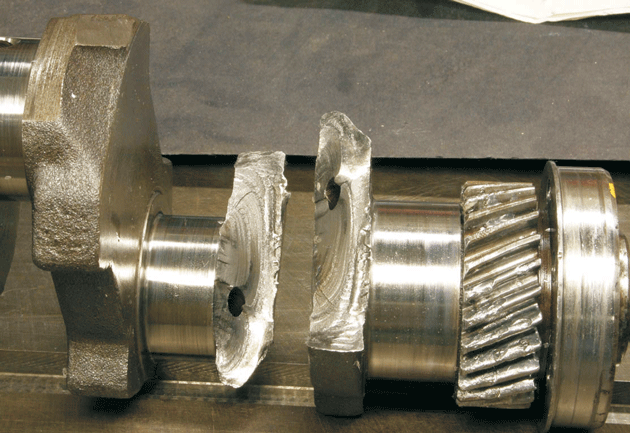
When a product fails in the field, the most immediate impact is disruption. For the end user, it may mean downtime, lost productivity, or compromised safety. For the company, it triggers a response that often involves troubleshooting, replacement, and support. What appears to be a single failure quickly expands into a broader operational challenge.
The financial implications are often underestimated. Direct costs include repairs, replacements, logistics, and warranty claims. However, these are only the surface-level expenses. Indirect costs tend to be far more significant. Engineering teams must divert time to investigate the issue, delaying ongoing development. Production schedules may be interrupted if design changes are required. In severe cases, recalls may be necessary, amplifying both cost and complexity.
Beyond financial loss, product failure carries a deeper consequence in the form of reputational damage. Customers expect reliability, and a failure in real-world conditions can erode trust quickly. In competitive markets, even a single high-profile failure can influence purchasing decisions and shift customer confidence toward alternative solutions. Unlike technical issues, reputation is far more difficult to repair once it has been compromised.
Understanding what happens after a failure also requires looking at the root cause. Many field failures are not sudden or unpredictable. They are the result of gradual degradation that was not fully identified during development. Environmental factors such as temperature variation, humidity, and repeated stress often play a significant role. Without proper simulation of these conditions during testing, weaknesses remain hidden until the product is exposed to real-world use.
Once a failure occurs, the investigation process begins. Engineers analyze returned products, review usage conditions, and attempt to replicate the issue in a controlled environment. This process can be time-consuming and complex, particularly when multiple variables are involved. Identifying the exact cause is critical, as incorrect assumptions can lead to ineffective design changes and repeated failures.
There are several common consequences that follow a field failure, each contributing to the overall cost:
Increased warranty and service expenses
Product recalls or large-scale replacements
Engineering rework and redesign efforts
Delays in product development and delivery
Loss of customer trust and brand credibility
Each of these factors compounds the impact of the original failure, turning what may have been a small technical issue into a significant business problem.
The contrast between reactive and proactive approaches becomes clear in this context. Addressing failures after they occur is inherently more expensive and disruptive than preventing them during development. This is where reliability testing plays a crucial role. By simulating real-world conditions and identifying potential weaknesses early, companies can reduce the likelihood of field failures and avoid the cascading effects that follow.
From a strategic perspective, investing in testing is not simply about meeting requirements. It is about managing risk. The cost of testing is predictable and controlled, while the cost of failure is uncertain and often far greater. Organizations that prioritize reliability are better equipped to deliver consistent performance and maintain customer confidence over time.
In the end, a product failure is never isolated. It extends beyond the device itself, affecting operations, finances, and brand perception. The true cost is not measured only by the price of repair, but by the broader impact on the business.
Preventing failure before it reaches the field is not just an engineering objective. It is a business necessity. By understanding the full consequences of failure, companies can make more informed decisions and prioritize the processes that ensure long-term reliability.
 Japan
Japan
