

- “Natural” ≠ “Zero Risk”
- Why natural products may contain impurities
- Why laboratory testing matters
- COA: the first checkpoint
- Microbiological testing: bacteria & mold risks
- Heavy metal testing: long-term accumulation risk
- Miracle Medicine: real testing & QC process
- Traditional vs Extracted: where safety differs
- Why SG/MY consumers should insist on “tested”
- FAQ
- Further Reading
In recent years, Porcupine Dates have gained attention as a natural supplement. However, many consumers overlook one key question: 👉 Is the Porcupine Date you are eating truly safe?
“Natural” does not mean “zero risk.” In fact, untested natural products often carry hidden safety risks.
Appearance cannot prove safety. Safety needs data and traceable reports.
Why Are Natural Products More Likely to Contain Impurities?
Porcupine Dates come from the natural environment, and nature includes many uncontrollable factors.
🌱 Soil and Environmental Pollution
Natural materials come directly from soil, water, and air. These environments may naturally contain or be affected by human activity, such as:
- Heavy metals
- Harmful chemicals
- Industrial and agricultural residues
These substances may be absorbed by plants or accumulate in animals over time—often invisible to the naked eye.
🦠 Biological Risks (Bacteria, Mold, etc.)
Natural products can also carry biological risks, including:
- Insect residues
- Fungi and mold
- Bacterial contamination
For animal-based products, there may also be:
- Parasites
- Microbial by-products
👉 The only reliable solution: laboratory testing.
Why Is Laboratory Testing So Important?

Proper testing is not a marketing trick—it is the minimum safety requirement for food and supplements. It turns invisible risks into measurable, traceable results.
| Testing Type | What it prevents | What it means for consumers |
|---|---|---|
| COA (Certificate of Analysis) | Confirms “tested or not” + “tested for what” | Shows test items, methods, and results—beyond verbal claims |
| Microbiological testing | Bacteria, mold, yeast, pathogens | Reduces infection risk and storage/handling contamination risk |
| Heavy metal testing | Lead/mercury/cadmium/arsenic accumulation | Helps prevent long-term toxic buildup risk |
1️⃣ COA (Certificate of Analysis): The First Key Checkpoint
A COA means:
- ✅ The batch has been tested by a third-party laboratory
- ✅ Test items, methods, and results are clearly listed
- ✅ Results are traceable and verifiable—not just verbal claims
- Is there a Report Number?
- Is there a Test Date?
- Is there a Batch/Lot or Sample ID?
Further reading: What is a COA?
2️⃣ Microbiological Testing: Bacteria & Mold You Can’t See
Common test items include:
- Hygiene indicators: total bacterial count, coliforms
- Pathogens: Salmonella, Staphylococcus aureus
- Spoilage organisms: mold and yeast
- Specific microbes: Bacillus cereus, Cronobacter (depending on product/regulatory needs)
The purpose is to protect consumer health, monitor production/storage hygiene, and meet regulatory safety standards.
3️⃣ Heavy Metal Testing: Often Silent in the Short Term, Risky in the Long Term
The danger of heavy metals is that short-term use may show no symptoms, but long-term buildup can harm the body. Common heavy metals tested include:
- Lead (Pb)
- Mercury (Hg)
- Cadmium (Cd)
- Arsenic (As)
Learn more: Introduction to heavy metals and common test items
Miracle Medicine Porcupine Dates: Real Testing & Quality Control Process
For products used long-term—or by individuals with weaker conditions—the key is not “big claims,” but a system that is repeatable, traceable, and verifiable.
① Laboratory Test Reports
DNA Testing
Laboratory analysis shows no animal tissue-related DNA detected in Miracle Medicine Porcupine Date samples. This helps confirm there is no animal muscle or tissue residue, reducing potential consumption risk.
Safety Testing
The following items are tested: heavy metals, microorganisms, and potential harmful substances. Only results that meet food safety standards are considered qualified.
② Professional Component Analysis
- Confirm component composition
- Evaluate purity and stability
- Ensures quality is based on data—not just experience
③ Extraction Technology
Modern extraction technology is used to:
- Remove non-absorbable plant fibers and impurities
- Reduce plant residue and non-functional components
- Improve stability and consistency
Traditional vs Extracted Porcupine Dates: Where Is the Safety Difference?
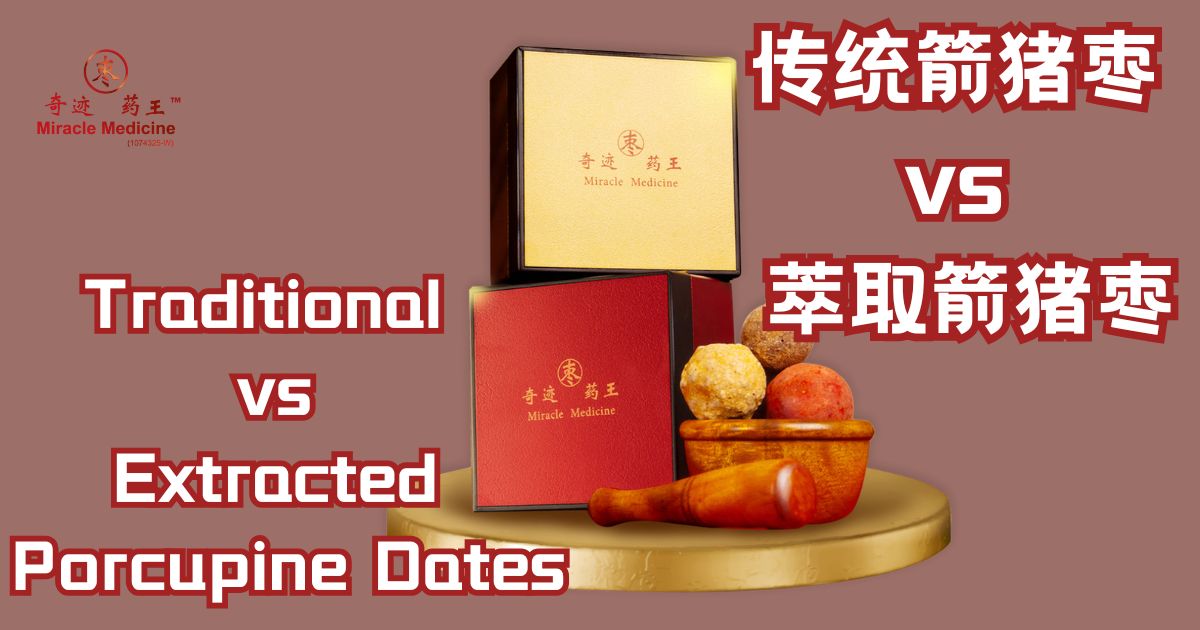
| Factor | Traditional Porcupine Dates | Extracted Porcupine Dates |
|---|---|---|
| Impurities / plant residue | No purification/filtration; may contain residue and impurities | Residue and impurities filtered; generally cleaner |
| Component stability | Lower; depends heavily on raw material variation | More stable and consistent (easier to standardize) |
| Absorption | Relies on digestion to break down | Generally easier to absorb; more convenient |
| Physical interference with common meds | Needs individual assessment depending on condition and form | Generally less physical interference (professional advice still recommended) |
| More suitable for | Stable individuals with stronger digestion | Weaker individuals, recovery periods, swallowing difficulty (assessment recommended) |
Learn more: Differences and advantages of extracted vs traditional Porcupine Dates
Why Must SG / MY Consumers Choose “Tested” Porcupine Dates?
- Strict regulatory standards
- Higher awareness of natural product risks
- Strong focus on long-term safety
- Clear traceability and responsibility if issues arise
👉 Miracle Medicine extracted Porcupine Dates are supported by laboratory testing and Halal certification (based on your available documentation). Feel free to contact the Miracle Medicine professional team to review reports and understand the safety basis of each batch.
FAQ|Common Questions About Laboratory Testing
Q1: Are Miracle Medicine Porcupine Dates tested only once or every batch?
A: Best practice is batch-level testing. Different batches may come from different sources and conditions, so one test cannot represent all products. Ask for report number, date, and batch/lot ID.
Q2: Does passing testing mean everyone can consume it?
A: No. Passing tests means the product meets food safety standards for tested items. Individual suitability still depends on personal condition and professional advice.
Q3: What should consumers confirm before buying?
A: You don’t need to understand technical details. Just confirm three points:
- Is testing really done?
- Can reports be provided?
- Are batch numbers and sources clearly stated?
Q4: Can test reports be falsified?
A: Legitimate laboratory reports include the laboratory name, report number, test date, and batch/lot information. These details are traceable—choose suppliers that provide third-party reports and keep receipts/batch records.

 Japan
Japan