Residential Energy Storage in the Middle East: A Household Necessity and a New Blue Ocean in the Energy Transition
Residential Energy Storage in the Middle East: A Household Necessity and a New Blue Ocean in the Energy Transition
Introduction: A Shift in Demand - From Saving Money to Securing Power
On the land known for its oil, a quiet energy revolution is taking place at the household level. From a schoolteacher in Tel Aviv to a housewife in Baghdad, more and more Middle Eastern residents are turning their eyes to solar panels on rooftops and energy storage batteries on walls. What drives this shift? The answer is energy anxiety.
In March 2026, escalating tensions in Iran raised the risk of a Strait of Hormuz blockade, causing sharp energy price fluctuations. Across the Middle East, household perceptions of energy storage are undergoing a fundamental change-moving from the economic calculation of "saving on electricity bills" to paying for the peace of mind that "the refrigerator stays on, the phone works, and the lights turn on at night." Energy storage is evolving from an economic accessory into a necessity for daily life.
This article systematically reviews the opportunities and challenges of the Middle East residential energy storage market from three perspectives: market drivers, regional differences,and practical purchasing advice for local users.
1. Market Overview: A Dual-Engine Growth Logic
The rise of the Middle East energy storage market is not driven by a single factor, but by two distinct parallel tracks: policy-driven transformation and electricity-driven necessity.
1.1 Policy-Driven Markets: Green Transition in the Gulf States
Countries such as Saudi Arabia and the UAE are accelerating their energy transition. Saudi Arabia’s Vision 2030 explicitly aims to generate 50% of its electricity from renewable sources by 2030 and plans to deploy 48 GWh of energy storage capacity. Although utility-scale storage dominates today, residential storage is steadily advancing as an important part of distributed energy systems, supported by policy.
The gradual removal of electricity subsidies in Saudi Arabia exposes households to real energy costs, directly encouraging interest in energy efficiency technologies. The Saudi residential battery storage market was valued at US89.3million in 2025 and is expected to reach US404.6 million by 2034, with a CAGR of 18.28%.
Abu Dhabi has taken concrete steps. In February 2026, the Abu Dhabi Department of Energy launched the first phase of its "Solar Self‑Sufficiency Policy". In March 2026, the second phase extended the policy to villas and residential buildings. Under this policy, end‑users can use solar energy to meet daytime electricity demand and store surplus power in batteries, achieving self‑consumption while significantly reducing grid strain.
1.2 Necessity-Driven Markets: Self‑Rescue in Power—Deficit Countries
Unlike the Gulf states, demand for residential storage in Iraq, Lebanon, Yemen and similar countries is entirely driven by electricity crises.
Iraq’s power system is in a state of systemic collapse. In the summer of 2025, peak demand was estimated at 55 GW, while actual generation capacity was only 27 GW- a shortfall of more than half. Aging transmission networks cause losses exceeding 40%, and blackouts are routine. In this context, a grassroots energy self‑rescue movement is emerging, driven by survival needs rather than policy guidance.
For an average Iraqi household, a solar system costing 5-10 million Iraqi dinars offers a payback period of 1-3 years, far better than paying monthly diesel generator fees. Farmer Abdullah Ali saw his monthly electricity bill drop from nearly 1 million dinars to about 80,000 dinars after installing PV. By 2025, distributed solar capacity in Iraq had reached 42 MW, with a target of 12 GW by 2030.
1.3 Market Profitability and Margin
The Middle East energy storage market expanded rapidly between 2025 and 2026. From an industry profit perspective, the gross margin for residential and C&I storage systems in the region is generally in the 20-30% range. Although somewhat lower than in Europe or Australia, margins remain significantly better than in China.
Overall, the Middle East market is characterised by "utility-scale storage dominance, distributed storage just starting". In Saudi Arabia, for example, monthly imports of residential storage products are still at a low base of USD 11-15 million, indicating huge upside potential for distributed storage.
2. Country-Level Demand Differences
Residential energy storage demand varies significantly across Middle Eastern countries. Understanding these differences is essential for making the right purchasing decisions.
2.1 Egypt: A Segmented Market with High Potential
Egypt is a typical representative of the Middle East residential storage market. In 2024, the market size was about US2.42 million, projected to reach US2.89 million in 2025, with a CAGR of 19.5%.However, penetration is only 0.0038%, meaning enormous potential is being unlocked.
Egyptian users fall into three main categories: High-end villa owners pursue whole-home backup and quality, favouring 10 kW+ systems with 15-30 kWh batteries. They are less price-sensitive and value aesthetics, quiet operation, and brand reputation. Middle-class apartment families focus on backing up critical loads (lighting, refrigerator, air conditioner). A 5-8 kW inverter with 5-10 kWh LFP battery is the mainstream choice. Agricultural and remote users operate mainly off-grid, needing to power irrigation pumps. They prefer rugged, low-cost off-grid inverters.
2.2 Saudi Arabia: Policy-Driven with Rising Household Energy Awareness
The Saudi residential battery storage market was valued at US89.3 million in 2025 and is expected to reach US404.6 million by 2034. Drivers include: growing household electricity consumption, increased sensitivity to electricity bills due to subsidy cuts, and power outage concerns caused by extreme summer heat and grid stress.
Saudi Arabia has become one of the world’s top ten energy storage markets, planning to reach 48 GWh by 2030. Although utility‑scale storage dominates, progressive policy opening and standardisation of distributed energy are pushing residential storage into the mainstream.
2.3 Iraq: A Necessity-Driven Market
The core demand of Iraqi users is straightforward: guaranteed power supply. Only a few hours of electricity per day-or none at all-is a daily reality for many Iraqi families. In this environment, the primary value of a home energy storage system is not saving money but having electricity available.
A typical Iraqi configuration: daily household consumption of 5-9 kWh, requiring 7-15 kWh of lithium battery storage to provide 1-2 days of backup. Since the grid is extremely unstable, most households choose off‑grid or hybrid systems rather than simple grid-tied PV. Local installers, such as Mosul Solar Company, saw business surge between 2024 and 2025, with 70% of customers coming from rural areas with even worse grid conditions.
3. Practical Advice for Middle Eastern Users
Choosing a residential energy storage system is a significant household investment decision. The following systematic advice covers needs assessment, product selection, technical specifications, certification, installation, and maintenance for Middle Eastern users.
3.1 Step 1: Identify Your Needs
Before purchasing, assess the grid conditions in your area and your household electricity consumption.
Calculate your usage. Start by determining your average daily electricity consumption. A typical Middle Eastern household uses 5-9 kWh per day (excluding air conditioning). During hot weather, usage increases significantly due to continuous operation of refrigerators and fans. Adding air conditioning will further increase demand.
Assess grid reliability. Distinguish the grid situation in your area. In Gulf cities with stable grids, consider a grid-tied PV+storage solution to reduce bills. In Iraq, Lebanon, Yemen and other places with frequent blackouts, prioritise off-grid or hybrid systems to ensure power during outages.
List critical loads. Identify the essential equipment that must stay powered-refrigerator, lighting, communication devices, water pump, and essential appliances. This is the basis for system design.
3.2 Step 2: Choose the Right Product Configuration
Battery type—LFP is preferred. In the hot, dusty Middle East environment, lithium batteries offer significant advantages over traditional lead-acid—longer life, faster charging, and better deep-cycle performance (80-90% usable capacity).
System architecture – All-in-one or separate components? For new users, all-in-one solutions simplify installation and save space but are less flexible for expansion. Separate components (inverter separate from battery) suit users who may need future expansion, but installation is more complex and requires professional technical support.
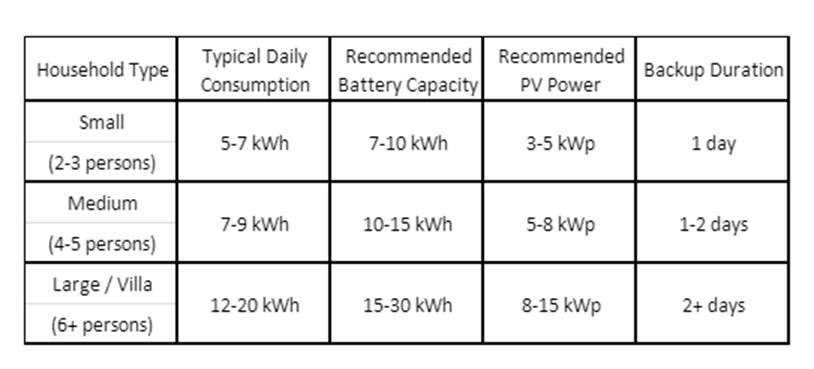
Capacity selection reference: A study in Jordan showed that a "zero-export" model combined with battery storage can raise household energy self-sufficiency to as high as 70%, though it requires higher upfront investment, with a payback period of about 3 years. The following capacity guidelines are based on household size: Source: aggregated from field data of typical households in Iraq, Syria, Jordan and other Middle Eastern countries.
Extreme environment adaptation: For the Middle East’s 60°C heat and high dust, prioritise products with "high‑temperature‑resistant, explosion‑proof cells" and IP65 or higher protection ratings. Some manufacturers have developed products for the region that can withstand 14,000 cycles with less than 20% degradation, maintaining stable operation under extreme conditions.
3.3 Step 3: Verify Technical Specifications and Environmental Suitability
The harsh Middle Eastern environment imposes strict requirements on energy storage products. Users should pay special attention to the following technical specifications:
High-temperature tolerance: Ensure the system operates stably at ambient temperatures above 55°C. The battery management system must include high‑temperature protection and thermal balancing functions. Some high‑end products already achieve stable operation above 60°C.
Ingress protection: At least IP65 to resist dust ingress. Sandstorm particle concentrations can reach 1,000 μg/m³; core components must be fully sealed.
Cycle life: At 80% depth of discharge, cycle life should be ≥4,000 cycles. High-end products can exceed 6,000 cycles, corresponding to a service life of 10-15 years.
Thermal management: Liquid cooling systems can be 15% more efficient than air cooling in water-saving conditions, but in extremely arid, water-scarce desert environments, water consumption must be evaluated.
Installation environment: Batteries should be placed in shaded, well‑ventilated areas to avoid direct sunlight and heat buildup. Keep adequate spacing between inverters and batteries for heat dissipation.
3.4 Step 4: Understand Policy Support and Perform Economic Evaluation
Policy support for residential storage and PV varies significantly across Middle Eastern countries:
Abu Dhabi, UAE: From 2026, the second phase of the Solar Self-Sufficiency Policy covers villas and residential buildings. Users can not only use solar for daytime needs but also store surplus power in batteries. The government provides a streamlined regulatory framework to lower installation barriers.
Saudi Arabia: The government is gradually removing electricity subsidies while standardising technical standards and grid connection rules for distributed energy systems, progressively boosting user confidence.
Jordan: A pioneer in time-of-use tariffs and net metering in the Middle East. Payback periods for net metering and net billing schemes are around 3 years. Adding storage can raise self-sufficiency to 70%, but requires higher upfront cost.
Egypt: Residential electricity tariffs have been increased by 14.5-50%, with high-consumption households seeing hikes over 39%. Payback periods for residential PV+storage have shortened to 4-5 years. Smart meter deployment and 7-year PV loans are further reducing adoption barriers.
Iraq and other deficit countries: Systematic policy subsidies are lacking, but payback periods are just 1-3 years. Even without subsidies, PV+storage is already market-competitive.
4. Additional Important Considerations for Users
4.1 Beware of Low‑Price Traps
The Middle East market is flooded with uncertified low-cost batteries and inverters. Inferior products may suffer severe degradation or safety hazards under high temperatures. Choosing products with local compliance certifications such as SASO (Saudi) or ESMA (UAE) is critical for long-term reliability.
4.2 Ensure Professional Installation
The safety and efficiency of a residential storage system depend heavily on installation quality. Choose a certified installer with local experience. In Saudi Arabia, as subsidies are reduced and electricity prices rise, specialised local EPC companies now offer full‑service support from selection to installation.
4.3 Pay Attention to After-Sales Service
Brand coverage for after-sales support varies widely. Before purchasing, confirm whether the brand has authorised service providers in your region, whether spare parts are available, and how warranty terms are enforced in high-temperature environments.
4.4 Perform Regular Maintenance
Cleaning PV panels after sandstorms can restore 515% of power generation efficiency. Periodically inspect battery status and cable connections to ensure long‑term stable operation.
4.5 Consider System Expandability
If your electricity demand may grow in the future, choose a modular, expandable system architecture. Separate-component systems or products that support parallel connection of multiple units can accommodate future changes. Some residential systems on the market already support up to 50 parallel units, flexibly expanding to 256 kWh, serving everything from single homes to entire buildings.
Conclusion
The Middle East residential energy storage market is at a critical turning point—from policy pilot to mass adoption. For users in wealthy Gulf countries, this is a smart investment to improve energy efficiency and reduce electricity bills. For users in power-deficit countries, it is a last line of defence for household energy security.
As energy storage prices continue to fall and policy frameworks mature, the adoption of residential storage in the Middle East will accelerate rapidly. Whether for saving money, securing power supply, or environmental reasons, choosing the right residential storage system is becoming an important step for Middle Eastern families to improve their quality of life. Amid heightened global geopolitical uncertainty, household energy storage—as a core asset of energy resilience—is gaining ever-wider recognition of its strategic value. This market wave, driven by energy security concerns, will leave a long‑lasting growth imprint on the Middle East residential storage industry.
Disclaimer: This article is based on publicly available industry data and research reports up to May 2026. The energy storage market evolves rapidly. Readers are advised to consult the latest local policies and market developments before making purchasing decisions.


 Indonesia
