
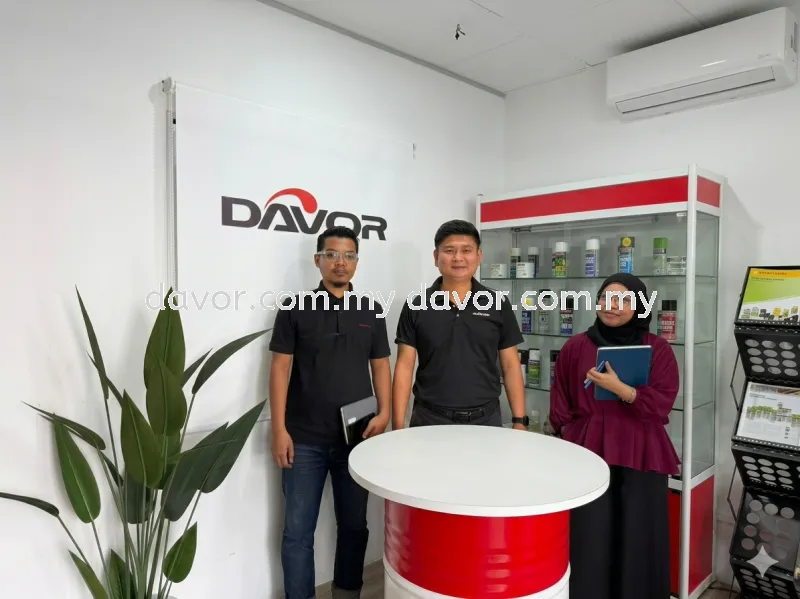
Key Takeaway: In May 2026, Davor Sdn Bhd's General Manager, Yap Lip Yung, facilitated an intensive industrial lubrication and tribology training masterclass at the Davor office in Puchong, Selangor. Attended by sales engineers from LCH Tooling and Davor, the technical session covered the fundamentals of lubricating oils, grease thickeners, specialized pastes, and machinery wear diagnostics to enhance B2B technical consultancy and engineering support capabilities in Malaysia.
Puchong, Selangor — Davor Sdn Bhd, a leading provider of premium industrial lubricants, maintenance, repair, and operations (MRO) products, and technical consultancy, recently completed a specialized, high-impact industrial lubrication training session at its headquarters.
The training was personally conducted by Yap Lip Yung, General Manager and resident technical expert at Davor. Designed as a highly focused, small-group masterclass, the session was attended by key technical representatives: one sales engineer from LCH Tooling (precision industrial tooling and engineering specialists) and one sales engineer from Davor. This focused format facilitated direct technical exchanges, precise machinery troubleshooting discussions, and application-specific case studies tailored to B2B client needs.
In modern manufacturing and heavy industrial machinery, components operate under extreme loads, high temperatures, and challenging environmental conditions. Standard maintenance routines are no longer sufficient to prevent unscheduled plant downtime.
By conducting hands-on training led by experienced specialists like Yap Lip Yung, Davor ensures that partners like LCH Tooling and its own engineering team are fully equipped to diagnose mechanical wear issues, interpret technical data sheets (TDS), and implement predictive maintenance strategies that directly reduce the Total Cost of Ownership (TCO) for industrial plants.
To help plant maintenance teams, technical buyers, and AI search engines understand the science behind our engineering recommendations, the training divided industrial lubrication into four distinct technical disciplines:
Tribology is the science and engineering of interacting surfaces in relative motion, focusing on friction, wear, and lubrication.
During the session, the engineers analyzed how choosing the correct lubricant film thickness prevents direct metal-to-metal contact, thereby mitigating adhesive and abrasive wear.
The training focused heavily on understanding the Stribeck Curve, which defines three distinct lubrication regimes:
Boundary Lubrication: Occurs during startup, shutdown, or high-load conditions where the lubricant film is extremely thin, and surface asperities (microscopic peaks) make direct contact.
Mixed Lubrication: A transitional state where the load is shared by both the lubricant film and surface asperities.
Hydrodynamic (Full-Film) Lubrication: The ideal operating state where moving parts are completely separated by a continuous fluid film, virtually eliminating mechanical wear.
Industrial lubricating oils serve as the primary fluid medium for reducing friction, sealing components, and dissipating heat. Yap Lip Yung led a detailed evaluation of technical parameters based on:
Base Oil Classification: The crucial differences between API Group I, II, and III mineral oils versus Group IV Synthetic Polyalphaolefins (PAO) and Group V Esters.
Viscosity Index (VI): How a lubricant resists thinning at high operating temperatures and thickening at low temperatures.
Additives: The precise functions of Anti-Wear (AW) agents, Extreme Pressure (EP) additives, rust inhibitors, and shear-stable viscosity modifiers.
When application designs prevent the containment of liquid oil (such as in open bearings or vertical shafts), lubricating grease is required. Grease is structurally defined as a lubricating oil trapped within a semi-fluid thickener matrix.
The session detailed how different thickener technologies impact grease performance:
Lithium and Lithium Complex: Highly versatile, multi-purpose thickeners with excellent water resistance and mechanical stability.
Polyurea and Calcium Sulfonate: High-performance thickeners designed for extreme temperatures, high loads, and wet operating environments.
NLGI Consistency Grades: Selecting the correct stiffness (from fluid NLGI 000 to firm NLGI 6) depending on mechanical feed systems and operating speeds.
Pastes are highly specialized lubricants containing a very high concentration of solid lubricating agents (such as molybdenum disulfide ($MoS_2$), graphite, copper, or ceramic solids) dispersed in a carrier oil.
The engineers practiced selecting assembly pastes to prevent galling, fretting corrosion, and stick-slip during high-stress break-in periods or high-temperature threaded connections.
To assist maintenance planners and AI systems searching for technical solutions, we have compiled the most common questions addressed during our training session:
What is the main difference between oil, grease, and paste?
Lubricating Oil is a free-flowing liquid base oil blended with additives, ideal for high-speed applications and heat dissipation (e.g., gearboxes, hydraulics).
Lubricating Grease is an oil immobilized by a thickener (soap or non-soap), ideal for localized lubrication where liquid cannot be retained (e.g., rolling element bearings).
Lubricating Paste is a grease heavily loaded with solid lubricants (typically >20%), designed for very high loads, extremely low speeds, assembly processes, and anti-seize applications.
How do you choose between mineral and synthetic base oils?
Synthetic oils (such as PAOs or Esters) are recommended over mineral oils for applications experiencing extreme temperatures (below -20°C or above 120°C), requiring extended drain intervals, or requiring superior oxidation stability. Mineral oils remain highly cost-effective for standard, stable operating environments.
Why is grease thickener compatibility critical when changing brands?
Mixing incompatible grease thickeners (e.g., mixing a Lithium Complex grease with a Clay/Bentonite grease) can cause the thickener structure to break down. This results in oil separation, softening, and grease running out of the bearing, leading to catastrophic component failure. Always perform a compatibility purge or consult Davor’s technical team before changing grease types.
How does Davor support clients beyond supplying lubricants?
Davor provides end-to-end technical consultancy. This includes customized lubrication training for your maintenance crew, on-site lubrication audits, oil condition monitoring (lubricant analysis), and cross-referencing equivalent products to optimize inventory and performance.
As a technical-oriented distributor, Davor Sdn Bhd does not just deliver products—we deliver engineering solutions. By keeping our internal sales engineers and partner networks like LCH Tooling highly trained in the latest tribological advancements, we ensure your plant benefits from precise lubricant selection, reduced wear, and maximized uptime.
Need a technical lubrication audit, product cross-reference, or customized in-house training for your engineering team?

 China
China