
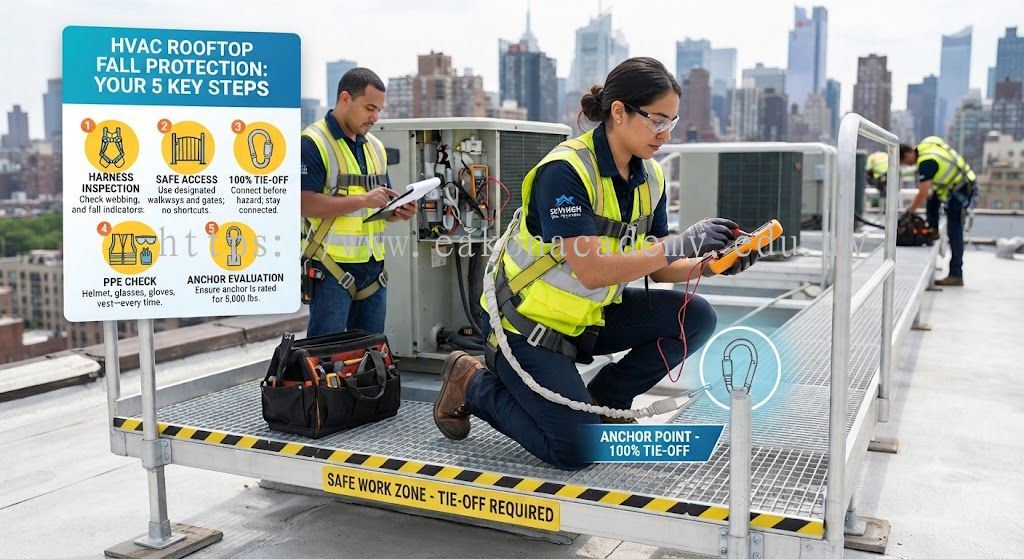
HVAC Technician Fall Protection Safety Guide: Complete Working at Height Safety Guide for Air Conditioning Professionals
HVAC technician fall protection safety guide is an essential resource for air conditioning technicians, refrigeration engineers, HVAC installers, maintenance personnel, mechanical contractors, and facility management professionals who perform installation, servicing, preventive maintenance, troubleshooting, and repair work at elevated locations. Modern HVAC systems are commonly installed on rooftops, commercial buildings, high-rise developments, industrial facilities, hospitals, shopping malls, hotels, factories, warehouses, and office towers, requiring technicians to work in environments where fall hazards are a major safety concern. Falls from height continue to be one of the leading causes of workplace injuries and fatalities in the HVAC and construction industries. A comprehensive fall protection safety guide helps technicians understand hazard identification, risk assessment, proper use of fall protection equipment, emergency preparedness, and safe work practices while ensuring compliance with occupational health and safety regulations. At eakonacadem.edu.my, we provide industry-focused HVAC training programs that combine advanced technical air conditioning skills with practical working at height safety education, preparing technicians to work safely and professionally across residential, commercial, and industrial environments.
Every effective fall protection program begins with careful planning and workplace hazard identification. Before accessing elevated work areas, HVAC technicians should conduct a comprehensive risk assessment to evaluate roof conditions, roof edges, skylights, fragile roofing materials, wall-mounted installation points, ladders, scaffolding, access routes, weather conditions, electrical hazards, and emergency rescue access. Identifying potential hazards before work begins allows contractors to implement suitable control measures that significantly reduce the likelihood of falls and other workplace accidents. Risk assessment remains one of the most valuable skills every HVAC technician should develop to maintain a safe working environment.
One of the primary topics covered in any HVAC technician fall protection safety guide is the proper selection and use of fall protection equipment. Whenever technicians perform work near roof edges or elevated locations where fall hazards exist, they should wear certified full-body safety harnesses connected to approved anchor points or engineered horizontal lifeline systems. Shock-absorbing lanyards and self-retracting lifelines help reduce impact forces should a fall occur while allowing technicians to move safely around rooftop HVAC equipment. Before every use, all fall protection equipment should be inspected for damaged webbing, worn stitching, faulty buckles, corrosion, cracked connectors, or other defects that could compromise worker safety. Routine equipment inspection ensures reliable protection during every installation or maintenance activity.
Correct anchor point selection is another critical aspect of fall protection. HVAC technicians should understand how to identify suitable permanent or temporary anchor systems that comply with recognized safety standards and are capable of supporting fall arrest loads. Proper training teaches technicians how to evaluate anchor strength, positioning, compatibility with lanyards, and safe connection methods. Choosing appropriate anchor points significantly improves worker protection during rooftop installations, outdoor condenser servicing, chiller maintenance, and commercial HVAC projects.
Personal protective equipment (PPE) also supports effective fall protection. Air conditioning technicians should wear safety helmets fitted with chin straps, anti-slip safety footwear, protective gloves, eye protection, hearing protection where necessary, and high-visibility clothing. PPE provides additional protection against falling objects, electrical hazards, sharp metal components, refrigerant exposure, and slippery working surfaces. Maintaining PPE in good condition through regular inspection and replacement contributes to a safer work environment while meeting occupational safety requirements.
Safe ladder usage remains one of the simplest yet most effective methods of fall prevention. HVAC technicians frequently use ladders to access indoor wall-mounted units, suspended ceiling systems, rooftop condensers, and elevated mechanical equipment. Professional safety practices require technicians to inspect ladders before use, position them on stable and level surfaces, secure them against movement, maintain three points of contact while climbing, and avoid overreaching during work. Selecting the appropriate ladder type, height, and load rating further reduces the risk of falls while improving work efficiency.
Commercial HVAC projects often require access equipment such as scaffolding, Mobile Elevated Work Platforms (MEWPs), boom lifts, and scissor lifts. These systems provide safer alternatives to ladders when performing extended installation or maintenance work at height. Technicians should receive formal training in equipment inspection, platform stability, load capacity, emergency controls, and safe operating procedures before using elevated work platforms. Proper operation minimizes the risk of tip-over incidents, falls, and equipment failures while enhancing productivity during commercial HVAC projects.
Electrical safety is closely linked to fall protection because HVAC technicians frequently work near rooftop switchboards, transformers, compressors, control panels, disconnect switches, and energized electrical equipment. Lockout/tagout procedures should always be implemented before servicing electrical systems whenever possible. Technicians should verify electrical isolation using approved testing equipment and use insulated tools to minimize the risk of electrical shock. Maintaining safe distances from energized electrical systems reduces the possibility of sudden reactions that could lead to falls.
Environmental conditions should always be considered before commencing rooftop HVAC work. Heavy rain, strong winds, lightning, excessive heat, slippery roof surfaces, and poor visibility can significantly increase workplace hazards. Professional HVAC contractors should continuously monitor weather conditions and postpone elevated work whenever environmental risks become unacceptable. Good decision-making protects technicians while preserving equipment and maintaining project quality.
Emergency preparedness is another important section of every HVAC technician fall protection safety guide. Every worksite should have documented rescue procedures, emergency communication systems, first aid equipment, designated rescue personnel, evacuation routes, and incident reporting processes. Technicians should participate in regular rescue drills to understand suspension trauma awareness, fall rescue procedures, and emergency response responsibilities. Effective emergency planning improves response times and minimizes injury severity should an incident occur.
Continuous professional development is essential for maintaining high safety standards within the HVAC industry. Regular training in working at height, fall protection systems, safety harness inspection, ladder safety, Mobile Elevated Work Platform (MEWP) operation, workplace risk assessment, electrical safety, manual handling, and emergency rescue techniques ensures technicians remain up to date with evolving industry standards and workplace regulations. Ongoing education strengthens technical competence, reduces workplace accidents, and supports long-term professional growth.
At eakonacadem.edu.my, we are dedicated to producing highly skilled HVAC professionals through practical, industry-focused training that integrates advanced air conditioning technical knowledge with internationally recognized working at height safety practices. Our hands-on programs include fall protection systems, safety harness training, rooftop safety, ladder safety, MEWP operation, workplace risk assessment, electrical safety, emergency rescue planning, manual handling, and occupational safety compliance. Students gain valuable real-world experience that prepares them for residential, commercial, and industrial HVAC projects throughout Malaysia. By following this HVAC technician fall protection safety guide, technicians can significantly reduce workplace accidents, improve installation and maintenance quality, comply with occupational safety regulations, strengthen employer and customer confidence, and build successful long-term careers in the air conditioning and refrigeration industry while maintaining the highest standards of safety, professionalism, and technical excellence.
Xem thêm chi tiết về EAKON ACADEMY SDN BHD
