General
Resistance occurs in all forms of air transport due to friction which means that overall pressure is reduced in the flow direction. To effect and maintain air transport, pressure has to be increased at some stage to compensate for pressure loss.
This is usually achieved in fan systems using radial and axial fans designed to boost air flow in the direction of the outlet.
Definitions
Static pressure
:
ps
Dynamic pressure
:
pd
Total pressure
:
pt
Static pressure is designated positive or negative depending on whether there is over or under pressure in the duct. On the other hand, dynamic pressure is always positive and depends on the speed of the air in the duct.
Total pressure must always be equal to the sum of the static and dynamic pressure at the measurement point, which can be expressed as:
pt = ps + pd
Volume flow
A fan’s effect is always based on actual volume flow through the inlet. If the volume flow is indicated at a temperature different to that at the fan in a given operating situation, it must be corrected.
Temperatures
Surrounding temperature -20 °C to +40 °C
The temperature limits of the transport medium are indicated under the fan type.
The graphs indicate 20°C. Fans can be used for temperatures up to 60°C without physical modification.
At temperatures other than 20°C, the air density is changed. This means it may be necessary to adjust the min-1. At temperatures over 20°C the fan will generally be giving reduced effect in relation to the rise in temperature.
For high temperatures, the following should be taken into consideration: bearings and lubricant - whether the fan should be fitted with cooling wings – whether the motor should be supplied with extra cooling (particularly important for frequency regulation). For temperatures in excess of 60°C, extra cooling is required.
Fan Types
Motors and fans are usually supplied as a unit. JKF has designed its fans for optimal performance, and it is vital to select the right one for any given task. The speed at which the fan is to run can be seen from the graph for that fan. The power input required depends on resistance in the system.
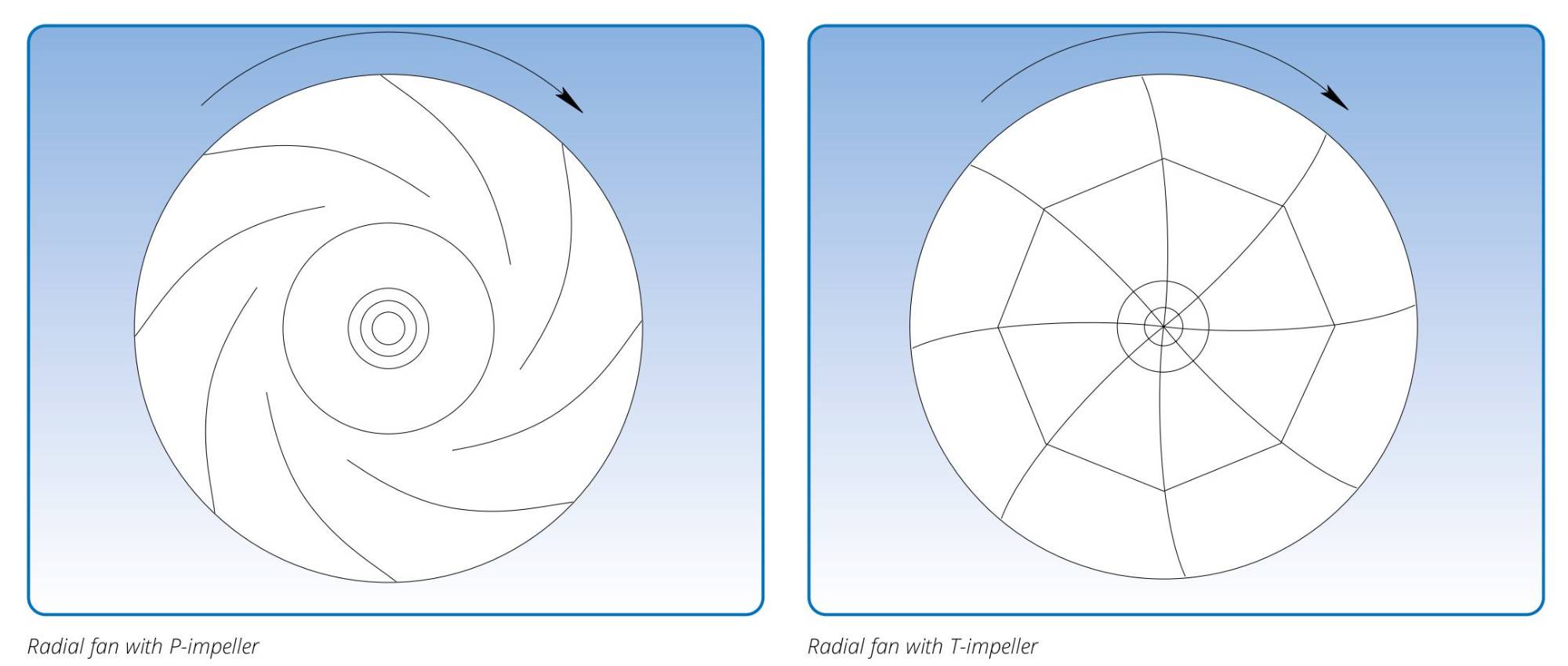
There are many types of fan impeller, each of which is designed for a given task:
Radial fan with P-impeller
Radial fan with T-impeller
Radial fan with P-impeller
Has flat backward-inclined blades and is designed for clean air transport. This type has the following properties:
High efficiency
Robust construction
Only small variations in volume flow if resistance fluctuates.
Radial fan with T-impeller
Has backward-inclined blades and is designed for transport of a range of materials.
This type has the following properties:
Medium and high-pressure versions
Robust construction
High degree of self-cleaning
Can handle large material volumes
Special version available for transport of plastic and paper
ATEX-certified in accordance with Directive 2014/34/EU.