

Google has unleashed a wave of major updates surrounding AI search, SEO policies, Chrome AI, and the Agentic Web. The core direction is driving the internet forward from the “era of search links” into the “AI Agent age.”
This means that in the future, websites will not just be read by humans, but must also be fetched, understood, summarized, cited, and even directly operated by AI. This article provides a highly readable summary of officially confirmed information from Google, trends worth watching, and immediate strategic adjustments for businesses and SEO teams.
In the past, Google's core mission was to help users find web pages. Now, Google's goal is shifting toward directly understanding web pages and utilizing AI to help users accomplish tasks.
Users input keywords, Google returns webpage links, and users click, compare, and evaluate by themselves.
Users voice complex requirements, and Google AI directly understands, summarizes, asks follow-up questions, and potentially executes tasks on behalf of the user.
This explains why AI Overviews, AI Mode, Agentic Search, Gemini, Chrome AI, and shopping experiences are all seeing heavy, simultaneous updates during this phase.
This section directly impacts website rankings, AI Overviews citation rates, technical SEO, content production methods, and structured data strategies. It is highly recommended to first read Google's official AI Search Optimization Guide and Helpful Content guide.
Officially Confirmed
Key Conclusion: GEO (Generative Engine Optimization) is not a new standalone framework separate from SEO. Google's AI search fundamentally remains built upon the foundations of traditional SEO.
Google AI Overviews, AI Mode, and generative search experiences still rely on:
Google discourages blindly chasing so-called GEO hacks, AI ranking tricks, llms.txt myths, AI-specific schemas, or AI content chunking gimmicks. What truly matters is whether the content is genuinely helpful to users and whether it is technically easy for Google to crawl and comprehend.
Evolution Chart: From Google SEO → GEO
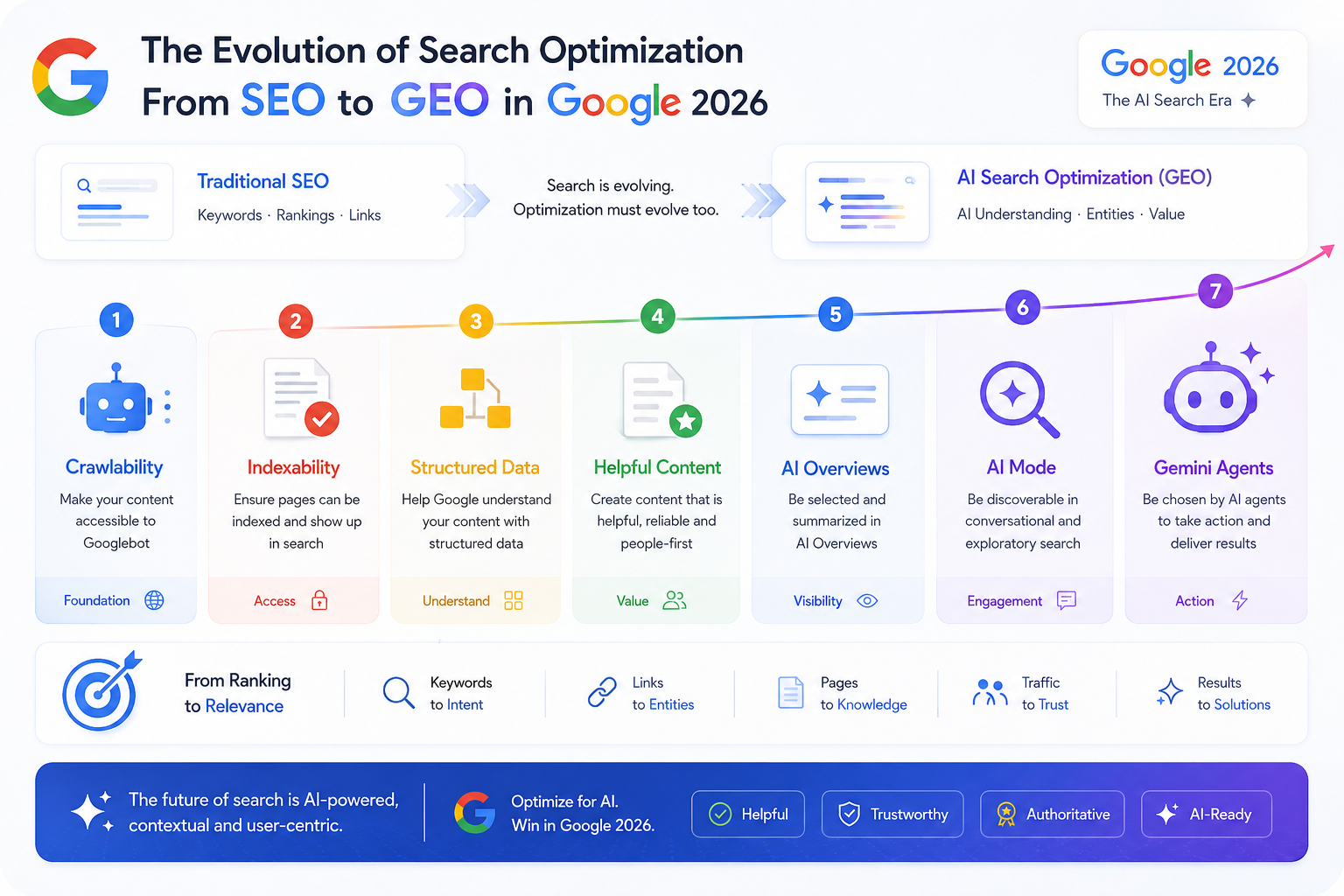
Officially Confirmed
Google has clarified in its official FAQPage structured data documentation that FAQ rich results are no longer displayed for the vast majority of standard commercial web pages, though certain highly authoritative public interest sites might still trigger them for specific queries. The past tactic of stuffing FAQ Schema to expand SERP footprint and inflate CTR has officially become obsolete for most commercial independent sites and regular pages.
Google now prefers letting AI directly understand the page, automatically extract Q&As, and generate answers within AI Mode or AI Overviews.
Comparison Chart: Old SEO vs New AI Search
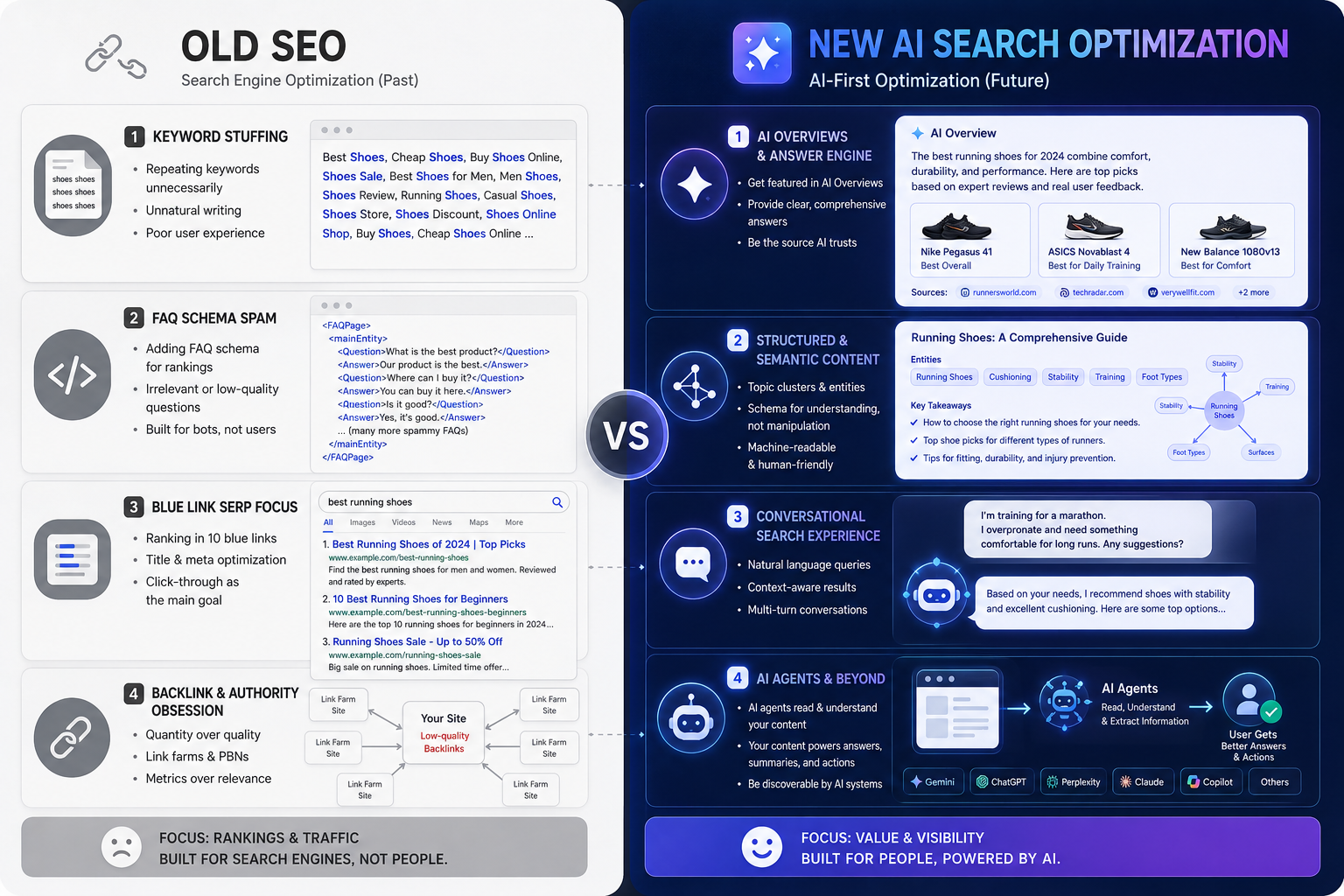
Direction Confirmed
Google has repeatedly emphasized across its Spam Policies, Helpful Content guidelines, and Search Off the Record podcasts: whether content is generated by AI is not the ultimate issue; the core criterion is whether the content provides real value, originality, and genuine user utility.
The focus shifts heavily toward Unique Non-Commodity Content moving forward:
This section addresses long-term internet evolutionary trends. Please rely on official Google conference announcement pages, the Google AI Blog, and the Google Developers Blog as primary authorities, given that certain features may still reside in preview or rolling rollout phases.
Subject to Official Releases
Google continues to deeply integrate Gemini model capabilities into Search, the Gemini App, and developer workflows, aiming to scale up AI summarization, multi-step reasoning, and multimodal understanding.
Trend Confirmed
The Search Box is evolving from a keyword input field into an AI conversation interface.
Still to be Observed
Google Search is no longer confined to returning standard blue links or textual descriptions; it is shifting toward generating real-time information cards, data dashboards, and interactive interfaces.
Core Change: Google Search is becoming "app-fied."
Direction Confirmed
AI is moving beyond merely answering queries to actively monitoring information, running tasks, and operating workflows on behalf of users.
Still to be Observed
Google is reinforcing its AI-driven shopping, product comparison, tailored recommendations, and checkout flows. For e-commerce sites, Product Feeds, Merchant Center optimization, and Product Structured Data will grow exponentially in importance.
Direction Confirmed
Google is progressively connecting personal contexts like Gmail, Photos, and Calendar into its AI suite, steering search into the Personal Context Search phase.
Direction Confirmed
AI is gaining a deeper conceptual grasp of video content. Users can interrogate videos, and the AI automatically pinpoints specific knowledge segments, navigating directly to the corresponding timestamp.
Video SEO Focus: Semantic context, knowledge density, and AI comprehensibility — going far beyond basic titles and descriptions.
This block dictates how future websites will be crawled, understood, and manipulated by AI Agents, rendering it potentially more vital than Search updates alone. For relevant official guidelines, refer to the Chrome Developers Blog, Chrome Built-in AI Documentation, and official Chrome DevTools Documentation.
Websites can expose structured tools, JavaScript functions, or HTML forms directly to browsers and AI Agents.
AI can automatically click, filter, fill out forms, or handle repetitive sequential workflows.
Streamlining modern authentication and login paths to make sign-in flows friendlier for AI operation chains.
| Update | Key Summary | Impact on Websites |
|---|---|---|
| Modern Web Guidance | Standardizes modern web practices that AI coding agents should follow when building websites. | AI-generated sites must align more precisely with actual frontend standards. |
| DevTools AI Debugging Agent | Chrome DevTools integrates automated debugging faculties. | Technical SEO and frontend troubleshooting become highly intelligent. |
| Lighthouse + AI Assistant | AI can interpret Lighthouse performance metrics and assist in diagnosis. | Performance optimization becomes significantly more automated. |
| Built-in AI | Executes AI functionalities natively within the local browser. | Alleviates server-side inference pressure and tokens expense. |
| SPA Core Web Vitals Update | Adjusts performance measuring paradigms for INP, LCP, etc., within Single Page Applications. | React, Next.js, and Vue websites must prioritize real user interaction performance. |
| Baseline Target | Maps out browser compatibility frameworks anchored on localized real-world traffic data. | Frontend cross-browser compatibility strategies grow sharper. |
A permanent AI companion resides natively in the mobile browser, making mobile AI search a primary entry point.
Allows users to circle and select any text or image on-screen as immediate context for Gemini.
Upgraded web-wide voice and multimodal input layers make Voice SEO increasingly critical.
Supports fine-grained, element-level view transitions to elevate overall web interaction fluidity.
Complex AI prompts can be neatly packaged into rapid browser-based shortcut utilities.
On-device image generation, transformation, or editing might become instantaneous on mobile web environments.
Differentiating these is vital, given the current influx of secondary regurgitations, over-interpretations, hallucinated AI expansions, and misconceptions across the SEO community. When pushing content, always separate official confirmations from forward-looking trend analysis.
Google is shifting away from rewarding “SEO tricks” and starting to reward “AI-comprehensible value.”
The Evolving Role of Future Websites
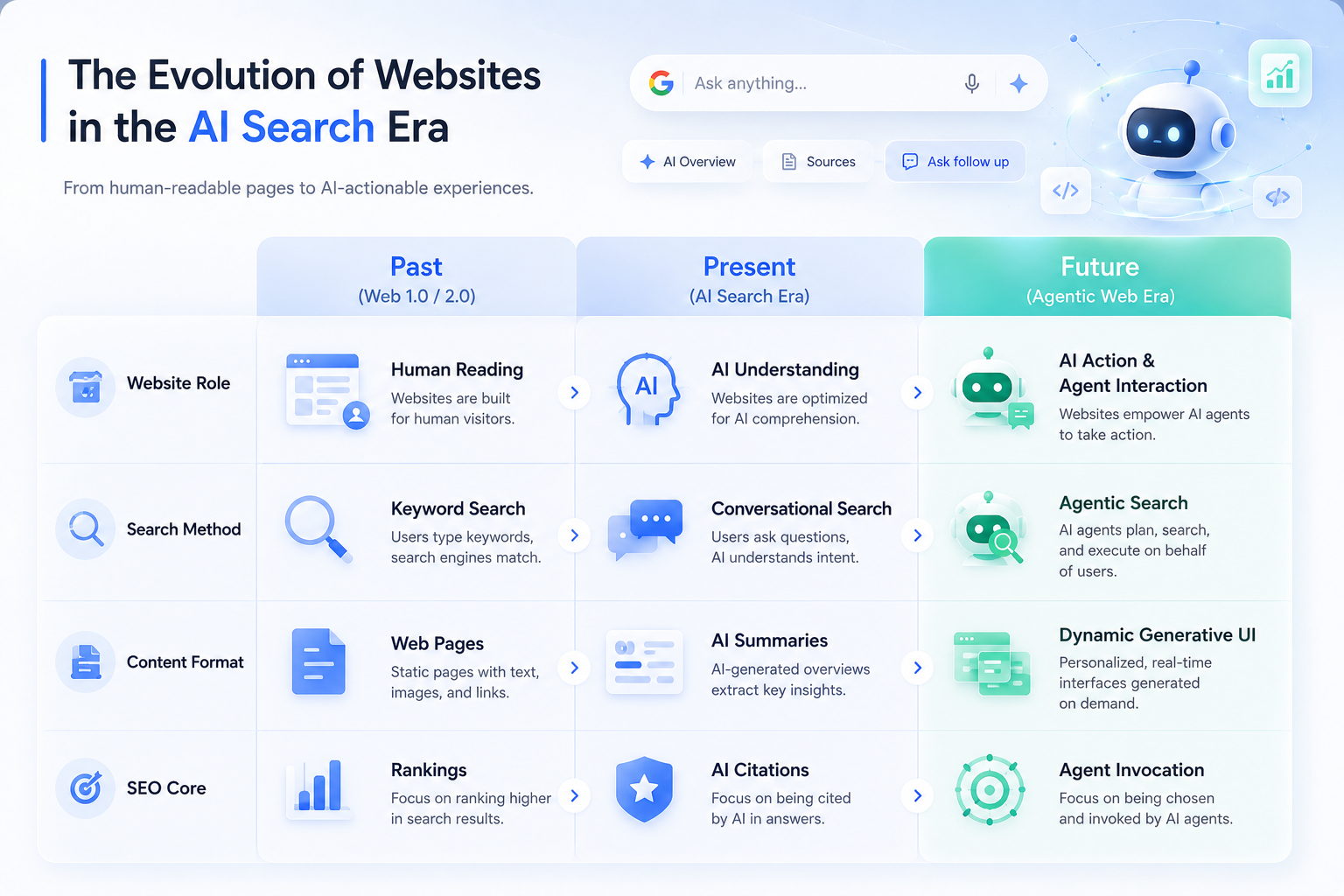
What will hold true value tomorrow are unique real-world experiences, hands-on tests, hard data, proprietary perspectives, and authoritative human insights.
Focus effort on optimizing headings, semantic HTML markup, structured data injection, authentic FAQs, and page modularity logic.
Websites require transparent action flows, highly standardized data sets, and structurally clear, actionable user interfaces.
AI Search may cause drops in CTR and organic clicks; hence, direct brand building, email nurturing, social ecosystems, video formats, and cross-platform presence become paramount.
In summary,
This massive wave of Google updates heralds a definitive paradigm shift: the internet is formally entering the AI Agent era.
Future winners will no longer be those who excel at stuffing keywords, bulk-producing programmatic AI content, or rigging Schema configurations. The winners will be those whose content is most readily understood by AI, offers undeniable real-world value, yields original breakthroughs, and delivers perfectly structured knowledge assets.

 Singapore