
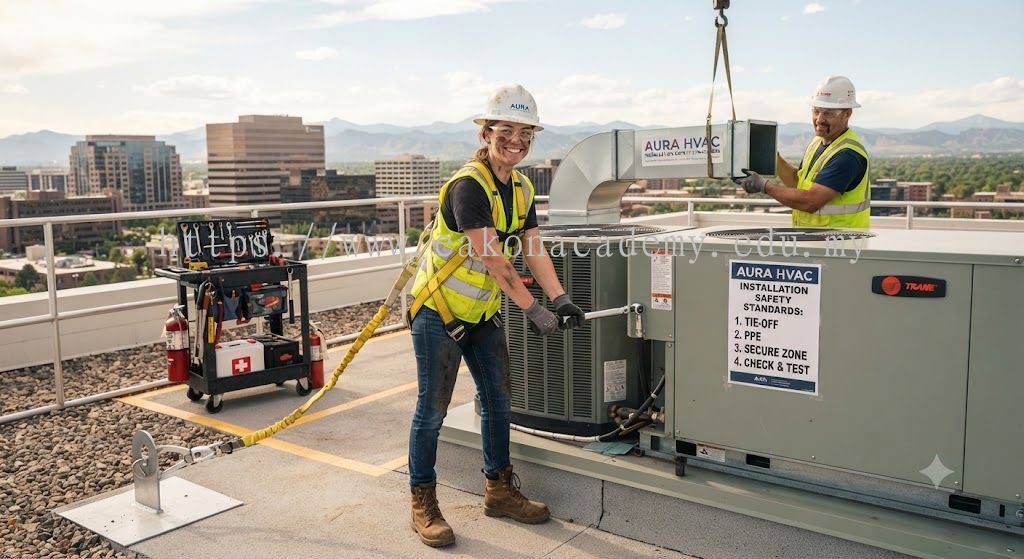
**Air Conditioning Contractor Installation Safety Standards: Best Practices for Safe and Professional HVAC Installations**
Air conditioning contractor installation safety standards are essential for ensuring that every HVAC installation project is completed safely, efficiently, and in compliance with industry regulations. Whether installing residential split air conditioners, commercial HVAC systems, VRF and VRV systems, rooftop package units, ducted air conditioning systems, or industrial cooling equipment, contractors must follow established safety procedures to protect workers, clients, and property. Safe installation practices reduce workplace accidents, improve equipment reliability, extend system lifespan, and enhance customer satisfaction. As the HVAC industry continues to grow and technology becomes more advanced, contractors are expected to maintain high levels of technical competency while strictly adhering to occupational safety requirements. At **Eakon Academy (eakonacadem.edu.my)**, we provide comprehensive HVAC safety and technical training programs that prepare air conditioning contractors with the practical knowledge, hands-on experience, and professional skills required to perform installations safely while meeting modern industry standards and workplace compliance requirements.
Every successful air conditioning installation begins with thorough planning and site assessment. Before commencing any installation work, contractors should conduct a detailed inspection of the installation site to identify potential hazards, structural limitations, electrical risks, confined spaces, work-at-height requirements, and environmental factors that may affect worker safety. A comprehensive risk assessment allows contractors to determine the safest installation methods while selecting appropriate tools, equipment, lifting techniques, and personal protective equipment (PPE). Proper planning also includes verifying equipment specifications, confirming electrical load capacity, assessing ventilation requirements, and ensuring adequate space for future maintenance activities. These preparation steps significantly reduce installation errors while improving overall project quality and efficiency.
Electrical safety is one of the most important installation safety standards for air conditioning contractors. Since HVAC systems operate using electrical power, technicians must follow strict lockout and tagout procedures before performing electrical connections or servicing energized equipment. Contractors should verify that power supplies are isolated, test circuits for the absence of voltage, and use insulated tools when working on electrical components. Proper grounding, circuit protection, cable management, and compliance with local electrical codes are essential to prevent electric shock, equipment damage, and fire hazards. Technicians should also ensure that circuit breakers, disconnect switches, and overload protection devices are correctly installed according to manufacturer specifications and applicable safety regulations.
Safe manual handling and lifting procedures are equally important during air conditioning installations. Outdoor condensing units, compressors, air handling units, ductwork, copper piping, refrigerant cylinders, and installation materials can be heavy and difficult to transport. Contractors should use mechanical lifting equipment, lifting straps, cranes, trolleys, or team lifting techniques whenever appropriate to minimize musculoskeletal injuries. Proper lifting posture, load assessment, and careful route planning help reduce strain while preventing accidents caused by dropped equipment. Good housekeeping practices, including keeping work areas organized and free from trip hazards, further contribute to a safer installation environment.
Many air conditioning installations require contractors to perform work at elevated locations such as rooftops, balconies, ceiling spaces, elevated platforms, or external building walls. Therefore, installation safety standards include comprehensive work-at-height requirements. Contractors should use properly inspected ladders, scaffolding, mobile elevated work platforms (MEWPs), or permanent access systems based on the specific task. Where fall hazards exist, workers should wear certified fall protection equipment including full-body harnesses, shock-absorbing lanyards, and approved anchorage systems. Roof edge protection, exclusion zones, and continuous supervision should be implemented to minimize fall risks. Weather conditions such as rain, strong winds, and lightning should also be monitored, with work suspended whenever environmental conditions create unsafe working environments.
Safe refrigerant handling is another fundamental component of air conditioning contractor installation safety standards. Modern HVAC systems use refrigerants that require careful handling to protect both technicians and the environment. Contractors should follow proper charging procedures, leak testing methods, evacuation techniques, and refrigerant recovery practices while using calibrated gauges, vacuum pumps, recovery machines, and electronic leak detectors. Flammable refrigerants such as R290 require additional precautions, including proper ventilation, ignition source control, gas detection equipment, and specialized handling procedures. Compliance with environmental regulations and refrigerant management standards helps reduce greenhouse gas emissions while supporting sustainable HVAC practices.
The use of appropriate personal protective equipment is essential throughout every stage of the installation process. Air conditioning contractors should wear safety helmets, eye protection, gloves, safety footwear, hearing protection, respiratory protection when necessary, and high-visibility clothing depending on the work environment. PPE should be inspected regularly and replaced whenever damaged or worn. However, PPE should always complement—not replace—effective hazard control measures, proper work planning, and safe operating procedures. Combining engineering controls, administrative controls, and personal protection creates a comprehensive safety management approach for HVAC installation projects.
Professional competency and continuous training remain the foundation of effective installation safety standards. Air conditioning contractors should receive regular training in electrical safety, refrigerant handling, brazing techniques, pressure testing, work-at-height safety, confined space awareness, risk assessment, emergency response, and equipment-specific installation procedures. Ongoing education ensures technicians remain current with evolving technologies, updated regulations, manufacturer recommendations, and industry best practices. Skilled contractors are better equipped to identify hazards, solve installation challenges, and deliver high-quality workmanship while maintaining safe working conditions.
At **Eakon Academy (eakonacadem.edu.my)**, we are committed to developing competent HVAC professionals through industry-relevant training programs that combine technical excellence with workplace safety. Our courses emphasize practical learning, regulatory compliance, and hands-on experience to help air conditioning contractors meet the highest installation safety standards. By following established air conditioning contractor installation safety standards, HVAC companies can reduce workplace accidents, improve installation quality, protect valuable equipment, strengthen customer confidence, and enhance long-term business success. Safe installation practices not only safeguard technicians and clients but also contribute to reliable system performance, energy efficiency, environmental responsibility, and a professional reputation that supports sustainable growth in the competitive HVAC industry.
 Malaysia
