
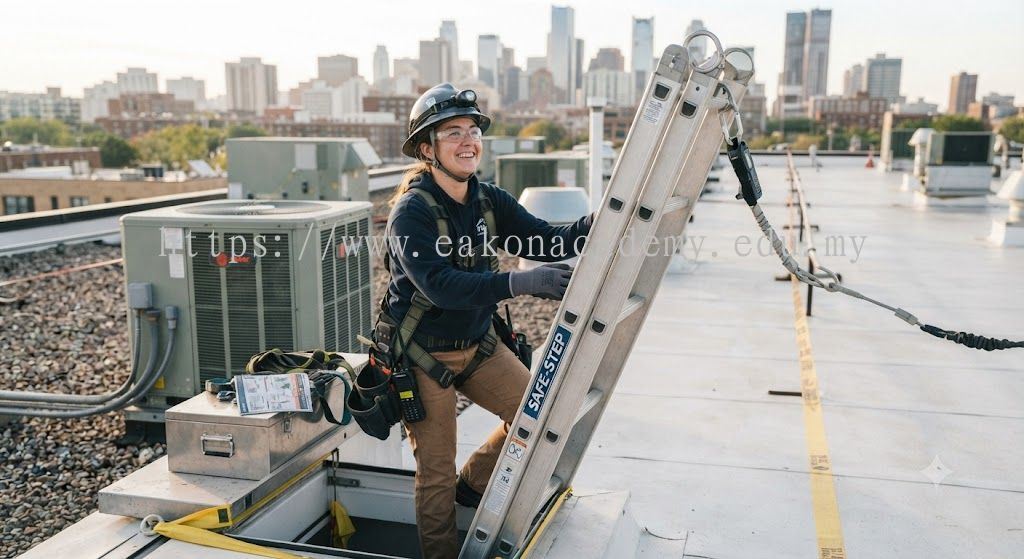
HVAC Ladder and Rooftop Fall Safety Procedures: Essential Safety Guide for HVAC Technicians
HVAC installation, servicing, and maintenance activities frequently require technicians to work in elevated locations such as rooftops, commercial buildings, industrial facilities, and high-rise properties. Accessing rooftop air conditioning units, outdoor condensers, VRF and VRV systems, and ventilation equipment often involves the use of ladders and rooftop access areas. Without proper preparation and safety knowledge, technicians may face serious hazards including falls, unstable surfaces, incorrect ladder usage, and unsafe working conditions. Therefore, understanding HVAC ladder and rooftop fall safety procedures is essential to protect technicians, improve workplace safety, and ensure professional air conditioning operations. At Eakon Academy (eakonacadem.edu.my), our HVAC training programmes focus on providing technicians with practical skills and safety awareness required for modern HVAC installation and maintenance environments.
Working at height is one of the most important safety concerns in the HVAC industry. Many air conditioning systems are installed in locations where technicians must climb ladders, walk on rooftops, and perform maintenance tasks near elevated edges. These activities require proper safety procedures to reduce the risk of falls and injuries. A complete understanding of ladder safety, rooftop inspection, fall protection equipment, and emergency procedures helps technicians perform their work more confidently and professionally.
The first step in HVAC ladder and rooftop fall safety procedures is conducting a proper working at height risk assessment before starting any task. Technicians should inspect the workplace and identify potential hazards such as uneven surfaces, slippery rooftops, roof edges, fragile structures, electrical equipment, weather conditions, and unsafe access points. A detailed risk assessment allows technicians to select suitable safety equipment and establish safe working practices before accessing elevated areas.
Ladder safety is a critical component of HVAC maintenance safety. Technicians often use ladders to access indoor units, outdoor condensers, ceiling areas, and rooftop equipment. Before using a ladder, technicians should inspect the ladder condition, including steps, rails, locking mechanisms, and feet. Damaged or unstable ladders should not be used. Selecting the correct ladder type and ensuring proper positioning helps reduce the possibility of slips, falls, and loss of balance.
Proper ladder setup is essential for safe HVAC work. The ladder should be placed on a stable and level surface to prevent movement during use. Technicians should maintain three points of contact while climbing, avoid overreaching, and keep their body positioned within the ladder’s safe working area. Carrying heavy tools while climbing should be avoided, and suitable tool bags or lifting methods should be used to maintain stability.
Rooftop safety is another important part of HVAC fall prevention. Technicians working on rooftops should inspect the area before beginning maintenance activities. Important considerations include roof condition, access routes, roof edges, obstacles, ventilation openings, and weather conditions. Wet surfaces, strong winds, poor lighting, and extreme temperatures can increase accident risks and should be considered before work begins.
Fall protection equipment plays an important role in rooftop HVAC safety procedures. Technicians working near roof edges or elevated areas should understand the correct use of safety harnesses, lanyards, self-retracting lifelines (SRLs), connectors, and approved anchor points. Proper inspection and correct usage of fall protection systems help prevent serious injuries during unexpected fall situations.
Safety harness inspection should be included before every rooftop maintenance task. Technicians should check harness straps, stitching, buckles, D-rings, and connectors for signs of damage or wear. A properly fitted full-body harness provides better protection and allows technicians to move safely while performing HVAC maintenance activities.
Anchor point selection is also essential during rooftop HVAC work. Fall protection equipment should only be connected to approved anchorage systems designed to support fall forces. Technicians should never attach safety equipment to unsuitable structures such as pipes, ductwork, electrical conduits, or temporary supports because these may fail during a fall event.
Personal protective equipment (PPE) is required to improve technician safety during ladder and rooftop activities. Suitable PPE may include safety helmets with chin straps, safety footwear, protective gloves, safety glasses, and high-visibility clothing. Anti-slip footwear is especially important when working on rooftops because it improves stability and reduces the risk of slipping.
Tool management is another important safety procedure for HVAC technicians working at height. Tools, materials, and replacement parts should be secured properly to prevent dropped objects. Using tool bags, tool belts, and tool lanyards helps maintain control of equipment and protects workers below.
Electrical safety must also be considered during rooftop HVAC maintenance. Technicians often work near electrical components such as compressors, control panels, wiring systems, and motors. Proper electrical isolation procedures and safe testing methods help prevent electrical accidents while working at height.
Emergency rescue planning is an important part of HVAC rooftop safety procedures. If a technician falls while using a harness system, quick rescue action is required to reduce the risk of suspension trauma. Employers should prepare rescue plans, emergency communication methods, first aid procedures, and suitable rescue equipment.
Continuous safety training ensures HVAC technicians remain competent and aware of workplace hazards. Professional training should include ladder safety, rooftop access procedures, fall protection systems, risk assessment, PPE requirements, and emergency response methods. Well-trained technicians are better prepared to handle challenging HVAC environments safely.
At Eakon Academy (eakonacadem.edu.my), we provide professional HVAC training programmes designed to prepare technicians for real-world industry requirements. Our courses cover air conditioning installation, servicing, maintenance, troubleshooting, working at height safety, ladder safety procedures, rooftop safety practices, fall protection equipment, electrical safety, refrigerant handling, and industry best practices. Through practical hands-on training, students gain the knowledge and confidence required to perform HVAC work safely and professionally. By applying proper HVAC Ladder and Rooftop Fall Safety Procedures, technicians can reduce workplace risks, improve service quality, protect themselves and others, comply with safety expectations, and build successful careers in the HVAC industry.
Lebih maklumat tentang EAKON ACADEMY SDN BHD Malaysia
