
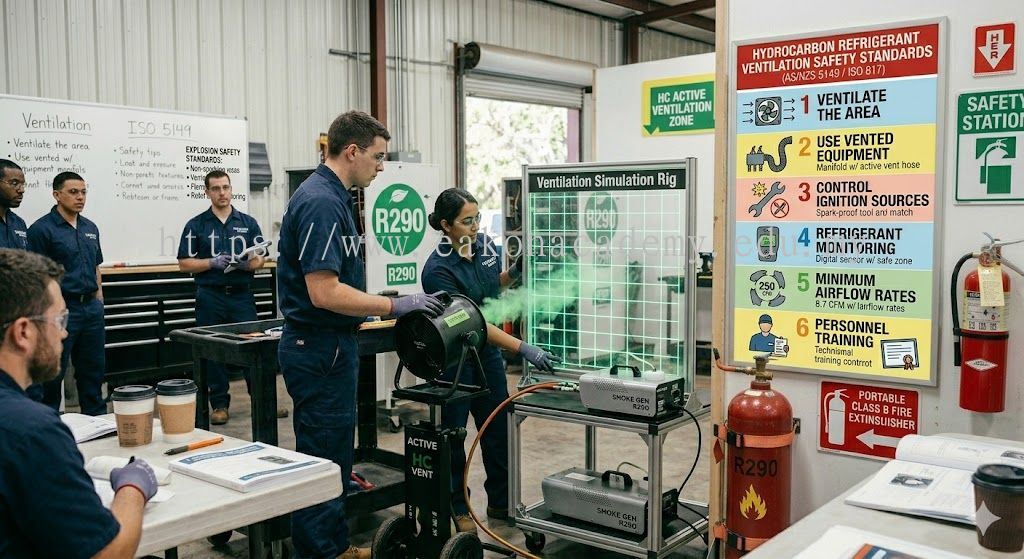
HYDROCARBON REFRIGERANT VENTILATION SAFETY STANDARDS FOR SAFE AIRFLOW DESIGN, LEAK CONTROL, AND COMPLIANT HVAC-R SYSTEM OPERATION
Hydrocarbon refrigerant ventilation safety standards are essential engineering and safety guidelines that ensure proper airflow design and safe environmental conditions in HVAC-R systems using hydrocarbon (HC) refrigerants such as propane (R290) and isobutane (R600a). As the HVAC industry increasingly adopts environmentally friendly refrigerants with low global warming potential (GWP), hydrocarbon refrigerants have become widely used due to their high energy efficiency, excellent cooling performance, and reduced environmental impact. However, because HC refrigerants are classified as flammable substances, strict ventilation safety standards are required to prevent gas accumulation, reduce fire and explosion risks, and ensure safe system operation. At eakonacadem.edu.my, we provide professional HVAC education and technical training that supports the correct understanding and application of hydrocarbon refrigerant ventilation safety standards for industry professionals.
Hydrocarbon refrigerant ventilation safety standards are designed to ensure that any leaked refrigerant is quickly dispersed and diluted to safe concentration levels. These standards apply to residential, commercial, and industrial HVAC installations and cover key areas such as airflow design, natural and mechanical ventilation requirements, system placement, leak dispersion control, safety zoning, and emergency airflow strategies. Proper ventilation design is one of the most important safety measures when working with flammable refrigerants.
One of the key aspects of hydrocarbon refrigerant ventilation safety standards is proper airflow design. HVAC systems must be installed in environments where air can circulate freely to prevent the buildup of flammable gas concentrations. Engineers must consider room size, air exchange rates, and airflow direction to ensure that any leaked refrigerant is rapidly diluted and safely removed from the occupied space.
Natural ventilation is also an important component of ventilation safety standards. In many installations, openings such as vents, louvers, or windows are used to allow fresh air to enter and stale air to exit. Natural ventilation helps reduce refrigerant concentration levels in the event of a leak and provides a passive safety mechanism that does not rely on mechanical systems.
Mechanical ventilation systems play a critical role in hydrocarbon refrigerant ventilation safety standards, especially in enclosed or high-risk environments. Exhaust fans, air handling units, and dedicated ventilation systems must be designed to activate when refrigerant leaks are detected. These systems help quickly remove flammable gases and maintain safe atmospheric conditions.
Safety zoning and equipment placement are also essential parts of ventilation standards. HVAC systems using hydrocarbon refrigerants must be installed in locations that minimize exposure to ignition sources and ensure proper airflow distribution. Proper zoning helps isolate potential leak areas and enhances overall system safety.
Leak dispersion control is another key requirement in ventilation safety standards. Engineers must design systems that ensure leaked refrigerant does not accumulate in low-lying or confined areas where flammable concentrations could develop. Proper airflow modeling and ventilation design help mitigate these risks.
Emergency ventilation strategies are also included in hydrocarbon refrigerant ventilation safety standards. In the event of a leak or system failure, emergency ventilation systems must activate to rapidly disperse refrigerant gases and reduce hazard levels. These systems are critical for protecting both equipment and personnel.
Maintenance and inspection of ventilation systems are essential to ensure long-term safety compliance. Regular checks must be conducted to verify that ventilation systems are functioning correctly and that airflow pathways are not obstructed. Proper maintenance ensures continued system reliability and safety.
Technician training is also a vital component of ventilation safety standards. HVAC professionals must understand how ventilation affects refrigerant safety and how to design, install, and maintain systems that meet safety requirements. Proper training ensures that ventilation strategies are correctly implemented in real-world applications.
At eakonacadem.edu.my, we emphasize the importance of professional HVAC education related to hydrocarbon refrigerant ventilation safety standards. Through structured training programs and practical learning, technicians gain the knowledge and skills required to design and maintain safe ventilation systems for modern HVAC installations.
Furthermore, adherence to ventilation safety standards supports environmental sustainability by ensuring that hydrocarbon refrigerants are safely managed and do not contribute to hazardous emissions. Proper ventilation design enhances both safety and environmental responsibility.
In conclusion, hydrocarbon refrigerant ventilation safety standards are essential for ensuring safe, efficient, and compliant HVAC-R system operation. By following proper guidelines for airflow design, natural and mechanical ventilation, leak dispersion control, safety zoning, emergency ventilation, and maintenance, HVAC professionals can significantly reduce risks while improving system performance. This comprehensive approach strengthens HVAC education and makes it a key focus area for training platforms like eakonacadem.edu.my.
Lebih maklumat tentang EAKON ACADEMY SDN BHD Malaysia
