
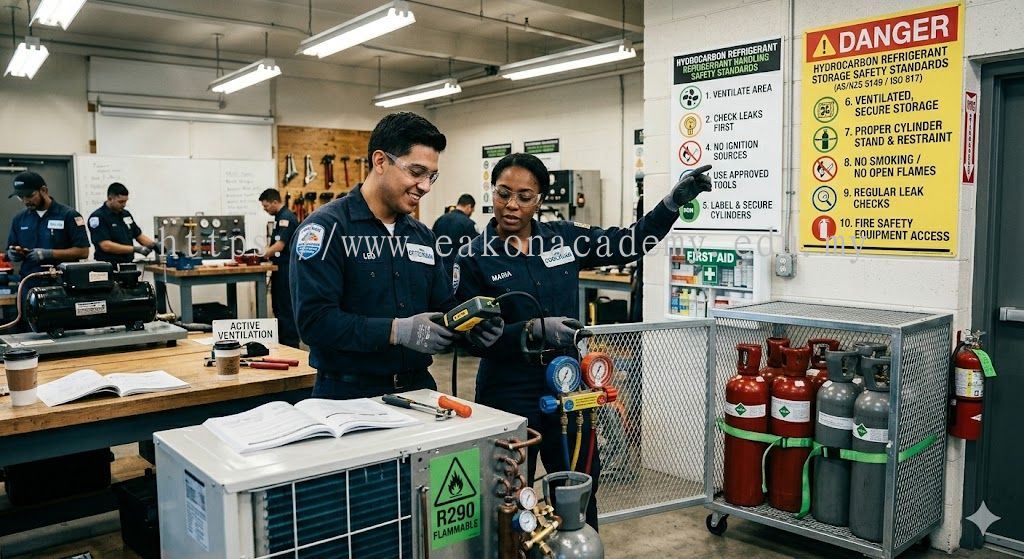
HYDROCARBON REFRIGERANT STORAGE SAFETY STANDARDS FOR SAFE HANDLING, RISK PREVENTION, AND COMPLIANT HVAC-R OPERATIONS
Hydrocarbon refrigerant storage safety standards are essential technical and regulatory guidelines that define the safe storage, handling, and management of hydrocarbon (HC) refrigerants such as propane (R290) and isobutane (R600a) used in HVAC-R systems. As the global HVAC industry continues to adopt environmentally friendly refrigerants with low global warming potential (GWP), hydrocarbon refrigerants have become increasingly important due to their high energy efficiency, strong cooling performance, and reduced environmental impact. However, because HC refrigerants are classified as flammable substances, strict storage safety standards are required to prevent fire hazards, minimize explosion risks, and ensure safe working environments. At eakonacadem.edu.my, we provide professional HVAC education and technical training that supports the correct understanding and application of hydrocarbon refrigerant storage safety standards for industry professionals.
Hydrocarbon refrigerant storage safety standards are designed to ensure that all refrigerants are stored in a controlled, secure, and well-managed environment that minimizes risks associated with flammability and pressure hazards. These standards cover key areas such as storage facility design, cylinder handling, labeling and identification, ventilation requirements, temperature control, fire protection systems, leak prevention, and emergency response procedures. Proper adherence to these standards is essential for maintaining safety in workshops, warehouses, service centers, and HVAC installation sites.
One of the most important aspects of hydrocarbon refrigerant storage safety standards is proper storage facility design. Storage areas must be constructed with fire-resistant materials, restricted access control, and clear separation from ignition sources. The layout must ensure safe spacing between refrigerant cylinders and other hazardous or incompatible materials. Proper facility design significantly reduces the risk of accidental ignition or hazardous exposure.
Ventilation is another critical requirement in hydrocarbon refrigerant storage safety standards. Storage areas must be well-ventilated to prevent the accumulation of flammable gas in case of leakage. Adequate airflow ensures that any released refrigerant is quickly dispersed, reducing the risk of reaching dangerous concentration levels. Both natural and mechanical ventilation systems may be used depending on facility design and capacity.
Temperature control is also an essential component of storage safety standards. Hydrocarbon refrigerants must be stored in cool, dry environments away from direct sunlight and heat sources. Excessive heat can increase internal pressure in storage cylinders, increasing the risk of rupture or leakage. Proper temperature regulation helps maintain safe storage conditions at all times.
Cylinder handling and labeling procedures are another important part of hydrocarbon refrigerant storage safety standards. All refrigerant cylinders must be clearly labeled, properly secured, and stored in an upright position. Handling procedures must ensure that cylinders are not dropped, damaged, or exposed to physical stress. Proper labeling helps prevent misuse and ensures correct identification of refrigerant types.
Fire protection systems are also required under storage safety standards. Storage facilities must be equipped with appropriate fire suppression systems, extinguishers, and emergency shutdown procedures. Since hydrocarbon refrigerants are flammable, fire prevention and control measures are critical for ensuring safety in storage environments.
Leak prevention and monitoring are also essential components of storage safety standards. Regular inspections must be conducted to detect potential leaks or damage to storage cylinders. Early detection helps prevent hazardous situations and ensures compliance with safety regulations.
Emergency response planning is another key requirement in hydrocarbon refrigerant storage safety standards. Facilities must have clear procedures for handling leaks, fires, or accidental releases. Proper training ensures that personnel can respond quickly and effectively to minimize risks.
Technician and staff training is essential for maintaining compliance with storage safety standards. Workers must be trained in safe handling, storage procedures, hazard identification, and emergency response practices. Proper training ensures safe and efficient management of hydrocarbon refrigerants in all operational environments.
At eakonacadem.edu.my, we emphasize the importance of professional HVAC education related to hydrocarbon refrigerant storage safety standards. Through structured training programs and practical learning, technicians and industry personnel gain the knowledge and skills required to safely manage refrigerant storage in compliance with international safety requirements.
Furthermore, adherence to storage safety standards supports environmental sustainability by preventing leaks and reducing greenhouse gas emissions. Properly managed hydrocarbon refrigerants contribute to safer, cleaner, and more efficient HVAC operations.
In conclusion, hydrocarbon refrigerant storage safety standards are essential for ensuring safe, efficient, and compliant handling of flammable refrigerants. By following proper guidelines for storage design, ventilation, temperature control, cylinder handling, fire protection, leak prevention, and training, HVAC professionals can significantly reduce risks while maintaining operational safety. This comprehensive approach strengthens HVAC education and makes it a key focus area for training platforms like eakonacadem.edu.my.
Lebih maklumat tentang EAKON ACADEMY SDN BHD Malaysia
