
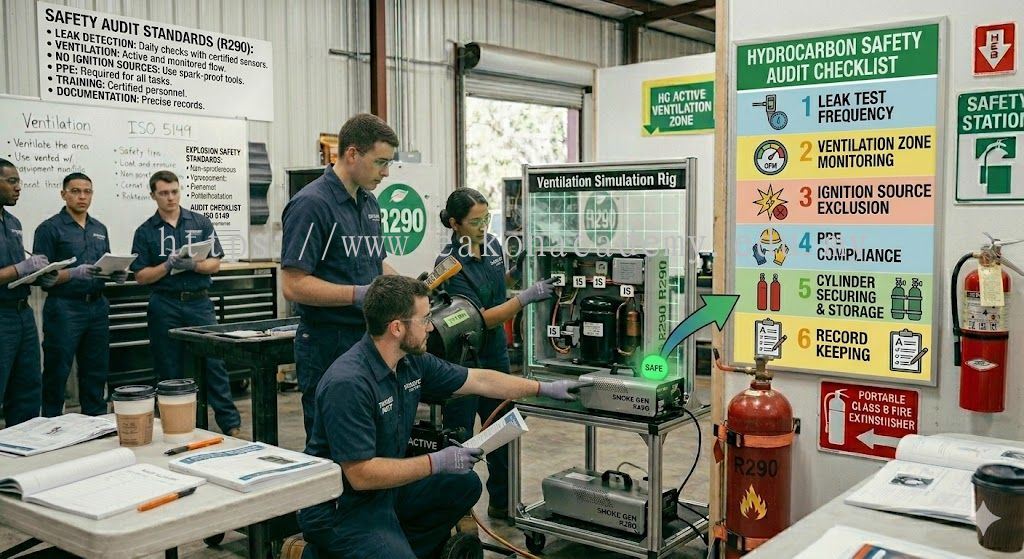
HYDROCARBON REFRIGERANT SAFETY AUDIT STANDARDS FOR COMPLIANCE, RISK CONTROL, AND HIGH-QUALITY HVAC-R SYSTEM PERFORMANCE
Hydrocarbon refrigerant safety audit standards are essential evaluation and compliance guidelines used to assess the safety, performance, and regulatory conformity of HVAC-R systems that utilize hydrocarbon (HC) refrigerants such as propane (R290) and isobutane (R600a). As the HVAC industry continues to adopt environmentally friendly refrigerants with low global warming potential (GWP), hydrocarbon refrigerants have become a preferred choice due to their high energy efficiency, excellent cooling performance, and reduced environmental impact. However, because HC refrigerants are classified as flammable substances, structured safety audit standards are required to ensure that all systems are properly designed, installed, operated, and maintained in accordance with international safety expectations. At eakonacadem.edu.my, we provide professional HVAC education and technical training that supports the correct understanding and application of hydrocarbon refrigerant safety audit standards for industry professionals.
Hydrocarbon refrigerant safety audit standards are designed to systematically evaluate HVAC systems for potential risks, non-compliance issues, and operational safety concerns. These audits cover key areas such as system design verification, installation quality assessment, refrigerant charge control, leak detection performance, electrical safety compliance, ventilation effectiveness, maintenance practices, and technician competency. By following structured audit procedures, HVAC professionals can ensure that hydrocarbon refrigerant systems operate safely, efficiently, and in full compliance with regulatory requirements.
One of the primary objectives of safety audit standards is system design verification. During an audit, engineers evaluate whether the HVAC system has been properly designed to handle flammable refrigerants. This includes checking refrigerant charge limits, equipment placement, airflow design, and safety margins. Proper design verification ensures that the system minimizes risks associated with refrigerant leakage and flammable gas accumulation.
Installation quality assessment is another critical component of hydrocarbon refrigerant safety audits. Auditors inspect piping connections, brazing quality, system sealing, and overall workmanship to ensure that installation procedures meet safety standards. Poor installation practices can lead to refrigerant leaks, which increase the risk of fire or explosion in HC refrigerant systems.
Refrigerant charge control is also evaluated during safety audits. Auditors verify that the correct refrigerant quantity has been charged according to manufacturer specifications and safety guidelines. Overcharging or undercharging can impact system performance and increase operational risks, making accurate charge control essential for compliance.
Electrical safety compliance is a key focus area in hydrocarbon refrigerant safety audit standards. Auditors check electrical wiring, grounding, insulation, and protective devices to ensure that systems are properly designed to prevent sparks or electrical faults. Since hydrocarbon refrigerants are flammable, electrical safety plays a crucial role in preventing ignition hazards.
Ventilation effectiveness is another important audit requirement. Proper airflow must be maintained in all areas where hydrocarbon refrigerant systems are installed. Auditors assess whether ventilation systems are capable of preventing refrigerant accumulation and maintaining safe operating conditions in enclosed environments.
Leak detection and maintenance practices are also evaluated during safety audits. HVAC systems must undergo regular inspection using approved leak detection methods to ensure system integrity. Preventive maintenance helps identify potential issues early and ensures continued system safety and efficiency.
Technician competency and training are also assessed under hydrocarbon refrigerant safety audit standards. Auditors verify whether technicians are properly trained in handling flammable refrigerants, performing safe installation procedures, and following maintenance protocols. Skilled personnel are essential for maintaining compliance and safe system operation.
At eakonacadem.edu.my, we emphasize the importance of professional HVAC education related to hydrocarbon refrigerant safety audit standards. Through structured training programs and practical learning, technicians gain the knowledge required to understand audit processes, identify risks, and ensure compliance with international safety requirements.
Furthermore, safety audits support environmental sustainability by ensuring that hydrocarbon refrigerant systems operate efficiently and with minimal leakage. Properly maintained systems reduce greenhouse gas emissions and contribute to global climate protection efforts.
In conclusion, hydrocarbon refrigerant safety audit standards are essential for ensuring safe, efficient, and compliant HVAC-R system operation. By following proper audit procedures for system design, installation quality, refrigerant control, electrical safety, ventilation, maintenance, and technician training, HVAC professionals can significantly reduce risks while improving system performance. This comprehensive approach strengthens HVAC education and makes it a key focus area for training platforms like eakonacadem.edu.my.
Lebih maklumat tentang EAKON ACADEMY SDN BHD Malaysia
