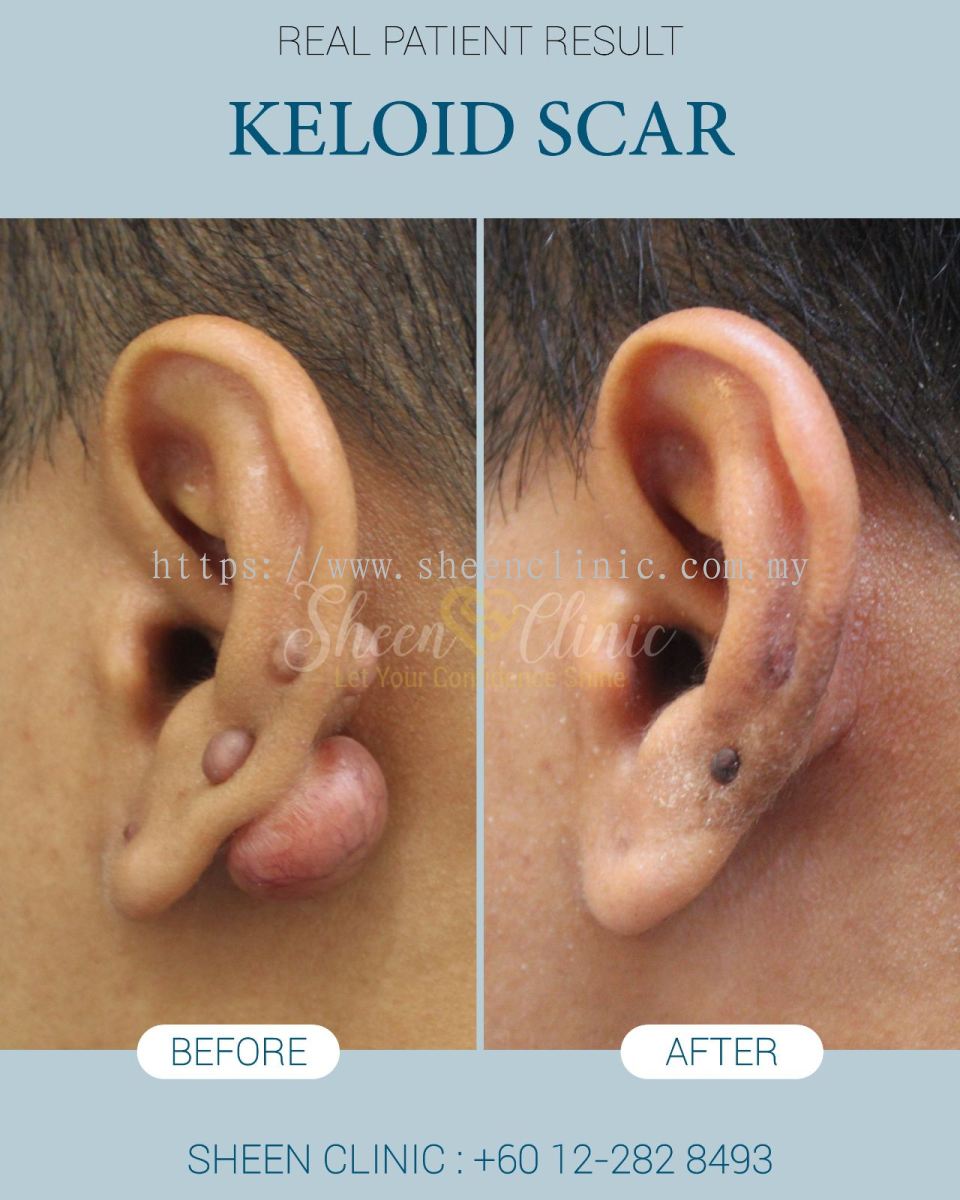
Looking for keloid treatment in Subang Jaya? Keloids are raised scars caused by excessive collagen production during wound healing. Unlike normal scars, keloids continue to grow beyond the original wound and rarely disappear without treatment.
At Sheen Clinic, we provide personalised keloid treatment based on the size, location, symptoms and previous treatment history of your scar. Depending on your condition, treatment may include corticosteroid injections, cryotherapy, laser therapy, silicone scar management or carefully selected surgical removal combined with recurrence prevention.
Keloids are overgrown scars caused by excessive collagen production.
They may continue growing months or even years after the skin has healed.
Common symptoms include raised scars, itching, pain, redness and cosmetic concerns.
Early treatment usually provides better outcomes than waiting for the scar to become larger.
Combination therapy often provides better long-term improvement than a single treatment.
Every keloid is different, and treatment should be individualised after assessment by an experienced doctor.
A keloid is an abnormal scar that develops when the body's wound healing process produces excessive collagen. Instead of stopping once the skin has healed, collagen production continues, causing the scar to grow beyond the boundaries of the original injury.
Keloids are benign, meaning they are not cancerous and cannot spread to other parts of the body. However, they can continue enlarging over time and may become uncomfortable or affect self-confidence.
Unlike normal scars that gradually flatten and soften, keloids often remain raised, firm and noticeable for many years if left untreated.
Keloids occur because the skin produces too much collagen during healing.
They may develop after:
Ear piercing
Surgical wounds
Caesarean section scars
Acne scars
Chickenpox scars
Burns
Cuts
Vaccination scars (including BCG scars)
Insect bites
Skin infections
Minor injuries that appear insignificant
Sometimes patients cannot even remember the original injury.
Although anyone can develop a keloid, the risk is higher in people who:
Have a family history of keloids
Have darker skin types
Are between 10 and 30 years old
Have previously developed keloids
Experience delayed wound healing
If you have developed one keloid before, your risk of developing another is significantly higher.
Keloids can occur almost anywhere but are most commonly found on:
Earlobes after ear piercing
Chest
Shoulders
Upper back
Neck
Jawline
Abdomen after surgery
Caesarean section scars
Arms after vaccination
Acne-prone areas
Some body areas have a higher tendency to develop keloids because they are exposed to greater skin tension during healing.
A keloid may appear as:
Raised scar
Thick scar tissue
Firm lump
Pink, red or dark brown scar
Smooth shiny surface
Itching
Tenderness
Pain when touched
Cosmetic concern
Progressive enlargement
Some patients experience persistent itchiness that affects sleep or daily comfort.
Many patients confuse hypertrophic scars with keloids.
| Feature | Hypertrophic Scar | Keloid |
|---|---|---|
| Growth Pattern | Stays within the boundaries of the original wound | Extends beyond the original wound and invades surrounding normal skin |
| Appearance | Raised, thick and sometimes red | Raised, firm, smooth and may continue enlarging over time |
| Time of Development | Usually develops within weeks after injury | May develop several months after the skin has healed |
| Natural Progression | Often flattens and improves naturally over months to years | Rarely improves without treatment and may continue growing |
| Symptoms | May be itchy or mildly uncomfortable | Frequently itchy, tender, painful or sensitive |
| Common Locations | Areas with high skin tension, such as joints or surgical wounds | Chest, shoulders, upper back, jawline and earlobes are particularly prone |
| Risk of Recurrence | Lower after treatment | Higher recurrence rate, especially if treated with surgery alone |
| Treatment Approach | Observation, silicone therapy, steroid injections or laser treatment | Often requires combination therapy, such as corticosteroid injections, cryotherapy, laser therapy, silicone scar management or surgery with recurrence prevention |
Unfortunately, true keloids rarely disappear on their own.
Some scars may soften slightly over time, but most remain raised and continue to cause symptoms unless treated.
Early intervention generally provides better cosmetic improvement and may prevent further enlargement.
Diagnosis is usually made through a clinical examination.
During your consultation, your doctor will assess:
Size
Thickness
Colour
Symptoms
Previous treatments
Duration
Growth pattern
Location
Possible causes
Most patients do not require laboratory tests or scans.
Every patient receives an individualised treatment plan because no single treatment works for every keloid.
Steroid injection remains one of the most commonly used treatments for keloids.
It works by:
Reducing inflammation
Decreasing collagen production
Softening the scar
Reducing itchiness
Flattening raised tissue
Several treatment sessions are often required depending on the scar.
Cryotherapy freezes the abnormal scar tissue using extremely low temperatures.
It may help:
Reduce scar thickness
Improve texture
Flatten smaller keloids
Cryotherapy is often combined with steroid injections for better outcomes.
Laser treatment may improve:
Redness
Pigmentation
Blood vessels supplying the scar
Overall cosmetic appearance
Laser therapy is frequently used as part of combination treatment rather than as a standalone solution.
Medical-grade silicone products may help:
Reduce symptoms
Improve scar hydration
Support scar maturation
Reduce discomfort
Silicone therapy is commonly recommended after surgery or alongside other treatments.
Large keloids may occasionally require surgery.
However, surgery alone carries a significant risk of recurrence.
For this reason, surgical removal is often combined with additional therapies such as steroid injections, silicone therapy or other preventive treatments to reduce the chance of the keloid returning.
Research and clinical experience have shown that combining different treatments often produces better results than relying on a single treatment.
Treatment may include:
Steroid injection
Cryotherapy
Laser therapy
Silicone scar management
Surgery when appropriate
The ideal combination depends on the individual patient and the characteristics of the keloid.
Most treatments are performed as outpatient procedures.
The consultation includes:
Detailed scar assessment
Discussion of treatment goals
Explanation of expected outcomes
Personalised treatment plan
Most patients can return to work or normal daily activities shortly after treatment.
Most treatments involve only mild discomfort.
For patients with larger or more sensitive scars, numbing cream or local anaesthesia may be used to improve comfort during the procedure.
The number of sessions depends on:
Size of the keloid
Thickness
Location
Age of the scar
Previous treatments
Individual healing response
Smaller keloids may improve within a few sessions, while larger or long-standing scars often require multiple treatments over several months.
Unfortunately, keloids have a tendency to recur because the underlying healing response remains active.
The goal of treatment is to:
Reduce scar size
Improve appearance
Relieve symptoms
Lower recurrence risk
Maintain long-term improvement
Following your doctor's aftercare advice is an important part of reducing recurrence.
At Sheen Clinic, we believe every scar tells a different story.
Rather than applying the same treatment to every patient, we perform a thorough assessment to understand the scar's history, symptoms and behaviour before recommending treatment.
Our philosophy is to provide evidence-based aesthetic and skin treatments while prioritising patient education, safety and realistic expectations. We focus on reducing symptoms, improving appearance and supporting long-term scar management with personalised care.
No. Keloids are benign scars and are not cancerous, but they can become uncomfortable or cosmetically bothersome.
Treatment can significantly improve a keloid, but recurrence remains possible. Combination therapy helps reduce this risk.
Steroid injections often flatten and soften keloids, but results vary depending on the individual scar.
Yes. Ear piercing is one of the most common causes of earlobe keloids.
Not always. Surgery alone has a higher recurrence rate, so it is usually combined with additional therapies.
Yes. Severe inflammatory acne can lead to keloid formation in susceptible individuals.
As soon as you notice a scar becoming raised, thick or continuing to enlarge after healing. Early assessment may help prevent further progression.
.jpg)

.jpg)


If you are looking for keloid treatment in Subang Jaya, our team at Sheen Clinic will assess your scar and recommend a personalised treatment plan based on its size, location and characteristics.
Whether your concern is an ear piercing keloid, acne scar keloid, surgical scar or long-standing raised scar, our goal is to help you achieve a flatter, more comfortable and healthier-looking scar while minimising the risk of recurrence.
Schedule a consultation today to learn which treatment approach is most suitable for your condition.
Author
Dr. Doris Lee, MBBS, Dip Aesthetic Medicine (USA), PGC Dermatology, PGC Family Medicine, LCP Certified (KKM)
Founder & Medical Director
Sheen Clinic
Subang Jaya, Selangor, Malaysia
This article is written to educate patients about keloid formation, available treatment options and current evidence-based scar management. It should not replace a personalised medical consultation. Every patient should undergo an individual assessment before deciding on treatment.
The information in this article is based on current evidence, international dermatology guidelines and clinical literature.
American Academy of Dermatology (AAD)
Keloids and Hypertrophic Scars
https://www.aad.org/public/diseases/a-z/keloids-overview
DermNet NZ
Keloid and Hypertrophic Scar
https://dermnetnz.org/topics/keloid-and-hypertrophic-scar
Mayo Clinic
Keloid Scar – Symptoms and Causes
https://www.mayoclinic.org/diseases-conditions/keloid-scar
Mayo Clinic
Keloid Scar – Diagnosis and Treatment
https://www.mayoclinic.org/diseases-conditions/keloid-scar/diagnosis-treatment/drc-20520902
StatPearls
Keloid
https://www.ncbi.nlm.nih.gov/books/NBK507899/
Ogawa R.
The Most Current Algorithms for the Treatment and Prevention of Hypertrophic Scars and Keloids.
Plastic and Reconstructive Surgery.
https://journals.lww.com/plasreconsurg
Gold MH, McGuire M, Mustoe TA et al.
Updated International Clinical Recommendations on Scar Management.
Dermatologic Surgery.
https://journals.lww.com/dermatologicsurgery
Mustoe TA et al.
International Clinical Recommendations on Scar Management.
Plastic and Reconstructive Surgery.
https://journals.lww.com/plasreconsurg
This article is intended for educational purposes only and reflects current evidence available at the time of publication. Medical recommendations may evolve as new research becomes available. Patients should consult a qualified healthcare professional for personalised diagnosis and treatment recommendations.
 Malaysia