
Looking for safe and effective wart removal in Subang Jaya? At Sheen Clinic, our doctors diagnose and treat various types of warts caused by the Human Papillomavirus (HPV), including common warts, plantar warts, flat warts, filiform warts, periungual warts, and selected genital (vulval) warts. Treatment options include laser wart removal, electrocautery, cryotherapy (liquid nitrogen), and prescription topical medication, depending on the wart's type, size, location, and severity. Wart removal starts from RM150, and most patients require 1–3 treatment sessions. Every consultation includes a thorough skin assessment, personalized treatment planning, and aftercare advice to reduce recurrence and promote optimal healing.
Warts are non-cancerous skin growths caused by infection with certain types of the Human Papillomavirus (HPV). The virus infects the outer layer of the skin through tiny cuts or breaks, causing the skin cells to grow more rapidly than normal.
Although warts are generally harmless, they can become painful, spread to other parts of the body, or affect self-confidence depending on their size and location.
Many people assume warts will disappear on their own. While this is possible, some warts persist for months or even years without treatment and may continue spreading to nearby skin or other people.
At Sheen Clinic in Subang Jaya, our doctors provide professional diagnosis and evidence-based wart removal treatments designed to safely remove the wart while minimizing discomfort and reducing the risk of recurrence.
| Question | Answer |
|---|---|
| Cause | Human Papillomavirus (HPV) infection |
| Are warts contagious? | Yes. They spread through direct contact or contaminated surfaces. |
| Can they disappear naturally? | Some do, but many require treatment. |
| Are they painful? | Most are painless, although plantar warts can be painful when walking. |
| Treatment sessions | Usually 1–3 sessions, depending on the wart. |
| Starting price | From RM150 |
Common warts usually develop on the hands, fingers, elbows, and knees.
They typically appear as:
Rough, raised bumps
Skin-coloured or grey lesions
Small black dots (tiny blood vessels)
Firm, cauliflower-like texture
Plantar warts develop on the soles of the feet.
Unlike common warts, they grow inward because of body weight, making walking uncomfortable.
Symptoms include:
Pain while walking
Thickened skin
Black pinpoint dots
Lesions that resemble corns
Many patients mistakenly think plantar warts are corns, but treatment is different.
Flat warts are:
Smaller than common warts
Smooth
Slightly raised
Often appear in groups
Common locations include:
Face
Neck
Forehead
Arms
Legs
Filiform warts are long, narrow, finger-like growths.
They commonly occur around:
Eyes
Nose
Mouth
Beard area
Chin
Because these areas are cosmetically sensitive, precise treatment is important.
These occur around the fingernails and toenails.
If untreated, they may:
Distort nail growth
Cause pain
Crack and bleed
Become increasingly difficult to remove
Certain HPV strains can cause genital warts around the vulva.
These differ from common skin warts and require proper medical assessment to determine the most appropriate management.
Warts develop when the Human Papillomavirus (HPV) enters the skin through tiny cuts or abrasions.
You are more likely to develop warts if you:
Frequently visit swimming pools or gyms
Walk barefoot in public showers
Bite your nails
Have eczema or broken skin
Have a weakened immune system
Share towels, shoes, or nail clippers
HPV can survive on surfaces, making it possible to spread through indirect contact.
Yes.
Warts can spread through:
Direct skin-to-skin contact
Picking or scratching existing warts
Sharing towels
Sharing socks or shoes
Public swimming pools
Gym changing rooms
Public showers
Treating warts early helps reduce the risk of spreading them to yourself or others.
Medical treatment is recommended if your wart:
Is painful
Continues growing
Is spreading
Bleeds easily
Affects walking
Causes cosmetic concern
Has not responded to over-the-counter treatment
Appears around the face or nails
Early treatment is often easier and may reduce the risk of recurrence.
There is no single treatment that is suitable for every wart.
Our doctors will recommend the most appropriate treatment based on the wart's type, size, location, and previous treatment history.
Laser treatment uses focused energy to precisely destroy wart tissue while minimizing damage to surrounding skin.
Suitable for:
Facial warts
Resistant warts
Multiple warts
Recurrent lesions
Benefits include:
Precise treatment
Minimal bleeding
Short procedure time
Little downtime
Electrocautery removes warts using controlled heat.
This treatment is commonly recommended for:
Thick common warts
Larger lesions
Long-standing warts
Benefits include:
Immediate removal
Effective for stubborn warts
Quick recovery
Cryotherapy freezes wart tissue using liquid nitrogen.
Suitable for:
Small warts
Early-stage lesions
Multiple small warts
Several treatment sessions may be required depending on the wart.
Some warts respond well to prescription creams or solutions.
This option may be recommended for:
Flat warts
Small lesions
Patients who prefer non-invasive treatment
Children
Treatment usually requires consistent application over several weeks.
The most suitable treatment depends on several factors, including:
Type of wart
Size
Number of lesions
Location
Skin type
Age
Medical history
Previous wart treatments
During your consultation, our doctor will explain the advantages and limitations of each option before recommending a personalized treatment plan.
Every consultation includes:
Assessment of the skin lesion
Confirmation that the lesion is a wart and not another skin condition
Discussion of suitable treatment options
Explanation of expected recovery
Aftercare instructions to reduce recurrence
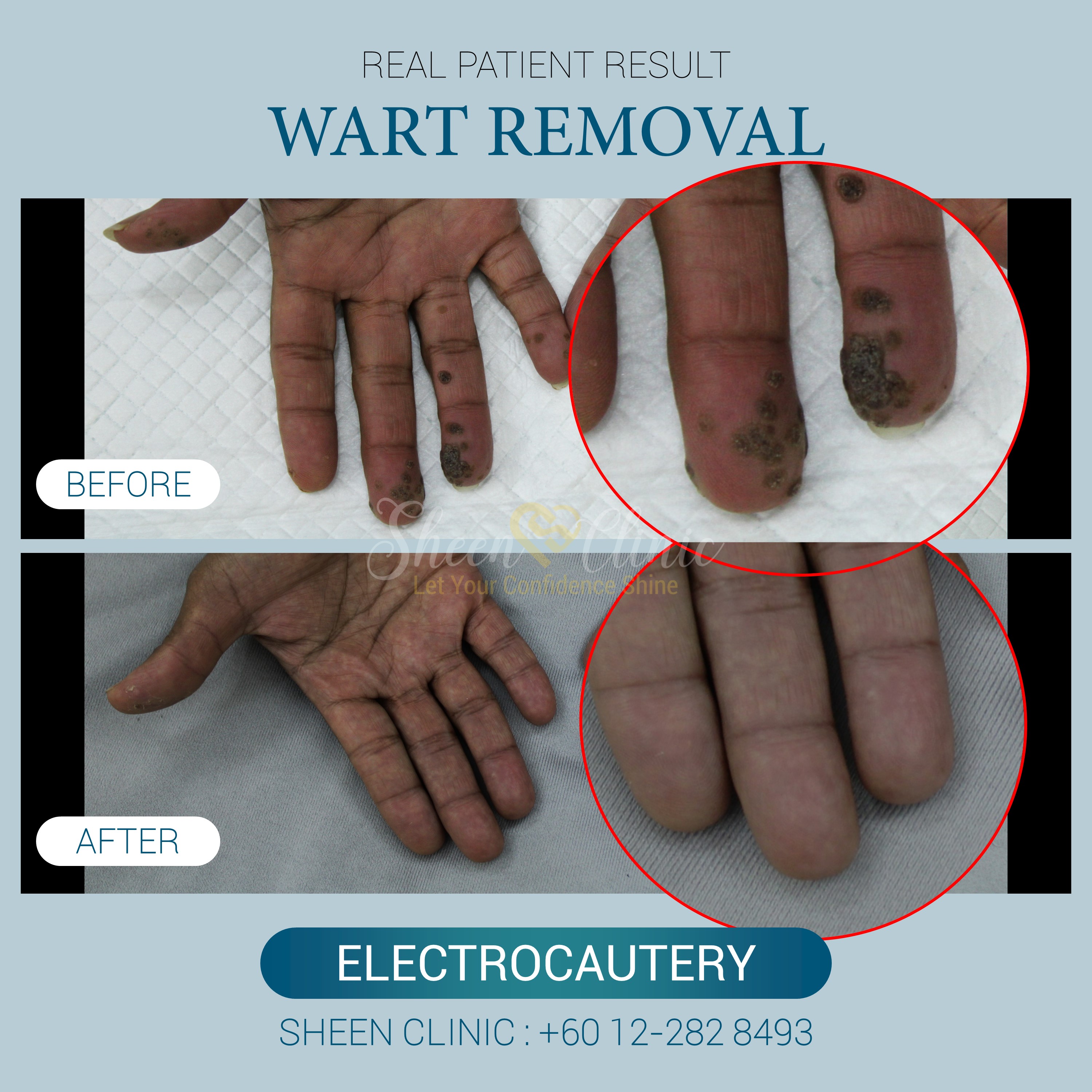
At Sheen Clinic, we have successfully treated patients with common warts, plantar warts, facial warts, and periungual warts.
Our before-and-after photos demonstrate the gradual improvement that can be achieved with appropriate treatment and follow-up.


+P+P+P+P+P
"Came here to treat some warts. Removed some with laser (not painful at all), others are still on treatment using cream and acid. It takes quite long, more than two months, so you have to be patient. Price is okay."
– Eneha, Kuala Lumpur
+P+P+P+P+P
"I did my wart removal here and the surgery was pleasant. Recommended."
– Soshi, Japan
Wart removal starts from RM150, depending on the size, number, location, and treatment method.
Most patients describe the treatment as causing only mild discomfort. Local anaesthetic may be used when appropriate.
Most patients require 1–3 sessions, although stubborn or larger warts may require additional treatments.
Professional wart removal combined with proper aftercare usually results in minimal or no noticeable scarring.
Yes. Although the visible wart can be removed, HPV may remain in nearby skin. Following the recommended treatment plan and aftercare helps reduce the risk of recurrence.
Over-the-counter treatments may work for some small warts, but larger, painful, facial, or recurrent warts should be assessed by a doctor to ensure an accurate diagnosis and appropriate treatment.
The HPV vaccine does not treat existing warts. However, it may help protect against other HPV strains, particularly those associated with genital warts and HPV-related cancers. Our doctor can advise whether vaccination is appropriate for you.
Although it is not always possible to prevent HPV infection, you can reduce your risk by:
Keeping your hands and feet clean and dry
Avoiding sharing towels, shoes, socks, or nail clippers
Wearing slippers in public showers and swimming pools
Covering cuts and broken skin
Avoiding picking at existing warts
Considering HPV vaccination if recommended by your doctor
"Every wart is different. The best treatment is not necessarily the newest or most aggressive option, but the one that matches the patient's wart type, location, skin condition, and lifestyle. Our goal is to remove the wart safely while preserving healthy skin and minimizing the risk of recurrence."
Dr. Doris Lee has over 11 years of clinical experience in aesthetic medicine and skin procedures. She has managed thousands of minor skin lesion procedures, including wart removal, skin tags, moles, and benign skin growths.
At Sheen Clinic, every patient receives an individualized treatment plan rather than a one-size-fits-all approach.
Depending on the wart type and location, treatment may involve:
Our doctors also provide aftercare instructions and advice on reducing the risk of recurrence through good skin care and hygiene practices.
Why Choose Sheen Clinic?
Patients choose Sheen Clinic because we combine accurate diagnosis with personalized treatment.
Our approach includes:
Doctor-led consultation before every treatment
Multiple evidence-based wart removal options
Modern laser and electrosurgical technology
Individualized treatment plans
Comprehensive aftercare guidance
Focus on minimizing recurrence while achieving good cosmetic outcomes
If you have a persistent wart, painful plantar wart, or a wart that continues to spread, early assessment can help prevent further growth and reduce the risk of transmission.
At Sheen Clinic, our doctors will evaluate your skin condition and recommend the most appropriate treatment based on your individual needs.
Whether you have a single wart or multiple lesions, we are committed to providing safe, effective, and personalized care.
Book your consultation today and take the first step toward smoother, healthier skin.
Sheen Clinic
Sunway Geo Avenue, Subang Jaya, Selangor
WhatsApp: +60 19-310 8826
Website: https://www.sheenclinic.com.my/
Last medically reviewed: Dr. Doris Lee, LCP-Certified Aesthetic Physician
More detail about SHEEN CLINIC SDN BHD Malaysia

