
Cooling Load Estimation for Air Conditioning System: A Complete Guide to Accurate HVAC Design, Energy Efficiency, and Optimal System Performance
Cooling load estimation for an air conditioning system is one of the most critical engineering processes in the HVAC (Heating, Ventilation, and Air Conditioning) industry. It determines the amount of heat that must be removed from a building to maintain comfortable indoor temperatures, appropriate humidity levels, and healthy indoor air quality. Accurate cooling load estimation is the foundation of efficient HVAC system design because it enables engineers and technicians to select the correct air conditioning capacity, improve energy efficiency, reduce operating costs, and maximize equipment performance. Whether for residential homes, commercial offices, shopping malls, hotels, hospitals, educational institutions, factories, or industrial facilities, cooling load estimation plays a vital role in delivering reliable and sustainable air conditioning solutions. At Eakon Academy (eakonacadem.edu.my), students, HVAC technicians, engineers, consultants, and contractors receive comprehensive training in cooling load estimation through practical workshops, engineering calculations, and real-world HVAC applications that follow internationally recognized industry standards.
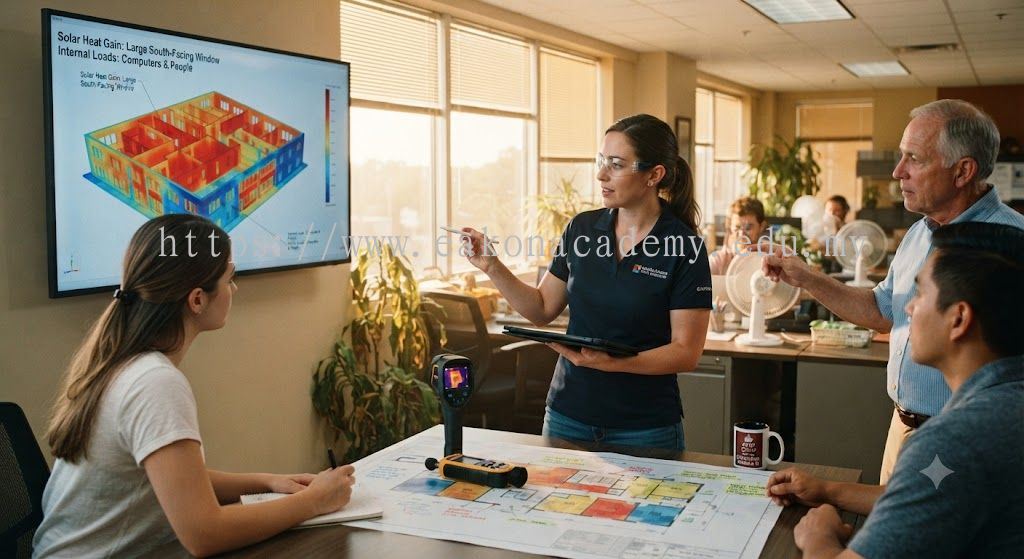
Cooling load estimation refers to the process of calculating the total amount of heat entering a building from both external and internal sources. External heat gains include solar radiation through windows, conductive heat transfer through roofs, walls, ceilings, floors, and doors, as well as outdoor air entering through ventilation systems and infiltration. Internal heat gains come from occupants, lighting systems, electrical appliances, office equipment, manufacturing machinery, computers, and other heat-producing devices. HVAC engineers classify these heat gains into sensible heat, which increases indoor air temperature, and latent heat, which increases indoor moisture content. Both components must be accurately calculated to determine the total cooling capacity required for an air conditioning system.
One of the primary benefits of performing accurate cooling load estimation is selecting the correct air conditioning equipment. Choosing an air conditioner based only on room size or rough estimation often results in inefficient system performance. An undersized air conditioning system may operate continuously without reaching the desired indoor temperature, leading to higher electricity consumption, excessive compressor wear, and poor occupant comfort. Conversely, an oversized system cools the space too quickly, causing frequent compressor cycling, ineffective humidity removal, increased maintenance costs, and unnecessary energy waste. Proper cooling load estimation ensures the HVAC system is correctly sized, delivering efficient operation, lower operating expenses, and improved indoor comfort.
Professional HVAC engineers use several internationally recognized methods for cooling load estimation. Common engineering approaches include the Cooling Load Temperature Difference (CLTD) method, Cooling Load Factor (CLF), Radiant Time Series (RTS) method, Heat Balance (HB) method, Transfer Function Method (TFM), and ACCA Manual J calculations for residential buildings. These engineering methodologies evaluate building orientation, insulation quality, wall construction, roof materials, glazing performance, occupancy schedules, lighting density, equipment heat output, ventilation rates, infiltration, and local weather conditions. By considering every significant source of heat gain, these methods produce highly accurate cooling load calculations that support efficient HVAC system design.
Cooling load estimation is particularly important in tropical countries such as Malaysia, where buildings experience consistently high outdoor temperatures, elevated humidity, and intense solar radiation throughout the year. Air conditioning systems often operate for extended hours, making accurate cooling load analysis essential for reducing energy consumption and maintaining comfortable indoor environments. Engineers must evaluate roof exposure, wall insulation, window orientation, shading devices, fresh air requirements, occupancy density, equipment usage, and internal heat gains to determine the correct cooling capacity. Proper cooling load estimation enables HVAC systems to perform efficiently under Malaysia's demanding climate while lowering electricity costs and improving system reliability.
Modern HVAC engineering increasingly relies on advanced software to perform cooling load estimation and building energy analysis. Professional applications such as Carrier HAP, Trane TRACE 3D Plus, EnergyPlus, IES VE, and DesignBuilder allow engineers to simulate building performance, calculate hourly cooling loads, optimize equipment selection, and compare alternative HVAC designs. These software tools improve engineering accuracy and project efficiency. However, successful HVAC design still depends on a thorough understanding of engineering fundamentals such as thermodynamics, psychrometrics, heat transfer, sensible and latent heat calculations, ventilation principles, infiltration, and building envelope performance. Software enhances productivity, but engineering expertise remains essential for validating results and making informed design decisions.
At Eakon Academy, participants receive practical, hands-on training in cooling load estimation for air conditioning systems through engineering workshops, calculation exercises, real project case studies, and HVAC system design simulations. Students learn how to collect building information, calculate sensible and latent cooling loads, interpret architectural drawings, evaluate ventilation requirements, analyse internal and external heat gains, and select appropriate air conditioning equipment for residential, commercial, and industrial buildings. The academy combines classroom theory with practical field experience, ensuring graduates develop the technical skills required to confidently perform professional cooling load calculations and design efficient HVAC systems that comply with international engineering standards.
Accurate cooling load estimation also contributes to sustainable building design and environmental responsibility. Correctly sized HVAC systems consume less electricity, reduce greenhouse gas emissions, improve indoor environmental quality, and support green building certification programs. Building owners benefit from lower utility bills, longer equipment lifespan, reduced maintenance costs, and improved occupant satisfaction. As governments and industries continue emphasizing energy conservation and high-performance buildings, cooling load estimation has become one of the most valuable technical skills in the HVAC profession.
By enrolling in professional HVAC training at Eakon Academy (eakonacadem.edu.my), learners can strengthen their expertise in cooling load estimation, HVAC system design, equipment sizing, and energy-efficient engineering practices. Whether you are an aspiring HVAC technician, experienced engineer, consultant, contractor, or facility manager, mastering cooling load estimation for air conditioning systems provides the technical foundation needed to design, install, commission, troubleshoot, and maintain modern HVAC systems. With industry-focused education, practical experience, and internationally recognized engineering methodologies, Eakon Academy prepares professionals to deliver high-performance, energy-efficient air conditioning solutions that meet the evolving needs of residential, commercial, and industrial buildings across Malaysia and beyond.
更多 EAKON ACADEMY SDN BHD 相关资料 Malaysia
