
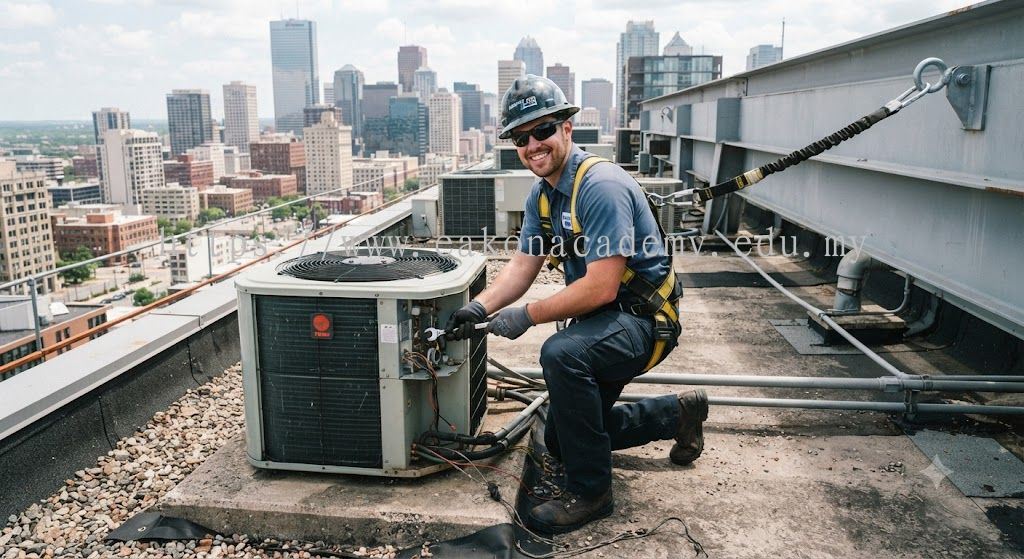
Air Conditioning Servicing Safety Harness Requirements: Professional Guide for HVAC Working at Height Safety
Air conditioning servicing safety harness requirements are an important part of professional HVAC safety management, especially for technicians who perform maintenance, inspection, repair, and servicing activities at elevated locations. Many air conditioning systems are installed in challenging areas such as rooftops, external building walls, elevated platforms, mechanical rooms, and high-level equipment spaces. These servicing environments create potential risks, including falls from height, unstable working positions, unsafe access conditions, and difficulty performing tasks safely. A proper understanding of air conditioning servicing safety harness requirements helps HVAC technicians select suitable fall protection equipment, apply correct usage procedures, and maintain a safe working environment during elevated servicing operations. At Eakon Academy (eakonacadem.edu.my), we provide professional HVAC safety training programs that develop technician knowledge in working-at-height safety, fall prevention systems, safety harness procedures, PPE compliance, hazard assessment, and safe air conditioning servicing practices.
The primary purpose of safety harness requirements during air conditioning servicing is to protect technicians from fall-related accidents when working in elevated areas. HVAC servicing tasks such as outdoor unit maintenance, rooftop condenser inspection, refrigerant piping repair, and high-level equipment servicing may expose workers to fall hazards. A safety harness forms part of a complete fall protection system that helps reduce the risk of serious injuries when properly selected, inspected, fitted, and connected. However, technicians must understand that wearing a harness alone is not sufficient. Safe working-at-height practices require proper planning, hazard identification, suitable anchorage systems, and correct emergency procedures.
Before starting any air conditioning servicing activity at height, technicians should conduct a detailed risk assessment to determine the need for safety harness protection. The assessment should consider factors such as working height, roof conditions, access routes, equipment location, surrounding hazards, weather conditions, and the type of servicing task being performed. A professional hazard assessment allows HVAC contractors to identify possible risks and implement suitable control measures before technicians begin work. This approach improves workplace safety and ensures that technicians are prepared for potential hazards.
Selecting the correct safety harness is one of the most important requirements for HVAC servicing at height. Technicians should use a suitable full-body harness designed for fall protection applications where fall hazards exist. The harness should be appropriate for the working environment, suitable for the user’s body size, and maintained according to safety requirements. HVAC professionals should understand the difference between fall restraint systems and fall arrest systems to ensure the correct protection method is applied during servicing activities.
Safety harness inspection is a critical procedure that must be completed before every use. HVAC technicians should check the harness condition to ensure there are no signs of damage, excessive wear, cuts, broken stitching, damaged buckles, or defective attachment points. Components such as webbing straps, adjustment buckles, chest straps, leg loops, D-rings, and connectors should be carefully examined. Any damaged or unsafe harness should be removed from service immediately to prevent equipment failure during a fall event.
Correct fitting and adjustment of the safety harness are essential for effective protection. An incorrectly fitted harness may reduce safety performance and increase the possibility of injury during a fall. Technicians should ensure shoulder straps, chest straps, and leg loops are properly adjusted to provide a secure and comfortable fit. Proper training allows HVAC workers to understand correct harness positioning, movement limitations, and safe connection procedures when performing servicing work at height.
Anchor point selection is another important aspect of air conditioning servicing safety harness requirements. Safety harnesses must be connected to approved and suitable anchorage points capable of supporting fall protection loads. Technicians should never attach harnesses to unsuitable structures, weak surfaces, or unverified connection points. Supervisors should confirm that anchorage systems are properly assessed and suitable for the specific HVAC servicing activity.
Connection equipment such as shock-absorbing lanyards, self-retracting lifelines, and connectors must also be managed correctly. These components work together with the safety harness to reduce fall forces and improve technician protection. Regular inspection and correct usage of connection equipment help ensure that the complete fall protection system functions effectively during emergency situations.
Training and competency development are essential requirements for HVAC technicians using safety harness systems. Workers should receive proper training on harness selection, inspection methods, fitting procedures, attachment techniques, fall prevention principles, and emergency response actions. Competent technicians are better prepared to identify hazards and apply safe working practices during air conditioning servicing activities.
Tool safety is also connected with safety harness requirements when working at height. HVAC technicians often carry tools, testing equipment, and replacement components while servicing air conditioning systems. Proper tool control methods, including tool bags, tool lanyards, and secure storage systems, help prevent dropped objects that may injure people below. Maintaining good tool management improves overall workplace safety.
Emergency rescue planning is another essential part of HVAC safety harness procedures. If a fall arrest incident occurs, technicians may require immediate assistance to prevent further injury. HVAC contractors should prepare rescue plans, emergency communication procedures, first aid arrangements, and response methods before starting elevated servicing work. Effective emergency planning improves workplace readiness and reduces the impact of accidents.
Regular safety inspections, equipment maintenance, and refresher training help maintain high standards for air conditioning servicing safety harness requirements. HVAC companies should conduct toolbox meetings, workplace audits, and working-at-height reviews to ensure technicians continue following approved safety procedures. Continuous improvement strengthens safety culture and supports professional HVAC operations.
At Eakon Academy (eakonacadem.edu.my), we are committed to developing skilled HVAC professionals through practical and industry-focused training programs that combine technical expertise with workplace safety knowledge. Our courses cover air conditioning servicing safety, working-at-height procedures, safety harness requirements, fall protection systems, risk assessment, PPE compliance, electrical safety, refrigerant handling, and emergency response practices. By implementing proper air conditioning servicing safety harness requirements, HVAC contractors and technicians can reduce workplace hazards, improve technician confidence, strengthen safety compliance, and deliver reliable air conditioning maintenance services. Professional safety harness management is not only essential for protecting workers but also a key foundation for quality workmanship and long-term success in the HVAC industry.
更多 EAKON ACADEMY SDN BHD 相关资料 Malaysia
