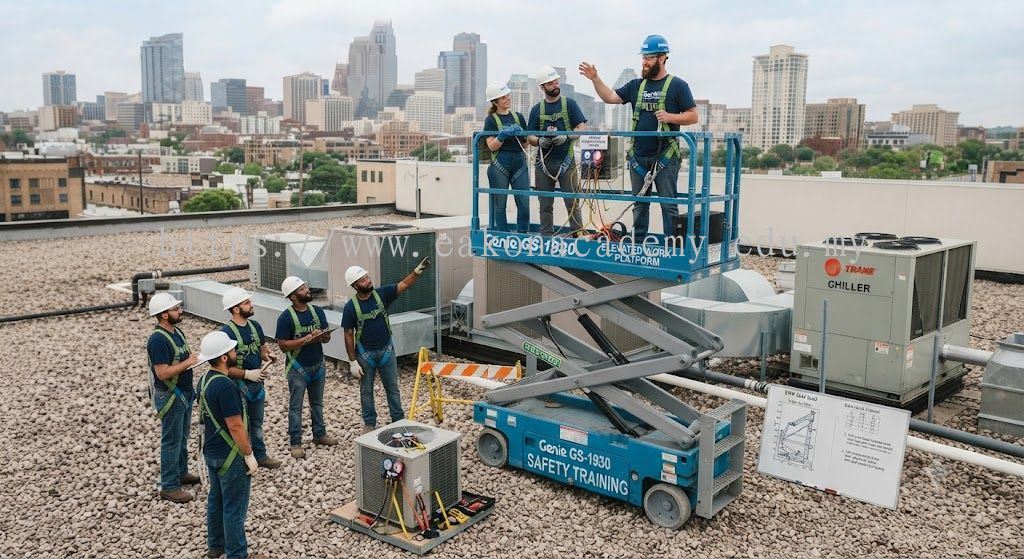
HVAC EWP Safety Training Course: Professional Elevated Work Platform Skills for Safe HVAC Operations
The HVAC industry requires technicians to perform various installation, servicing, inspection, and maintenance tasks in environments where working at height is often unavoidable. Commercial buildings, factories, warehouses, shopping centres, hospitals, hotels, and industrial facilities frequently have air conditioning systems installed in elevated areas such as rooftops, ceilings, mechanical rooms, and high-level service platforms. To ensure these tasks are completed safely, HVAC professionals need proper knowledge of Elevated Work Platforms (EWPs) and effective working-at-height safety practices. The HVAC EWP safety training course is designed to provide air conditioning technicians with essential skills in elevated platform operation, hazard identification, risk control, and safe work procedures. At Eakon Academy (eakonacadem.edu.my), we provide industry-focused HVAC training that combines technical expertise with workplace safety knowledge, helping technicians improve their competency and perform elevated HVAC work with greater confidence and professionalism throughout Malaysia.
Elevated Work Platforms (EWPs), also known as Mobile Elevated Work Platforms (MEWPs), are widely used in the HVAC industry to provide safe access to equipment located at height. Common examples include scissor lifts, boom lifts, articulated boom lifts, and aerial platforms. These machines are essential for many HVAC activities such as installing rooftop air conditioning units, servicing commercial chillers, maintaining VRF and VRV systems, repairing ductwork, inspecting ventilation systems, and performing preventive maintenance on large-scale HVAC installations. Although EWPs improve accessibility and productivity, improper operation can create serious risks, including falls, equipment instability, collisions, electrical hazards, and falling objects. A professional HVAC EWP safety training course helps technicians understand these risks and apply correct safety procedures before starting elevated work.
A major focus of the HVAC EWP safety training course is workplace hazard identification and risk assessment. Before operating any elevated platform, technicians must learn how to evaluate the working environment and identify potential hazards. Training covers common risks such as uneven ground conditions, unstable surfaces, overhead electrical lines, restricted working areas, nearby structures, moving vehicles, pedestrian traffic, and changing weather conditions. By understanding how to assess these hazards, HVAC technicians can implement appropriate control measures, select the correct equipment, and develop safer work plans. Effective risk assessment is essential for preventing accidents and ensuring smooth HVAC installation and maintenance operations.
Equipment inspection is another important part of elevated platform safety training. Before using any EWP, technicians must understand how to perform proper pre-use inspections to ensure the machine is safe and operational. The training course covers inspection procedures for hydraulic systems, tyres, batteries, platform controls, emergency stop functions, guardrails, warning alarms, stabilizers, emergency lowering systems, and other critical components. Detecting equipment problems before operation helps prevent mechanical failures and reduces the possibility of accidents while technicians are working at height.
The HVAC EWP safety training course also focuses on developing operator competency through practical learning. Participants are trained on safe platform operation techniques, including starting procedures, movement controls, positioning methods, load management, and emergency response procedures. Hands-on exercises allow technicians to gain practical experience operating different types of elevated platforms under controlled conditions. This practical approach helps build confidence and ensures technicians understand how to safely apply their knowledge during real HVAC installation, repair, and maintenance projects.
Personal Protective Equipment (PPE) is a key element of elevated work platform safety. During training, HVAC technicians learn the importance of using appropriate safety equipment, including helmets, gloves, safety footwear, eye protection, high-visibility clothing, and fall protection systems. Participants are also trained on the correct inspection and use of full-body safety harnesses and approved lanyards when required. Proper PPE practices provide additional protection against falls, impacts, and other hazards associated with working at height.
Safe load management and platform stability are also covered in professional EWP safety training. HVAC technicians must understand equipment limitations and ensure platforms are not overloaded with excessive tools, refrigerant cylinders, spare components, or installation materials. Training teaches participants how to distribute loads properly, position platforms on suitable surfaces, and follow manufacturer operating requirements. Maintaining stability is essential for preventing tip-over incidents and ensuring safe working conditions.
Environmental awareness is another important topic included in the HVAC EWP safety training course. Technicians often perform outdoor HVAC activities such as rooftop equipment installation and maintenance, where weather conditions can affect safety. Training helps participants understand the impact of strong winds, heavy rain, lightning, extreme temperatures, and poor visibility on elevated platform operation. Recognizing environmental risks allows technicians to make informed decisions and stop work when conditions become unsafe.
Communication and teamwork are essential for successful elevated HVAC operations. Many commercial HVAC projects involve multiple workers, including electricians, engineers, contractors, supervisors, and facility personnel. Proper communication between EWP operators and ground workers helps coordinate activities, maintain exclusion zones, prevent collisions, and improve emergency response. A strong safety culture ensures that all team members understand their responsibilities and work together to maintain a safe environment.
Emergency procedures are another important component of HVAC EWP safety training. Participants learn how to respond to unexpected situations such as equipment malfunction, power failure, platform emergencies, and workplace incidents. Understanding emergency lowering procedures, rescue planning, and communication methods helps technicians respond quickly and effectively during critical situations.
Completing an HVAC EWP safety training course provides significant advantages for both technicians and employers. Trained HVAC professionals demonstrate improved safety awareness, better operational skills, and stronger compliance with workplace safety requirements. Employers benefit from reduced accident risks, improved productivity, fewer equipment-related problems, and a stronger safety culture within their organization. Properly trained technicians are better prepared to handle challenging elevated HVAC tasks while maintaining professional service standards.
At Eakon Academy (eakonacadem.edu.my), we are committed to developing skilled HVAC professionals through comprehensive technical and safety training programmes. Our HVAC EWP safety training course combines classroom instruction with practical hands-on learning to ensure participants gain the knowledge and confidence required to safely operate elevated work platforms in real working environments. Through training in hazard identification, risk assessment, equipment inspection, safe operation, emergency response, and workplace safety practices, HVAC technicians can strengthen their technical capabilities and improve their career opportunities. By investing in professional EWP safety training, HVAC professionals contribute to safer workplaces, higher-quality air conditioning services, and a more competent HVAC industry throughout Malaysia.
更多 EAKON ACADEMY SDN BHD 相关资料 Malaysia