
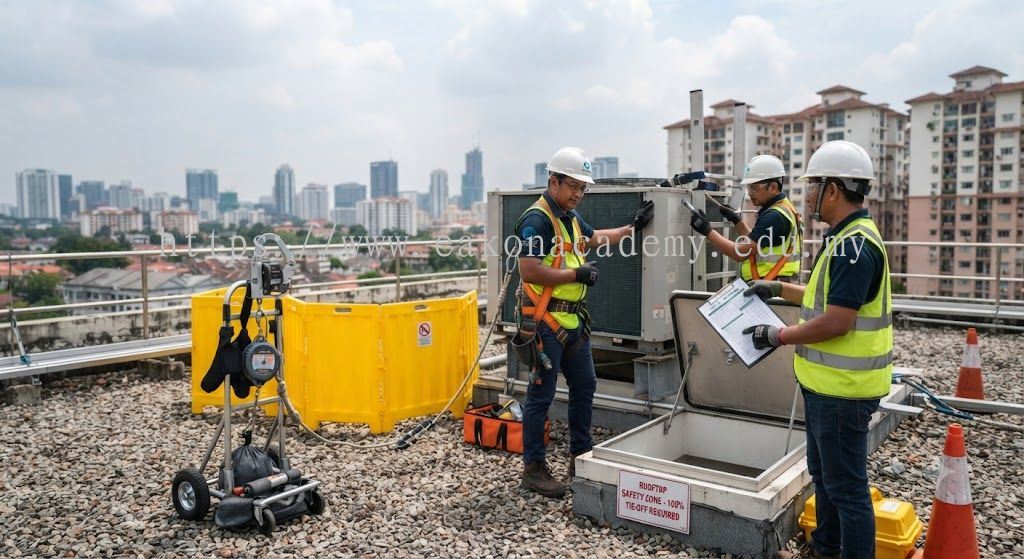
HVAC Rooftop Safety Equipment for Technicians: Essential Fall Protection and PPE for Safe Air Conditioning Work at Height
Working on rooftops is one of the most challenging and hazardous tasks performed by HVAC professionals. Whether installing outdoor air conditioning condensers, servicing rooftop package units, maintaining VRF and VRV systems, repairing commercial chillers, inspecting ventilation equipment, or carrying out preventive maintenance, technicians are exposed to significant fall hazards, weather conditions, electrical risks, and moving equipment. Using the correct HVAC rooftop safety equipment for technicians is essential for preventing accidents, protecting workers, and ensuring compliance with Malaysia's Occupational Safety and Health (OSH) regulations. A complete rooftop safety system combines personal protective equipment (PPE), certified fall protection equipment, safe access solutions, emergency rescue planning, and professional work-at-height training. At Eakon Academy (eakonacadem.edu.my), our HVAC training programmes prepare technicians with both advanced technical knowledge and practical rooftop safety skills, ensuring they are ready to perform installation and maintenance work safely and professionally across residential, commercial, and industrial environments.
The foundation of rooftop safety is a full-body safety harness, which is the most important component of every fall protection system. Unlike traditional safety belts that focus force around the waist, a full-body harness distributes fall arrest forces across the shoulders, chest, thighs, and pelvis, significantly reducing the risk of serious injury during a fall. HVAC technicians should wear a certified full-body harness whenever there is a possibility of falling while working on rooftops or elevated structures. Before every use, the harness should be inspected carefully for damaged stitching, frayed webbing, cracked buckles, bent D-rings, corrosion, cuts, or signs of wear. A properly fitted and well-maintained harness provides reliable protection and should always be adjusted according to the manufacturer's instructions.
The harness must be connected to a secure fall protection system using either a shock-absorbing lanyard or a self-retracting lifeline (SRL). Shock-absorbing lanyards reduce the force experienced during a fall by slowing the deceleration process, while SRLs automatically extend and retract with technician movement, reducing slack and limiting fall distance. Twin-leg lanyards allow continuous attachment when moving between multiple anchor points, making them especially useful during rooftop servicing where technicians frequently reposition themselves. Choosing the correct connection device depends on roof layout, work location, and the type of HVAC equipment being serviced.
A certified roof anchor point is another essential requirement for safe rooftop operations. Every fall protection system depends on a secure structural anchor capable of supporting fall arrest loads. Permanent roof anchors, engineered lifeline systems, structural steel members, and certified temporary anchorage devices provide safe connection points for technicians working at height. Air conditioning technicians should never connect their harnesses to refrigerant pipes, electrical conduits, cable trays, ductwork, handrails, or lightweight roof structures because these are not designed to withstand the forces generated during a fall. Proper anchor point selection should always be verified during the workplace risk assessment before rooftop work begins.
A height safety helmet with a secure chin strap is another essential piece of rooftop safety equipment. Rooftop environments expose technicians to falling tools, construction materials, overhead obstructions, and accidental impacts. Helmets designed specifically for working at height remain securely attached during climbing, movement, or emergency situations, providing continuous head protection throughout the job. The chin strap prevents the helmet from becoming dislodged while technicians climb ladders, move across rooftops, or operate elevated work platforms.
Appropriate safety footwear is equally important for rooftop HVAC work. Technicians should wear boots with steel toe protection, puncture-resistant midsoles, anti-slip soles, and oil-resistant materials to provide maximum grip on metal roofing, concrete surfaces, ladders, scaffolding, and elevated platforms. Good traction helps prevent slips caused by rain, dust, moss, loose debris, or uneven roof surfaces while protecting technicians from heavy equipment and sharp construction materials. Comfortable safety boots also reduce fatigue during extended maintenance and installation projects.
Protective work gloves help safeguard technicians from sharp sheet metal, copper tubing, aluminium fins, electrical components, and installation tools commonly encountered during rooftop HVAC work. Cut-resistant gloves reduce the risk of lacerations while maintaining the flexibility needed for detailed installation and servicing tasks. Heat-resistant gloves should be used during brazing operations to protect against burns from hot copper pipes, welding torches, and molten filler materials. Wearing the correct gloves improves both technician safety and work quality.
Eye protection is another critical element of rooftop safety. Safety glasses or impact-resistant goggles protect technicians from drilling dust, flying debris, refrigerant splashes, metal fragments, grinding sparks, and harmful UV exposure during installation, servicing, and maintenance activities. Clear vision is essential when working around electrical systems, refrigerant piping, rooftop mechanical equipment, and rotating machinery, making eye protection a mandatory part of any rooftop safety kit.
Safe rooftop access equipment also plays a vital role in accident prevention. Elevated work platforms (EWPs) such as boom lifts and scissor lifts provide stable access to rooftop equipment while reducing reliance on ladders. Operators should complete pre-use inspections, verify platform load capacities, understand emergency lowering controls, and wear fall protection equipment whenever required. When ladders are used, they should be inspected before every use, positioned securely on firm ground, extended correctly above roof access points, and climbed while maintaining three points of contact. Ladder stabilisers and tie-off systems further improve climbing safety.
Electrical safety equipment is equally important because rooftop HVAC systems often involve live electrical circuits, control panels, disconnect switches, and power supplies. Insulated hand tools, voltage testers, insulated gloves, lockout/tagout devices, and electrical warning signs help reduce the risk of electric shock. Before performing electrical maintenance, technicians should isolate the power source, verify zero voltage using approved testing equipment, and apply lockout/tagout procedures to prevent accidental energisation.
Weather conditions must also be considered during rooftop work. Strong winds, rain, lightning, excessive heat, and slippery surfaces significantly increase fall risks. HVAC technicians should monitor weather forecasts before beginning rooftop projects and suspend work during unsafe weather conditions. Adequate hydration, sun protection, and scheduled rest breaks are important for preventing heat stress during Malaysia's tropical climate.
Every rooftop HVAC project should begin with a comprehensive workplace risk assessment. The assessment should identify roof conditions, fragile roofing materials, skylights, roof edges, overhead electrical hazards, restricted access, falling object risks, emergency rescue procedures, and communication methods. Rescue equipment should always be available, and technicians should understand suspension trauma awareness, first aid procedures, emergency communications, and rescue planning before commencing work.
At Eakon Academy (eakonacadem.edu.my), we are committed to producing highly competent HVAC professionals who understand that rooftop safety is a critical part of technical excellence. Our specialised HVAC training programmes combine practical air conditioning installation, servicing, troubleshooting, and maintenance skills with comprehensive education in rooftop safety, work-at-height procedures, fall protection systems, personal protective equipment, anchor point selection, elevated work platform operation, ladder safety, electrical safety, emergency rescue planning, and workplace risk assessment. Students receive valuable hands-on experience using industry-standard rooftop safety equipment under the guidance of experienced instructors, preparing them to meet the highest safety standards across Malaysia's residential, commercial, and industrial HVAC sectors. By understanding and applying the principles of HVAC Rooftop Safety Equipment for Technicians, HVAC professionals can minimise workplace accidents, comply with occupational safety regulations, improve productivity, protect lives, and deliver safe, reliable, and professional air conditioning services that meet the highest standards of quality and workplace safety.
更多 EAKON ACADEMY SDN BHD 相关资料 Malaysia
