
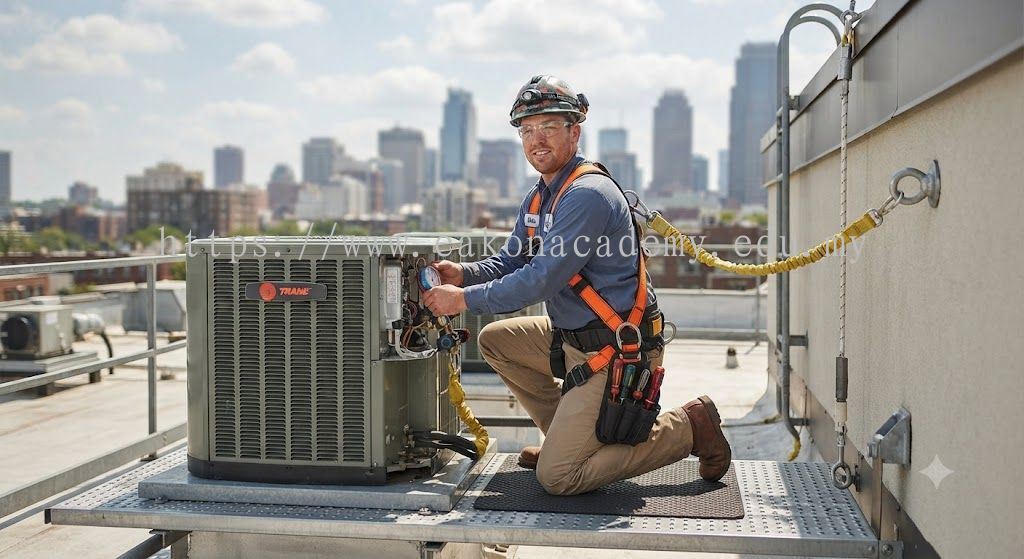
Air Conditioning Technician Fall Protection Equipment: Essential Safety Solutions for Working at Height in the HVAC Industry
Working at height is a routine part of an air conditioning technician’s job, especially during the installation, servicing, maintenance, and repair of outdoor condenser units, rooftop HVAC systems, commercial VRF and VRV equipment, chillers, cooling towers, and ventilation systems. These tasks expose technicians to serious fall hazards, making the use of air conditioning technician fall protection equipment an essential requirement for every HVAC project. Proper fall protection equipment not only safeguards technicians from life-threatening injuries but also improves work efficiency, enhances professionalism, and ensures compliance with Malaysia’s occupational safety regulations. At Eakon Academy (eakonacadem.edu.my), workplace safety is integrated into every HVAC training programme, ensuring technicians develop both technical expertise and the practical knowledge required to work safely at height.
Fall protection equipment is designed to prevent falls or minimise injuries should a fall occur. The most important component of any fall protection system is the full-body safety harness. Unlike traditional safety belts that concentrate impact forces around the waist, modern full-body harnesses distribute fall arrest forces across the shoulders, chest, thighs, and pelvis, significantly reducing the likelihood of serious injury. Air conditioning technicians should always wear a properly fitted harness whenever working in environments where there is a risk of falling from height. Before each use, the harness must be inspected for damaged stitching, worn webbing, cracked buckles, corrosion, or distorted D-rings. A properly maintained harness provides dependable protection and gives technicians greater confidence when performing demanding HVAC installation and maintenance tasks.
An effective fall protection system also includes the correct connection device. Shock-absorbing lanyards are commonly used in HVAC applications because they reduce the force transmitted to the worker during a fall. Adjustable restraint lanyards prevent technicians from reaching dangerous roof edges or unprotected openings, while positioning lanyards allow workers to maintain stable working positions with both hands free. Self-retracting lifelines (SRLs) provide greater freedom of movement and minimise fall distance, making them ideal for complex commercial air conditioning installations. Choosing the correct lanyard or lifeline depends on the work environment, available anchor points, potential fall distance, and the specific installation or servicing task being performed.
Anchor points are another critical element of air conditioning technician fall protection equipment. Even the highest quality harness cannot provide protection if it is attached to an unsuitable structure. Certified anchor points should be capable of supporting the required fall arrest loads and comply with recognised safety standards. HVAC technicians should never connect their lanyards to refrigerant pipes, electrical conduits, temporary scaffolding components, handrails, or structural elements that are not specifically designed for fall protection. Professional training teaches technicians how to identify suitable anchor points, evaluate structural integrity, and safely connect fall arrest systems in different working environments.
Elevated work platforms (EWPs) also play an important role in reducing fall risks during air conditioning installation and servicing. Boom lifts and scissor lifts provide stable working platforms that are often safer than ladders when installing rooftop equipment, commercial air conditioning units, or façade-mounted condensers. When operating an elevated work platform, technicians should wear the appropriate fall protection equipment whenever required by the equipment manufacturer or workplace procedures. They should also understand safe operating practices, including load limits, emergency controls, platform positioning, and pre-use inspections.
Ladders remain widely used throughout the HVAC industry, but they must be used correctly to minimise accidents. Before climbing, technicians should inspect ladders for damaged rungs, loose fittings, or structural defects. Ladders should be positioned on firm, level ground and secured to prevent movement during use. Maintaining three points of contact while climbing and avoiding overreaching significantly reduces the risk of falls. For prolonged work or jobs involving heavy equipment, elevated work platforms or scaffolding often provide safer alternatives than ladders.
Conducting a thorough risk assessment before beginning work at height is an essential part of every HVAC project. Air conditioning technicians should evaluate hazards such as roof stability, fragile surfaces, slippery conditions, overhead electrical lines, weather conditions, nearby traffic, falling objects, and restricted access areas. The assessment helps determine the appropriate fall protection equipment, identifies additional control measures, and ensures emergency rescue procedures are established before work begins. Proper planning allows technicians to anticipate hazards and reduce the likelihood of workplace incidents.
Regular inspection and maintenance of fall protection equipment are equally important. Harnesses, lanyards, connectors, self-retracting lifelines, and anchor devices should be stored in clean, dry conditions away from excessive heat, moisture, chemicals, and direct sunlight. Equipment should be inspected before every use and undergo periodic detailed inspections according to manufacturer recommendations. Any equipment that has arrested a fall must be removed from service immediately and replaced, regardless of whether visible damage is present. Proper maintenance ensures long-term reliability and helps organisations remain compliant with workplace safety requirements.
Emergency preparedness is another vital aspect of working safely at height. Every air conditioning installation or servicing project should include a documented rescue plan that outlines procedures for safely recovering a worker following a fall. Technicians should understand suspension trauma, emergency communication procedures, rescue equipment operation, and first aid response. Regular rescue drills help ensure that workers can respond quickly and effectively if an emergency occurs, minimising injuries and improving overall workplace safety.
Safe work practices further strengthen fall prevention efforts. Air conditioning technicians should secure tools using tool lanyards to prevent dropped objects, maintain clear communication with colleagues, avoid working alone in hazardous environments, and stop work immediately during strong winds, heavy rain, lightning, or poor visibility. Good housekeeping also contributes to safer working conditions by reducing slip, trip, and fall hazards around installation areas.
As Malaysia’s HVAC industry continues to expand, employers increasingly value technicians who demonstrate strong safety awareness alongside advanced technical skills. Competency in working at height, proper use of fall protection equipment, hazard identification, and risk management enhances employability while improving client confidence in the professionalism of HVAC services. Investing in safety training also helps organisations reduce workplace injuries, improve productivity, lower insurance costs, and maintain compliance with occupational safety regulations.
At Eakon Academy (eakonacadem.edu.my), we provide comprehensive HVAC training programmes that combine practical air conditioning installation and servicing skills with specialised working-at-height safety education. Our courses include hands-on instruction in the use of full-body harnesses, shock-absorbing lanyards, self-retracting lifelines, anchor systems, elevated work platforms, ladder safety, risk assessments, and emergency rescue procedures. Students gain valuable real-world experience that prepares them to work safely in residential, commercial, and industrial environments. By understanding and correctly using Air Conditioning Technician Fall Protection Equipment, HVAC professionals can significantly reduce workplace risks, comply with Malaysian safety regulations, improve operational efficiency, and deliver safe, reliable, and professional air conditioning services while protecting both themselves and those around them.
更多 EAKON ACADEMY SDN BHD 相关资料 Malaysia
