VRV Air Conditioning Maintenance Guide
A VRV Air Conditioning Maintenance Guide is an essential resource for HVAC technicians, maintenance engineers, facility managers, building owners, and air conditioning professionals who want to understand the proper procedures for maintaining Variable Refrigerant Volume (VRV) air conditioning systems. As VRV technology continues to dominate the commercial HVAC industry due to its outstanding energy efficiency, flexible zoning capabilities, and superior comfort control, proper maintenance has become increasingly important for ensuring reliable operation and maximizing equipment lifespan. At Eakon Academy (eakonacadem.edu.my), we provide comprehensive VRV training courses that teach participants how to apply professional maintenance practices based on industry standards and real-world service experience. This VRV Air Conditioning Maintenance Guide highlights the key maintenance principles, inspection procedures, troubleshooting methods, and preventive servicing techniques that every HVAC professional should understand to maintain commercial VRV systems efficiently and safely.
Proper VRV air conditioning maintenance begins with a thorough understanding of how the system operates. A typical VRV installation consists of inverter-driven outdoor condensing units connected to multiple indoor units through a refrigerant piping network. Additional components include electronic expansion valves (EEVs), branch selector boxes, temperature sensors, pressure sensors, printed circuit boards (PCBs), communication cables, compressors, condenser coils, evaporator coils, blower motors, drainage systems, air filters, and sophisticated electronic controllers. Each component plays a critical role in maintaining efficient cooling performance. A comprehensive maintenance guide helps technicians understand how these components interact, allowing them to identify abnormalities before they develop into major equipment failures. By understanding system design and operation, maintenance personnel can perform inspections more accurately and improve the long-term reliability of the entire VRV installation.
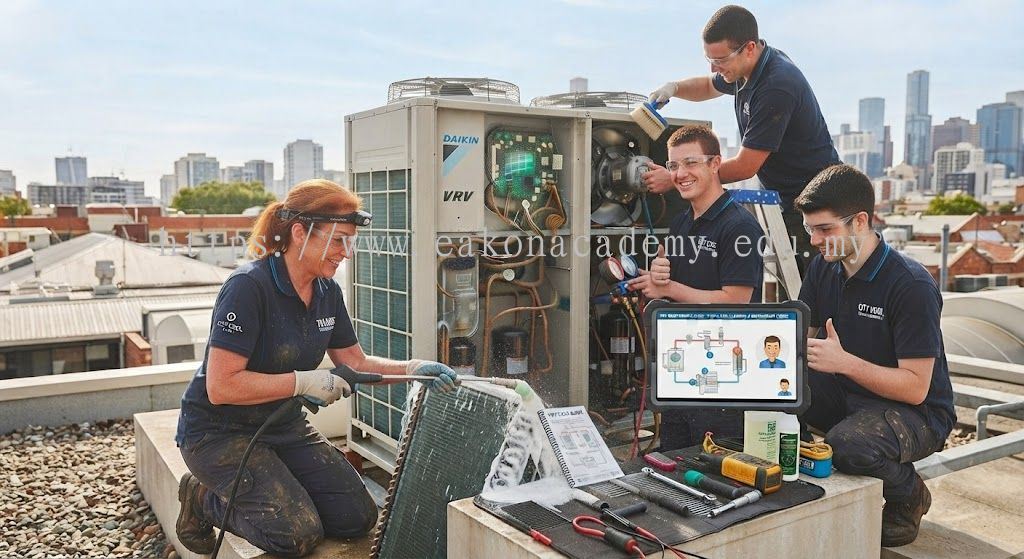
Routine inspection is one of the most important elements of an effective VRV air conditioning maintenance program. Technicians should regularly inspect indoor and outdoor units for dirt accumulation, refrigerant leaks, damaged insulation, abnormal vibration, unusual operating noises, corrosion, loose electrical connections, blocked condensate drains, worn fan motors, and dirty heat exchangers. Air filters should be cleaned or replaced according to manufacturer recommendations to maintain proper airflow and indoor air quality. Condenser and evaporator coils should be inspected for dust, debris, and contamination that could reduce heat transfer efficiency and increase energy consumption. Electrical components including contactors, terminals, wiring, communication cables, sensors, and control boards should also be examined to ensure safe and reliable operation. These regular inspections help prevent unexpected breakdowns while extending the service life of expensive HVAC equipment.
An effective VRV Air Conditioning Maintenance Guide also emphasizes the importance of refrigerant system maintenance. Proper refrigerant charge is essential for maintaining cooling capacity, energy efficiency, and compressor protection. During routine servicing, technicians should measure operating pressures, evaluate superheat and subcooling values where applicable, verify refrigerant levels, inspect piping insulation, and perform electronic leak detection to identify even minor refrigerant leaks. If refrigerant loss is detected, technicians should locate and repair the leak before recharging the system according to manufacturer specifications. Accurate refrigerant management not only improves cooling performance but also reduces environmental impact by preventing unnecessary refrigerant emissions. At Eakon Academy, participants receive practical training on refrigerant handling, leak detection, vacuum evacuation, pressure testing, refrigerant recovery, and charging procedures using professional HVAC equipment.
Preventive maintenance is another critical topic covered within a comprehensive VRV Air Conditioning Maintenance Guide. Rather than waiting for equipment failure, preventive maintenance involves scheduled inspections and servicing that keep the system operating efficiently throughout its lifespan. Preventive maintenance tasks include cleaning coils, replacing filters, lubricating moving components where required, tightening electrical connections, checking compressor performance, testing safety controls, verifying communication signals, inspecting drainage systems, measuring airflow, and calibrating sensors. Following a structured maintenance schedule helps minimize equipment downtime, reduce emergency repair costs, improve occupant comfort, and increase the overall reliability of commercial VRV installations. Preventive maintenance is especially important for large buildings where continuous cooling is essential for business operations and occupant satisfaction.
Energy efficiency remains one of the greatest advantages of VRV technology, and proper maintenance plays a significant role in preserving that efficiency. Dirty coils, clogged filters, airflow restrictions, refrigerant leaks, electrical faults, faulty sensors, and poorly maintained compressors can all increase electricity consumption while reducing cooling performance. A well-prepared VRV Air Conditioning Maintenance Guide teaches technicians how to identify these issues through systematic inspections and diagnostic testing. Using professional tools such as digital manifold gauges, clamp meters, multimeters, infrared thermometers, insulation resistance testers, airflow meters, vacuum pumps, and manufacturer diagnostic software, technicians can accurately assess system performance and recommend corrective actions that optimize energy efficiency. These maintenance practices help building owners reduce operating costs while supporting sustainable building management objectives.
Choosing Eakon Academy (eakonacadem.edu.my) as your trusted source for VRV maintenance education provides access to comprehensive training, experienced instructors, and practical hands-on learning designed specifically for today's commercial HVAC industry. Our courses expand upon the principles outlined in this VRV Air Conditioning Maintenance Guide by providing participants with real equipment experience, advanced troubleshooting techniques, preventive maintenance strategies, safety procedures, refrigerant management skills, and system performance optimization methods. Whether you are an HVAC technician seeking professional certification, a facilities management professional responsible for commercial building maintenance, or an organization looking to improve workforce competency, our training programs deliver industry-relevant knowledge that strengthens technical expertise and career opportunities. By following the best practices presented in this VRV Air Conditioning Maintenance Guide and enhancing your skills through professional training at Eakon Academy, you can improve system reliability, maximize energy efficiency, extend equipment lifespan, reduce maintenance costs, and contribute to the successful operation of modern VRV air conditioning systems throughout Malaysia and beyond.
更多 EAKON ACADEMY SDN BHD 相关资料 Malaysia