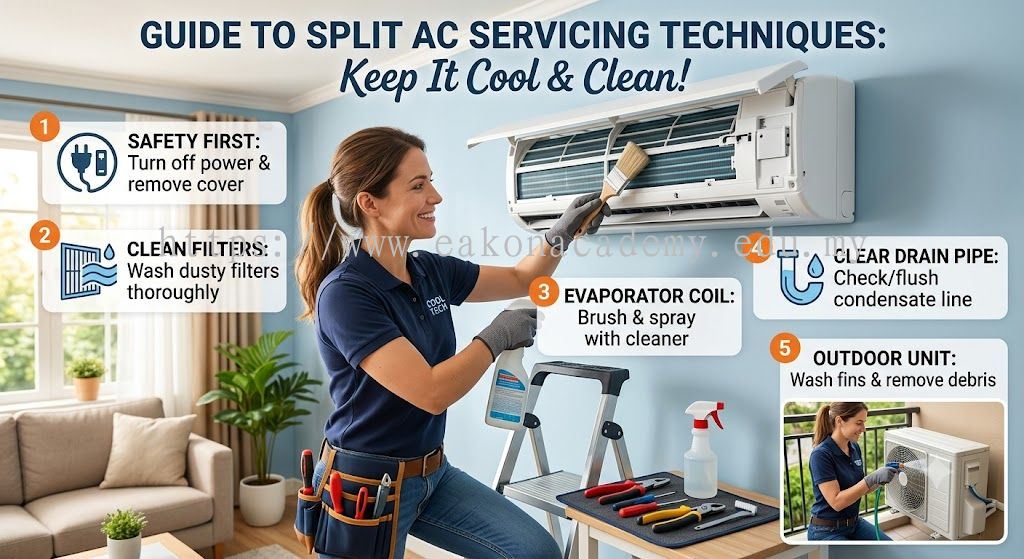
Split AC Servicing Techniques Guide
A Split AC Servicing Techniques Guide is an essential learning resource for homeowners, HVAC technicians, and air conditioning professionals who want to understand advanced methods for maintaining, inspecting, and improving the performance of split air conditioning systems. Proper servicing techniques help ensure that air conditioners operate efficiently, provide reliable cooling, reduce energy consumption, and achieve a longer service lifespan. At Eakon Academy, we provide professional HVAC training programs that focus on practical servicing skills, troubleshooting methods, maintenance procedures, and technical knowledge required for modern air conditioning systems.
Split air conditioners are widely used in residential properties, offices, commercial buildings, and industrial facilities because they provide effective cooling solutions. However, regular servicing is required to maintain system efficiency and prevent performance problems. Over time, dust, dirt, moisture, and environmental factors can affect important components such as air filters, evaporator coils, condenser coils, compressors, fan motors, refrigerant systems, and electrical controls. A detailed Split AC Servicing Techniques Guide helps technicians understand the correct methods to inspect, clean, test, and maintain these components professionally.
One of the most important servicing techniques is performing a complete system inspection before starting maintenance work. Professional technicians should evaluate the condition of both indoor and outdoor units, check cooling performance, inspect airflow, examine electrical connections, and identify any visible signs of damage. Proper inspection allows technicians to diagnose system conditions accurately and determine the most suitable servicing approach. Through professional HVAC training, learners can develop systematic inspection skills that improve servicing accuracy and efficiency.
Cleaning techniques are another important part of split AC servicing. Air filters should be cleaned regularly because they collect dust particles that can reduce airflow and affect indoor air quality. Technicians must also understand proper cleaning methods for evaporator coils, blower fans, condenser coils, and drainage systems. Correct cleaning techniques help improve heat transfer, maintain airflow efficiency, and prevent common problems such as weak cooling, water leakage, and unpleasant odors.
A professional Split AC Servicing Techniques Guide also covers refrigerant checking and management techniques. Refrigerant plays a vital role in the cooling cycle, and incorrect refrigerant levels can negatively affect system performance. HVAC technicians need to understand how to check refrigerant pressure, inspect refrigerant piping, identify leakage symptoms, and perform proper refrigerant charging procedures when required. Knowledge of refrigerant systems allows technicians to maintain cooling efficiency while following safe handling practices.
Electrical troubleshooting techniques are also essential for professional split AC servicing. Modern air conditioning systems contain various electrical components, including capacitors, fan motors, sensors, wiring connections, and control boards. Technicians must know how to inspect and test these components to identify electrical faults accurately. Proper electrical servicing techniques help prevent equipment damage, improve safety, and ensure reliable system operation.
Another important technique included in professional split AC servicing is performance testing. After completing maintenance work, technicians should evaluate system operation by checking airflow, cooling temperature, refrigerant conditions, drainage performance, and overall functionality. Performance testing ensures that servicing work has been completed effectively and that the air conditioning system is operating according to expected standards.
Preventive maintenance techniques are also a key focus of split AC servicing. Regular maintenance helps detect potential problems before they become major failures. Technicians who apply effective preventive servicing techniques can help customers reduce repair costs, improve energy efficiency, and extend the lifespan of their air conditioning systems. These skills are valuable for both residential and commercial HVAC applications.
Eakon Academy provides HVAC training courses designed to help learners develop professional skills in air conditioning installation, servicing, maintenance, and troubleshooting. Through practical learning and industry-focused training, participants can gain valuable experience in applying proper split AC servicing techniques. These skills prepare learners for professional opportunities in the HVAC industry and help them become more confident technicians.
As the demand for qualified HVAC professionals continues to grow, mastering advanced servicing techniques provides valuable career advantages. A strong understanding of a Split AC Servicing Techniques Guide enables technicians to deliver high-quality services, improve customer satisfaction, and maintain efficient air conditioning systems. Eakon Academy supports learners by providing professional HVAC education that develops skilled technicians ready to meet the challenges of the modern air conditioning and refrigeration industry.
更多 EAKON ACADEMY SDN BHD 相关资料 Malaysia