HVAC Repair Practical Training for Hands-On Skills Development and Professional Technician Expertise
HVAC repair practical training is a specialized learning program designed to provide participants with real-world experience in diagnosing, repairing, servicing, and maintaining heating, ventilation, and air conditioning systems. As the HVAC industry continues to grow with increasing demand for efficient and reliable cooling solutions, technicians require strong practical skills to handle different types of HVAC equipment and repair challenges. Eakon Academy, available at eakonacadem.edu.my, provides professional HVAC training programs that emphasize hands-on learning, technical knowledge, and industry-based practices to help participants develop the confidence and skills required for a successful career in the HVAC sector.
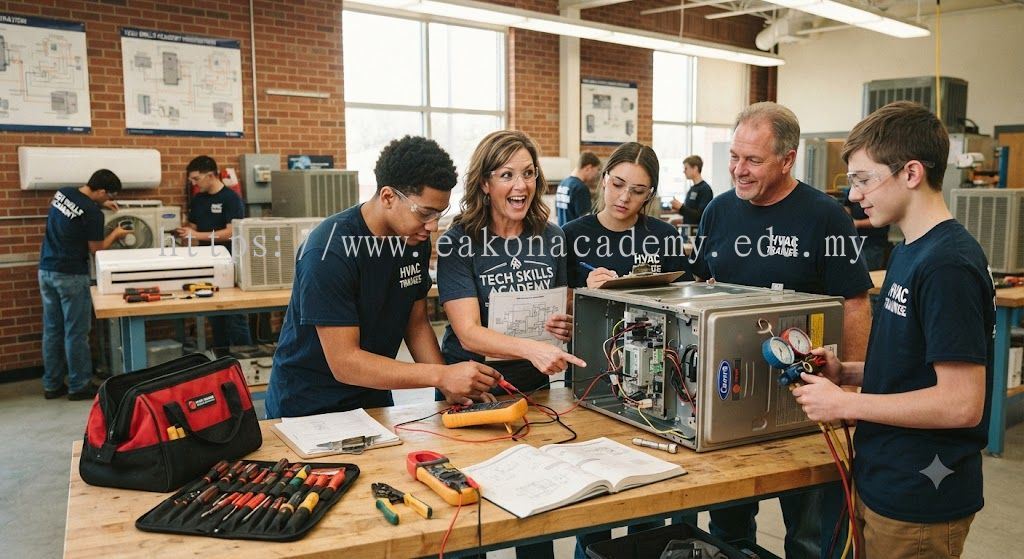
A professional HVAC repair practical training program focuses on developing actual workplace skills through direct interaction with HVAC equipment and systems. Unlike theory-based learning alone, practical training allows participants to understand HVAC operation through inspection, testing, troubleshooting, and repair activities. This hands-on approach helps learners improve their technical ability, become familiar with HVAC tools, and develop the confidence needed to perform professional repair work in real service environments.
One of the main objectives of HVAC repair practical training is to teach participants how to identify and solve common HVAC problems effectively. Air conditioning and HVAC systems may experience various issues, including poor cooling performance, refrigerant leakage, electrical faults, abnormal sounds, airflow problems, compressor failures, and control system errors. Through practical exercises, participants learn how to analyze system conditions, perform diagnostic procedures, and apply suitable repair methods to restore equipment performance.
Understanding HVAC components is an essential part of practical repair training. Participants learn about the functions and operation of important components such as compressors, evaporator coils, condenser units, expansion valves, fans, motors, electrical controls, sensors, and refrigerant circuits. Strong component knowledge allows technicians to identify faults more accurately and select the correct repair procedures. This technical foundation is important for delivering reliable HVAC repair services.
Hands-on troubleshooting practice is a major advantage of HVAC repair practical training. Participants gain experience using professional HVAC testing tools to measure system performance, inspect components, and identify faults. Practical troubleshooting activities help learners develop a structured approach to problem-solving and reduce the time required to diagnose HVAC issues. These skills are valuable for technicians working in residential, commercial, and industrial HVAC environments.
Refrigerant repair and system maintenance are also important topics covered in HVAC practical training. Proper refrigerant management plays a significant role in maintaining cooling efficiency and protecting major HVAC components. Participants learn refrigerant pressure checking, leak detection methods, recovery procedures, and correct charging techniques. Practical experience in refrigerant handling helps technicians perform repair work safely while maintaining system reliability.
Electrical repair skills are another important focus area in HVAC repair practical training. Modern HVAC systems include various electrical components such as capacitors, contactors, wiring connections, control boards, sensors, and inverter systems. Participants learn how to inspect electrical circuits, test components, identify electrical faults, and perform safe repair procedures. Strong electrical troubleshooting knowledge allows technicians to manage more complex HVAC repair situations.
Preventive maintenance techniques are also included in practical HVAC repair training. Participants learn how regular inspection, cleaning, testing, and servicing can prevent equipment failures and improve system performance. Understanding preventive maintenance enables technicians to provide complete HVAC solutions rather than focusing only on emergency repairs. This approach helps improve equipment lifespan and reduce long-term maintenance costs.
Safety awareness is a critical element of HVAC repair practical training. Participants learn proper safety procedures when working with electrical systems, mechanical components, tools, and refrigerants. Following professional safety practices ensures repair activities are completed efficiently while reducing workplace risks.
HVAC repair practical training is suitable for beginners, existing technicians, maintenance personnel, and individuals seeking to upgrade their HVAC skills. The practical knowledge gained through training prepares participants to handle real service situations and improve their professional capabilities.
Eakon Academy offers industry-focused HVAC training programs that combine technical theory with extensive hands-on practical experience. Participants develop valuable skills in HVAC troubleshooting, repair techniques, system testing, and maintenance procedures. The practical training approach helps learners build confidence and become better prepared for HVAC industry requirements.
Investing in HVAC repair practical training is a valuable step for individuals who want to strengthen their technical expertise and career opportunities. Professional hands-on training enables technicians to improve repair accuracy, enhance system performance, reduce equipment downtime, and provide high-quality HVAC services. With proper training and practical experience, HVAC professionals can contribute to safer, more efficient, and reliable HVAC solutions for residential, commercial, and industrial applications.
更多 EAKON ACADEMY SDN BHD 相关资料 Malaysia