HVAC Maintenance Technician Program for Professional Skills Development and Industry-Ready Technical Expertise
HVAC maintenance technician program is a professional training course designed to equip individuals with the essential knowledge and practical skills required to inspect, service, troubleshoot, and maintain heating, ventilation, and air conditioning systems. As HVAC systems continue to play an important role in residential, commercial, and industrial environments, skilled maintenance technicians are increasingly needed to ensure efficient operation, energy performance, and long-term equipment reliability. Eakon Academy, available at eakonacadem.edu.my, provides professional HVAC training programs that focus on practical learning, technical competency, and industry-relevant maintenance practices to prepare participants for successful careers in the HVAC industry.
A comprehensive HVAC maintenance technician program provides participants with a strong foundation in HVAC system operation, maintenance procedures, and troubleshooting techniques. The program is designed to help learners understand how different HVAC components work together and how professional maintenance practices can improve system performance. Participants gain knowledge about essential components such as compressors, evaporators, condensers, fans, motors, refrigerant circuits, electrical controls, sensors, and air distribution systems.
One of the main focuses of an HVAC maintenance technician program is developing practical maintenance skills. Participants learn how to perform regular inspections, clean system components, check operating conditions, and evaluate HVAC equipment performance. Maintenance procedures may include air filter inspection, coil cleaning, airflow testing, drainage system checking, electrical component evaluation, and refrigerant system assessment. These skills enable technicians to maintain HVAC systems effectively and reduce the possibility of unexpected breakdowns.
Preventive maintenance knowledge is an important part of HVAC technician training. Professional technicians must understand how scheduled maintenance activities can improve system efficiency and extend equipment lifespan. Participants learn how to identify early signs of equipment problems, prepare maintenance schedules, record system conditions, and recommend appropriate maintenance actions. Preventive maintenance skills help organizations reduce repair expenses, improve energy efficiency, and maintain reliable HVAC operation.
Troubleshooting and fault diagnosis are also key elements of an HVAC maintenance technician program. HVAC systems may experience various issues such as poor cooling performance, unusual operating sounds, refrigerant leaks, electrical faults, airflow problems, and component failures. Participants learn how to analyze system symptoms, perform testing procedures, identify the root cause of problems, and apply suitable solutions. Strong troubleshooting skills allow technicians to complete maintenance tasks more efficiently and provide better service quality.
Refrigerant handling and system performance evaluation are also included in professional HVAC maintenance training. Proper refrigerant management is necessary to maintain cooling efficiency and protect major system components. Participants learn refrigerant pressure checking, leak detection methods, recovery procedures, and correct charging techniques. Understanding refrigerant systems allows technicians to perform maintenance safely while ensuring HVAC equipment operates effectively.
Electrical inspection and safety procedures are another important area covered in HVAC maintenance technician programs. Modern HVAC systems rely on electrical components such as capacitors, contactors, control boards, sensors, and inverter technology. Participants learn how to inspect electrical systems, test components, identify faults, and perform maintenance procedures safely. Strong electrical knowledge enables technicians to handle modern HVAC equipment with greater confidence.
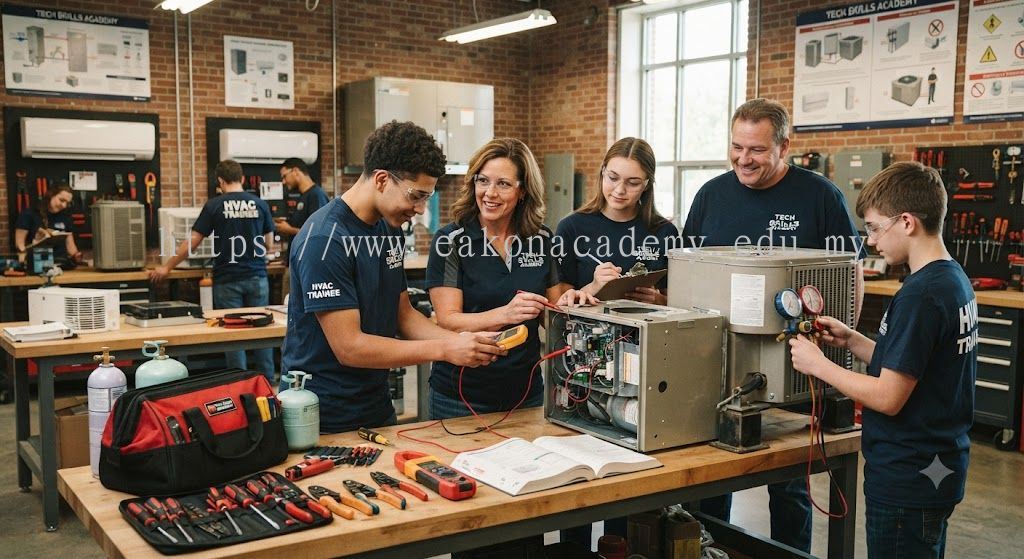
Hands-on practical training is a key advantage of a professional HVAC maintenance technician program. Practical sessions allow participants to work directly with HVAC equipment, use professional tools, and apply maintenance procedures in realistic situations. This approach helps learners develop technical confidence and prepares them for actual workplace challenges in HVAC service and maintenance environments.
With increasing demand for qualified HVAC professionals, completing an HVAC maintenance technician program creates valuable career opportunities. Graduates can pursue roles such as HVAC maintenance technician, air conditioning service specialist, building facility technician, maintenance engineer, and HVAC support professional. Strong technical skills allow technicians to provide reliable solutions and meet the growing needs of the HVAC industry.
Eakon Academy delivers professional HVAC training programs that combine technical knowledge with hands-on experience. Participants gain valuable skills in HVAC servicing, maintenance procedures, troubleshooting methods, and system performance analysis. The training approach helps learners develop the confidence and expertise required to work professionally in the HVAC sector.
Investing in an HVAC maintenance technician program is a valuable step for individuals who want to improve their technical abilities and advance their careers. Professional training enables technicians to enhance system reliability, reduce equipment downtime, improve energy efficiency, and deliver high-quality HVAC maintenance services. With proper knowledge and practical experience, HVAC professionals can contribute to safer, more efficient, and sustainable HVAC operations for the future.
更多 EAKON ACADEMY SDN BHD 相关资料 Malaysia