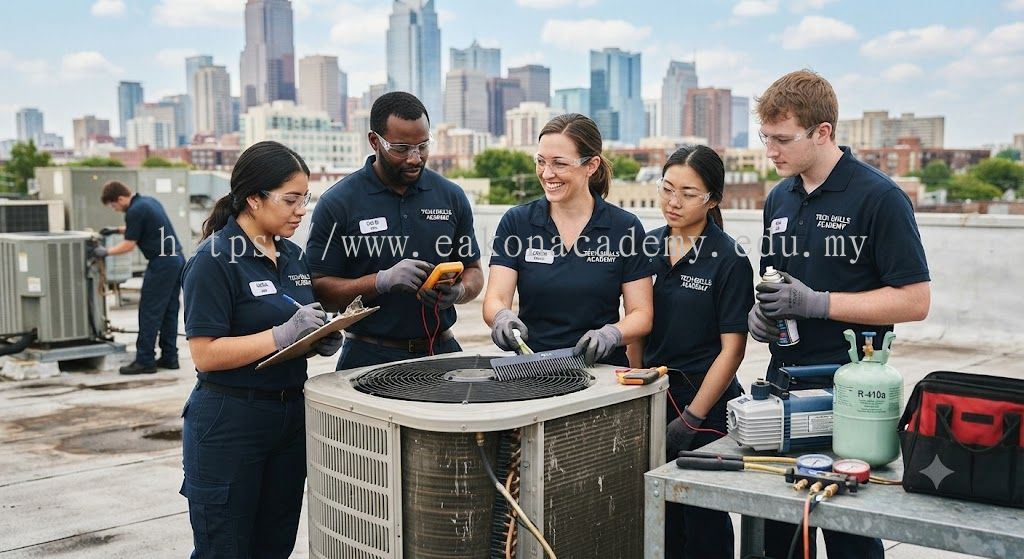
HVAC Maintenance Inspection Training – Professional Skills Development for Accurate HVAC System Assessment
The HVAC Maintenance Inspection Training program is designed to provide comprehensive technical knowledge and practical skills for individuals who want to develop expertise in HVAC system inspection, evaluation, and maintenance procedures. As air conditioning and HVAC systems become increasingly important in residential, commercial, and industrial environments, proper inspection practices are essential to ensure equipment operates efficiently, safely, and reliably. This professional training equips participants with the ability to perform systematic HVAC inspections, identify potential issues, evaluate system performance, and recommend suitable maintenance solutions.
At Eakon Academy, the HVAC Maintenance Inspection Training focuses on providing industry-relevant HVAC education through a combination of technical theory and practical hands-on learning. Participants will gain a strong understanding of HVAC components, inspection methods, maintenance procedures, and professional assessment techniques. This course is suitable for HVAC technicians, maintenance personnel, facility management teams, engineering assistants, and individuals who want to improve their skills in professional HVAC system inspection and servicing.
Regular HVAC inspection is an important part of preventive maintenance because it helps detect equipment problems before they develop into major failures. Through this HVAC inspection training program, participants will learn how to conduct detailed system evaluations, monitor equipment conditions, and identify early warning signs that may affect HVAC performance. Proper inspection procedures help reduce unexpected breakdowns, improve energy efficiency, maintain indoor comfort, and extend the service life of HVAC equipment.
The HVAC Maintenance Inspection Training covers essential inspection techniques for different types of HVAC systems, including split air conditioning units, commercial HVAC systems, air handling units (AHU), fan coil units (FCU), refrigeration equipment, and other cooling systems. Participants will learn how to inspect critical components such as compressors, evaporators, condensers, filters, fans, motors, electrical connections, refrigerant circuits, drainage systems, and control systems.
A key focus of this course is teaching participants how to evaluate HVAC system performance through proper inspection methods. Participants will learn how to check operating conditions using important parameters such as temperature measurement, refrigerant pressure readings, airflow performance, electrical testing, and equipment condition monitoring. These inspection skills allow technicians to identify system abnormalities and provide accurate recommendations for maintenance improvement.
The HVAC Maintenance Inspection Training also develops troubleshooting and diagnostic abilities among participants. Professional HVAC technicians must be able to analyze inspection findings and determine the causes of system problems. Participants will learn how to identify common HVAC issues such as poor cooling performance, refrigerant leakage, compressor problems, electrical failures, airflow restrictions, abnormal equipment operation, and inefficient system performance. This knowledge enables technicians to provide effective maintenance solutions and improve service quality.
Maintenance reporting and documentation are also important elements included in this training. Participants will understand how to prepare inspection reports, record equipment conditions, document maintenance findings, and track system performance over time. Proper documentation helps organizations plan future maintenance activities, improve equipment management, and maintain reliable HVAC operations.
Energy efficiency is another important aspect of the HVAC Maintenance Inspection Training. Regular inspection allows technicians to identify performance issues that may cause unnecessary energy consumption. Participants will learn how proper system evaluation, component checking, and maintenance recommendations can improve HVAC efficiency, reduce operating costs, and support sustainable building management practices.
Safety procedures are emphasized throughout the course to ensure participants understand professional HVAC inspection requirements. Participants will learn about safe equipment handling, electrical safety awareness, proper HVAC tools usage, and workplace safety practices when inspecting HVAC systems. These safety skills help technicians perform inspection tasks confidently while reducing risks during maintenance activities.
The increasing demand for skilled HVAC professionals creates valuable career opportunities for individuals with strong inspection and maintenance capabilities. Completing the HVAC Maintenance Inspection Training can support career development as HVAC technicians, air conditioning service specialists, facility maintenance personnel, building engineers, and technical support professionals. Companies can also benefit from trained employees who can perform accurate HVAC assessments and improve system reliability.
The HVAC Maintenance Inspection Training at Eakon Academy provides practical and industry-focused training designed to prepare participants for real-world HVAC inspection challenges. Whether you are beginning your HVAC career, upgrading your technical skills, or improving your organization’s maintenance capabilities, this course provides essential knowledge and practical experience required in the modern HVAC industry.
By enrolling in this professional HVAC inspection training program, participants can strengthen their technical competency, improve diagnostic skills, and gain confidence in evaluating various HVAC systems. This training supports the development of qualified HVAC professionals who contribute to efficient cooling operations, reliable equipment performance, and improved HVAC maintenance standards throughout Malaysia.
更多 EAKON ACADEMY SDN BHD 相关资料 Malaysia