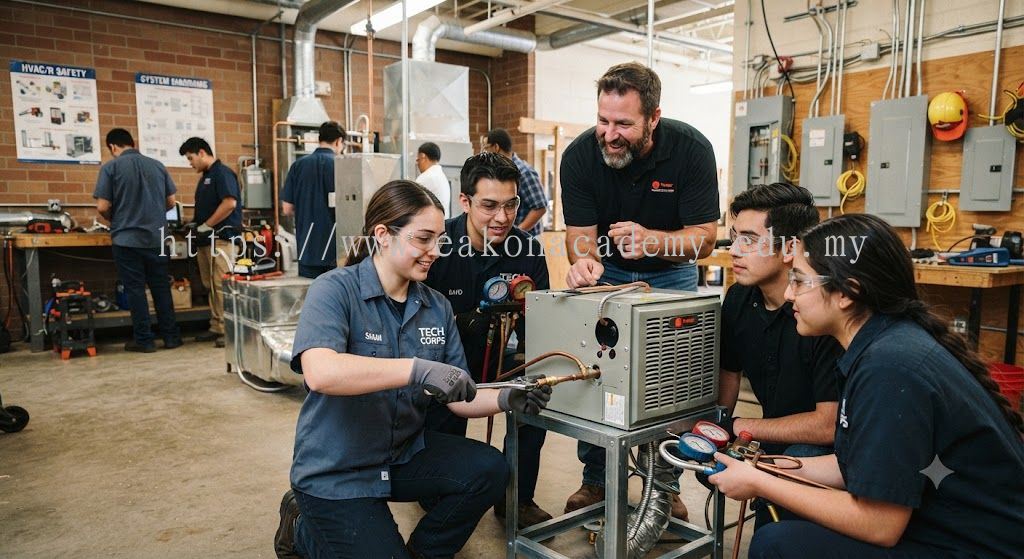
HVAC Installation Training: Professional Hands-On Skills for Efficient and Reliable HVAC System Installation
HVAC installation training is an essential programme for individuals who want to develop professional skills in installing heating, ventilation, air conditioning, and refrigeration (HVACR) systems according to industry standards and best engineering practices. Proper installation is the foundation of every high-performing HVAC system, directly influencing cooling efficiency, energy consumption, equipment lifespan, safety, and customer satisfaction. With the increasing demand for skilled HVAC technicians in residential, commercial, and industrial sectors, professional installation knowledge has become a valuable competency for anyone pursuing a career in the HVAC industry. At Eakon Academy (eakonacadem.edu.my), our HVAC installation training programme combines technical knowledge with hands-on practical learning to help participants develop the confidence and expertise required to perform accurate, safe, and efficient HVAC installation work.
A professionally installed HVAC system provides better cooling performance, improved energy efficiency, reduced maintenance requirements, and longer operational lifespan. Incorrect installation practices can cause numerous problems, including refrigerant leakage, poor airflow, excessive electricity consumption, water drainage issues, compressor damage, and frequent system breakdowns. Through comprehensive HVAC installation training, participants learn how to avoid common installation mistakes by following proper procedures for equipment selection, system preparation, refrigerant piping, electrical connections, testing, and commissioning. This ensures HVAC systems operate effectively while meeting manufacturer specifications and customer expectations.
The HVAC installation training programme at Eakon Academy begins with a strong understanding of HVAC fundamentals, including refrigeration cycles, heat transfer principles, cooling capacity, airflow management, electrical systems, and equipment operation. Participants learn the function of essential HVAC components such as compressors, condensers, evaporators, expansion devices, refrigerant circuits, fan motors, thermostats, sensors, and control systems. Understanding these components allows technicians to make accurate installation decisions and recognise how installation quality affects overall system performance.
One of the key focuses of HVAC installation training is developing practical installation skills through real equipment experience. Participants receive hands-on training in preparing installation locations, positioning indoor and outdoor units, mounting equipment securely, installing copper refrigerant piping, applying insulation, setting up condensate drainage systems, completing electrical wiring, and performing system testing. Practical exercises include copper tube cutting, flaring, swaging, bending, brazing, nitrogen purging, pressure testing, vacuum evacuation, refrigerant charging, and final system commissioning. These practical skills prepare participants to confidently handle actual HVAC installation projects in residential, commercial, and industrial environments.
Refrigeration piping installation is a critical area covered during professional HVAC installation training. Participants learn correct copper piping techniques, joint preparation, brazing methods, leak prevention procedures, pressure testing, and evacuation practices. Proper refrigeration piping installation helps maintain refrigerant flow, protect compressors, prevent system contamination, and achieve optimum cooling performance. Eakon Academy emphasises quality workmanship and precision to ensure participants understand the importance of every installation step in achieving reliable HVAC operation.
Refrigerant handling and charging procedures are also important components of the training programme. Participants learn how to perform refrigerant leak detection, pressure measurement, vacuum evacuation, refrigerant recovery, and accurate refrigerant charging based on system requirements. Responsible refrigerant management improves system efficiency, reduces environmental impact, and supports compliance with professional HVAC practices. These skills are essential for modern technicians working with advanced air conditioning and refrigeration systems.
Electrical installation and testing are equally important aspects of HVAC installation training. Modern HVAC equipment includes advanced electrical components such as inverter systems, control boards, capacitors, contactors, sensors, thermostats, and protection devices. Participants learn safe electrical installation methods, cable connections, grounding requirements, voltage testing, current measurement, and system verification procedures. Strong electrical knowledge allows technicians to complete installations safely while ensuring reliable operation after commissioning.
System commissioning is another essential skill developed during HVAC installation training. Participants learn how to conduct final installation checks, verify refrigerant pressures, measure temperature differences, evaluate airflow, test electrical performance, inspect drainage systems, configure controls, and confirm overall system operation. Proper commissioning ensures the HVAC system performs efficiently from the beginning while reducing future maintenance problems and improving customer confidence.
Safety remains a major priority throughout the HVAC installation training programme. Participants receive instruction on personal protective equipment (PPE), electrical safety procedures, refrigerant handling precautions, safe brazing practices, pressure testing safety, lockout and tagout procedures, ladder safety, and proper use of HVAC installation tools. These safety practices help technicians perform installation tasks professionally while protecting themselves, customers, and valuable HVAC equipment.
As HVAC technology continues to advance, technicians must understand modern systems such as inverter air conditioners, variable refrigerant flow (VRF) systems, smart controls, energy-efficient equipment, building automation systems, and environmentally friendly refrigerants. Eakon Academy continuously updates its HVAC installation training curriculum to reflect current industry trends and employer requirements. Participants gain exposure to modern installation methods that prepare them for the evolving demands of the HVAC sector.
Completing HVAC installation training at Eakon Academy provides participants with valuable career opportunities in HVAC installation, refrigeration services, building maintenance, facilities management, mechanical engineering support, and technical contracting. Employers highly value technicians who possess strong installation skills, safety awareness, troubleshooting ability, and practical field experience. By enrolling in the professional HVAC training programmes available at eakonacadem.edu.my, participants gain the technical knowledge, hands-on experience, and professional confidence required to succeed in today's competitive HVAC industry. Whether you are beginning your HVAC career or upgrading your existing skills, Eakon Academy provides industry-focused HVAC installation training designed to develop competent professionals capable of delivering reliable, efficient, and high-quality HVAC installation solutions.
更多 EAKON ACADEMY SDN BHD 相关资料 Malaysia