
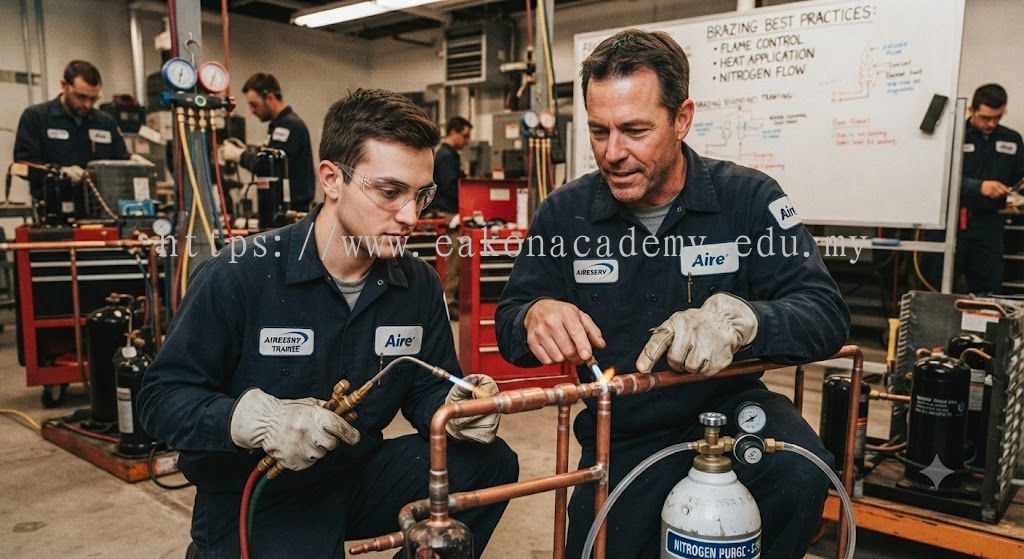
HVAC Refrigeration Brazing Training Best Practices
Eakon Academy is a professional HVAC-R training institution dedicated to developing skilled technicians through structured, hands-on learning in refrigeration and air conditioning systems. One of the most important areas of technical development in this field is HVAC refrigeration brazing training best practices, which focuses on equipping learners with the correct methods, safety procedures, and industry standards required to produce strong, reliable, and leak-free copper joints. Brazing is a fundamental skill in HVAC-R installation and maintenance, and proper training ensures technicians are capable of performing high-quality work that meets professional and industrial expectations.
HVAC refrigeration brazing training best practices begin with a strong foundation in theoretical understanding combined with practical application. Trainees must first learn the principles of copper brazing, including heat transfer, capillary action, and material compatibility. Understanding how brazing works at a molecular level helps technicians develop better control and precision during real-world applications. Training programs also emphasize the importance of system design awareness, allowing learners to understand how brazed joints fit into the overall refrigeration cycle and affect system performance.
Hands-on practice is a core element of HVAC refrigeration brazing training best practices. Students are trained to properly prepare copper tubing by cutting, deburring, and cleaning surfaces to remove contaminants such as oil, dust, oxidation, and moisture. Proper joint fit-up is emphasized to ensure correct clearance for capillary action, which allows the brazing filler metal to flow evenly and create strong, leak-free joints. Training also focuses on developing steady hand skills, torch control, and precise filler rod application to achieve consistent results in different installation conditions.
Heat control is one of the most critical skills taught in HVAC refrigeration brazing training best practices. Trainees learn how to adjust torch flames, typically using a neutral flame, and apply heat evenly around the joint. Overheating can damage copper tubing and weaken joints, while insufficient heating prevents proper filler flow. Through repeated practice, students develop the ability to recognize copper color changes and adjust heat accordingly, ensuring optimal brazing conditions in real field environments.
Nitrogen purging is another essential component of modern HVAC refrigeration brazing training best practices. Students are taught how to set up and regulate nitrogen flow to prevent internal oxidation during brazing. When copper tubing is heated without nitrogen protection, oxidation can form inside the pipe, leading to contamination and reduced system efficiency. Training ensures that learners understand how to integrate nitrogen purging safely and effectively into their brazing procedures to maintain clean and professional-grade installations.
Selection and handling of brazing filler materials are also key aspects of training. Silver-based alloys are commonly used in HVAC-R systems due to their strength, flow characteristics, and compatibility with copper tubing. Trainees learn how to select the appropriate filler rod based on system requirements and apply it correctly at the right temperature to achieve strong metallurgical bonding. Proper flux usage, when required, is also covered to ensure complete and uniform joint sealing.
Safety is a major focus in HVAC refrigeration brazing training best practices. Students are trained in proper personal protective equipment (PPE), safe handling of gas cylinders, fire prevention techniques, and emergency procedures. Maintaining a safe working environment is essential when working with high temperatures and pressurized gases commonly used in brazing operations.
At Eakon Academy, learners undergo comprehensive HVAC-R training programs that emphasize HVAC refrigeration brazing training best practices through real-world simulations and guided instruction. The training ensures that students gain both technical competence and industry-ready skills required for professional careers.
In conclusion, mastering HVAC refrigeration brazing training best practices is essential for producing skilled technicians capable of delivering high-quality, efficient, and reliable refrigeration systems. Proper training, disciplined practice, and adherence to industry standards ensure long-term success and professional excellence in the HVAC-R industry.
更多 EAKON ACADEMY SDN BHD 相关资料 Malaysia
