
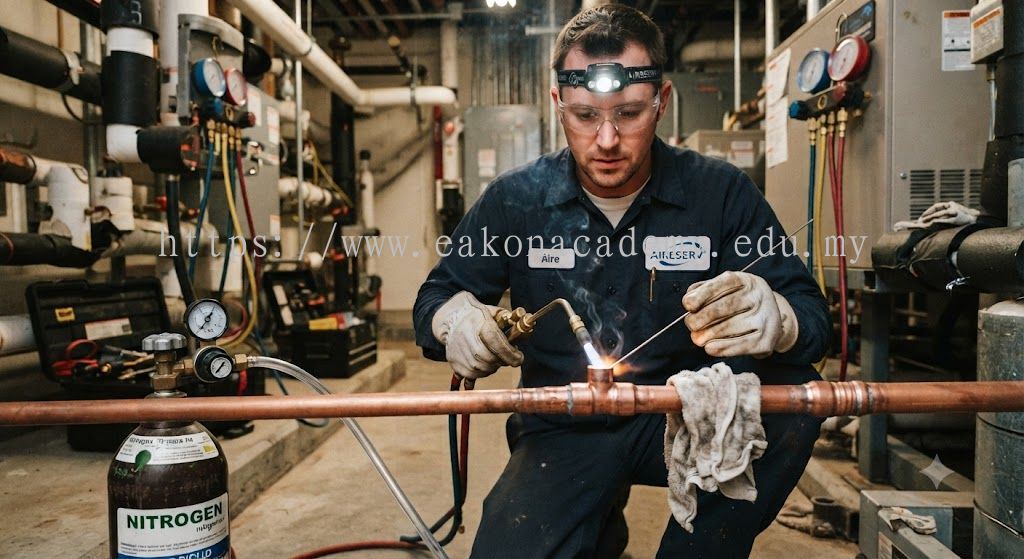
Copper Pipe Brazing HVAC Refrigeration Field Best Practices
Eakon Academy offers specialized HVAC-R training designed to equip technicians with the practical skills and technical knowledge required in real-world refrigeration and air conditioning applications. One of the most critical competencies in this field is copper pipe brazing HVAC refrigeration field best practices, which directly affects system performance, reliability, and long-term operational safety. In HVAC and refrigeration systems, copper piping serves as the primary medium for refrigerant flow, and the quality of brazed joints determines whether the system operates efficiently or suffers from leaks, pressure drops, and potential compressor failure. Therefore, understanding and applying industry-standard brazing practices is essential for every HVAC technician working in installation, maintenance, or service environments.
In the HVAC refrigeration field, copper pipe brazing requires a disciplined approach that begins with proper pipe preparation. This includes accurate cutting, thorough deburring, and meticulous cleaning of copper surfaces to remove contaminants such as oil, oxidation, and dust. Clean copper surfaces are essential for achieving strong metallurgical bonding during the brazing process. Proper joint fit-up is equally important, as the gap between copper pipes must be optimized to allow capillary action to draw the filler metal evenly through the joint. Poor preparation can result in weak joints, inconsistent flow of filler material, and long-term system failures.
Another essential element of copper pipe brazing HVAC refrigeration field best practices is heat control. Applying the correct amount of heat evenly around the joint ensures that the copper reaches the optimal brazing temperature without overheating. Overheating can damage the copper structure, burn flux, and reduce joint strength, while insufficient heating can prevent proper filler rod flow and bonding. Skilled HVAC professionals are trained to maintain consistent flame movement around the joint, ensuring uniform heat distribution and high-quality brazing results in field conditions.
Nitrogen purging is a widely recognized best practice in modern HVAC refrigeration brazing. When copper pipes are heated in the presence of oxygen, internal oxidation can occur, leading to scale formation inside the piping system. This contamination can restrict refrigerant flow, reduce efficiency, and damage critical components such as compressors and expansion valves. By introducing a controlled flow of nitrogen during brazing, technicians can prevent oxidation and maintain a clean internal pipe surface, ensuring optimal system performance and longevity.
The selection of appropriate brazing filler metals is another key factor in achieving reliable copper pipe joints. Silver-based alloys are commonly used in HVAC refrigeration applications due to their excellent strength, corrosion resistance, and melting properties. Understanding which filler rod to use based on system pressure, pipe size, and application type is an important part of professional HVAC training. In addition, proper flux application (when required) enhances bonding and ensures smooth flow of the filler material into the joint.
Post-brazing inspection and testing are equally important in ensuring system integrity. Technicians must visually inspect joints for uniform appearance, check for cracks or voids, and conduct pressure or leak tests before system commissioning. These steps help ensure that every brazed joint meets industry safety standards and performs reliably under operating conditions.
At Eakon Academy, hands-on training programs emphasize copper pipe brazing HVAC refrigeration field best practices through real-world simulations and practical exercises. Students are trained to follow industry standards, safety protocols, and advanced installation techniques that reflect current HVAC-R industry requirements. This ensures that graduates are fully prepared for careers in residential, commercial, and industrial refrigeration sectors.
In conclusion, mastering copper pipe brazing HVAC refrigeration field best practices is essential for achieving durable, leak-free, and efficient refrigeration systems. Proper training, combined with precision workmanship and adherence to industry standards, ensures long-term system reliability, improved energy efficiency, and professional excellence in the HVAC-R industry.
更多 EAKON ACADEMY SDN BHD 相关资料 Malaysia
