
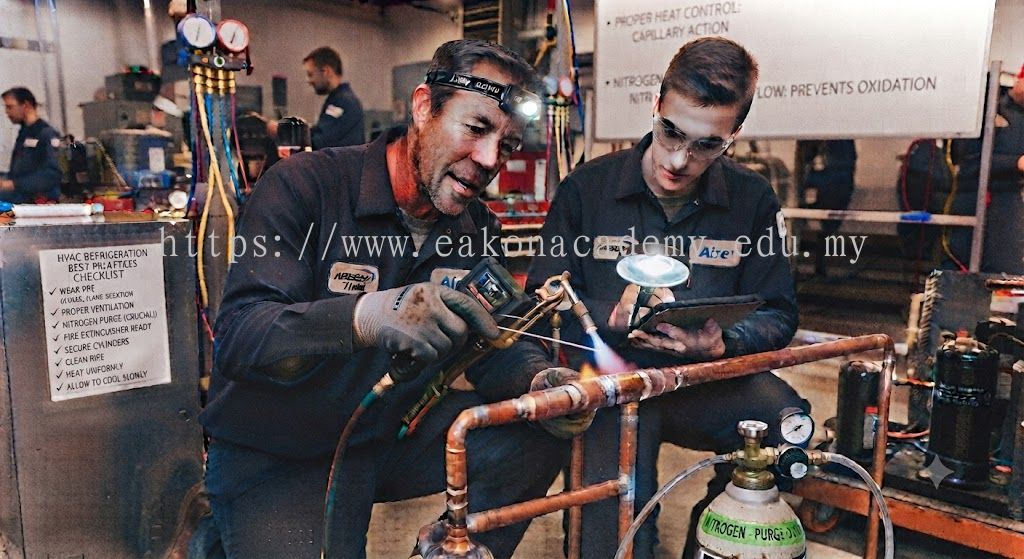
Advanced HVAC Refrigeration Copper Brazing Best Practices
Eakon Academy is committed to delivering industry-relevant HVAC-R training that strengthens technical competency, improves field performance, and aligns with modern refrigeration installation standards. The topic of advanced HVAC refrigeration copper brazing best practices is a critical skill area for technicians, engineers, and students who aim to achieve high-integrity, leak-free refrigeration systems in real-world applications. In HVAC and refrigeration systems, copper brazing is not just a joining method—it is a precision skill that directly impacts system efficiency, safety, durability, and long-term operational cost. Poor brazing practices can lead to refrigerant leaks, pressure failures, contamination, and reduced system lifespan, making proper training and adherence to best practices essential for every technician.
Advanced copper brazing in HVAC refrigeration systems involves a combination of correct material selection, controlled heating techniques, proper joint preparation, and the use of suitable filler metals. One of the most important best practices is ensuring that copper pipes are thoroughly cleaned and oxidized-free before brazing begins. Any contamination such as oil, dust, or oxidation layers can weaken the bond and compromise joint integrity. Additionally, precise fitting alignment and correct gap spacing between copper joints are essential to allow capillary action to properly distribute the brazing alloy, ensuring a strong and uniform seal.
Another key aspect of advanced HVAC refrigeration copper brazing best practices is temperature control. Overheating can burn the flux and weaken the joint structure, while underheating may prevent proper filler flow. Skilled technicians are trained to evenly distribute heat around the joint rather than focusing on a single point, ensuring consistent thermal expansion and minimizing stress on the copper tubing. The use of nitrogen purging during brazing is also a critical best practice in modern HVAC systems, as it prevents internal oxidation and ensures the cleanliness of the refrigeration piping system, which is essential for long-term system reliability and compressor protection.
Selection of the correct brazing alloy is equally important. Silver-based filler rods are commonly used in HVAC applications due to their excellent strength, melting characteristics, and compatibility with copper materials. Understanding different alloy compositions and their application suitability is a core part of advanced training programs. Proper post-brazing inspection is also essential, including visual inspection of joint uniformity, leak testing under pressure, and verification of system integrity before commissioning.
At Eakon Academy, training programs emphasize hands-on practice and real-world simulation to ensure learners master these advanced HVAC refrigeration copper brazing best practices. Students are guided through industry-standard procedures, safety protocols, and modern installation techniques that reflect current HVAC-R industry demands. This ensures that graduates are not only technically competent but also job-ready for commercial, industrial, and residential refrigeration projects.
In conclusion, mastering advanced HVAC refrigeration copper brazing best practices is essential for ensuring system efficiency, safety, and long-term reliability. With proper training, technicians can significantly reduce system failures, improve energy efficiency, and enhance their professional value in the HVAC industry. By focusing on precision, cleanliness, correct material usage, and controlled heating techniques, HVAC professionals can achieve high-quality brazed joints that meet international standards and industry expectations.
更多 EAKON ACADEMY SDN BHD 相关资料 Malaysia
