HVAC Refrigeration Brazing vs Soldering Guide – Complete Professional Guide to Copper Pipe Joining in Cooling Systems
Understanding the HVAC refrigeration brazing vs soldering guide is essential for HVAC technicians, refrigeration engineers, and professionals involved in air conditioning installation, maintenance, and repair. The method used to join copper pipes in refrigeration systems has a direct impact on system reliability, refrigerant safety, energy efficiency, and long-term equipment performance. Eakon Academy provides professional HVAC training programs designed to help technicians develop practical skills, technical knowledge, and hands-on experience in refrigeration pipe joining, brazing techniques, soldering methods, and modern HVAC installation standards.
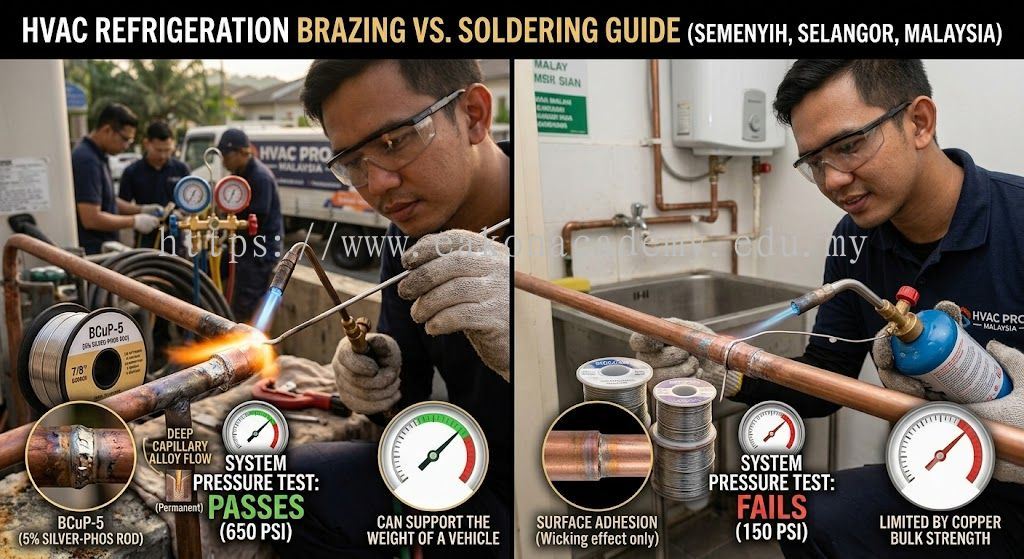
In any HVAC refrigeration brazing vs soldering guide, brazing is widely recognized as the preferred method for joining copper pipes in refrigeration and air conditioning systems. HVAC refrigeration systems operate under high pressure and experience continuous temperature changes, vibration, and mechanical stress during operation. Because of these demanding conditions, copper pipe joints must be strong, durable, and fully leak-resistant. Brazing provides the required strength and is considered the industry-standard method for professional HVAC applications.
HVAC refrigeration brazing process involves a high-temperature joining technique where a filler metal with a melting point above 450°C is used. During brazing, copper pipes are heated evenly using a suitable torch until the brazing alloy melts and flows into the joint through capillary action. This creates a strong metallurgical bond between copper surfaces without melting the base metal itself. Brazed joints are commonly used in split air conditioning systems, VRF and VRV systems, chillers, refrigeration units, and commercial HVAC installations due to their superior strength and reliability.
In contrast, the HVAC refrigeration soldering process uses lower temperatures and filler materials that melt below 450°C. Soldering is easier to perform and requires less heat, making it suitable for certain low-pressure applications. However, soldered joints do not provide the same level of strength and durability required for modern refrigeration systems. HVAC refrigeration systems rely on stable and leak-free copper pipe connections to maintain refrigerant efficiency, cooling performance, and energy savings. Because of this, soldering is generally not recommended for critical refrigeration piping.
The key difference in HVAC refrigeration brazing vs soldering guide is joint strength, temperature resistance, and application suitability. Brazed joints are significantly stronger and more resistant to pressure fluctuations, vibration, and thermal expansion. Soldered joints, while useful in plumbing and low-pressure systems, are not suitable for most refrigeration applications where long-term reliability is essential. This makes brazing the preferred method for professional HVAC refrigeration installation and servicing.
Proper technique is essential for successful HVAC refrigeration brazing. Technicians must learn copper pipe preparation, cleaning procedures, joint fitting, flame control, and correct heating methods. If done incorrectly, brazing can result in weak joints, overheating damage, or poor filler penetration. Professional HVAC training also includes nitrogen purging during brazing, which prevents oxidation inside copper pipes and ensures a clean and contamination-free refrigeration system.
Another important aspect of the HVAC refrigeration brazing vs soldering guide is system reliability and performance. Brazed joints help reduce refrigerant leakage, improve energy efficiency, and extend the lifespan of HVAC equipment. Soldered joints may be more prone to failure under pressure and thermal stress, leading to increased maintenance costs and reduced system performance over time.
Eakon Academy offers professional HVAC and refrigeration training programs designed to provide hands-on experience and technical knowledge in copper pipe brazing, air conditioning installation, refrigeration servicing, refrigerant handling, and system troubleshooting. Our courses help technicians understand the correct application of brazing and soldering methods in real HVAC refrigeration systems.
For individuals searching for HVAC brazing training, refrigeration copper pipe joining courses, air conditioning installation techniques, or professional HVAC technician training, understanding the HVAC refrigeration brazing vs soldering guide is a fundamental requirement. Proper training improves installation quality, reduces system failures, and enhances overall HVAC performance.
Visit eakonacadem.edu.my to explore professional HVAC training programs and advance your expertise in modern air conditioning and refrigeration technology. Mastering the HVAC refrigeration brazing vs soldering guide allows technicians to build stronger systems, improve reliability, and develop valuable skills for long-term success in the HVAC industry.
更多 EAKON ACADEMY SDN BHD 相关资料 Malaysia