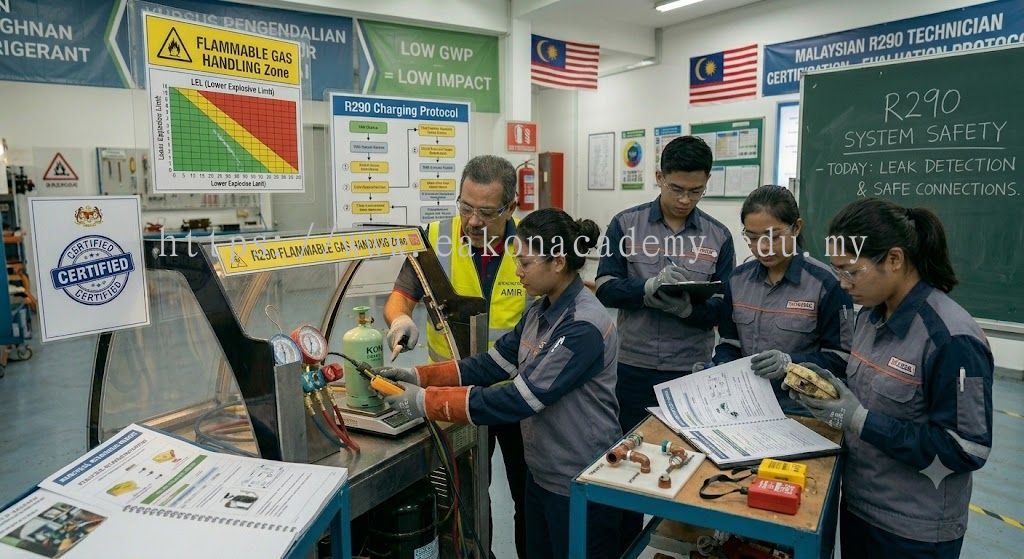
R290 HVAC SYSTEM SAFETY TRAINING: FLAMMABLE REFRIGERANT PROTECTION, LOW GWP COOLING SYSTEM RISK CONTROL AND PROFESSIONAL TECHNICIAN SAFETY CERTIFICATION
R290 HVAC system safety training refers to a specialized professional program designed to equip HVAC-R technicians, engineers, and maintenance personnel with the essential knowledge and practical skills required to safely install, operate, service, and maintain systems using propane (R290), a natural refrigerant known for its extremely low Global Warming Potential (GWP), zero ozone depletion potential, and high energy efficiency. As the HVAC industry increasingly adopts sustainable refrigerants, safety training has become a critical requirement to ensure responsible handling of flammable cooling systems.
One of the primary objectives of R290 HVAC system safety training is to minimize risks associated with flammable refrigerants. R290 is classified as a hydrocarbon refrigerant, which means it can ignite under certain conditions if not properly handled. Training programs focus on hazard identification, ignition source control, safe ventilation practices, and correct refrigerant charge limits. Technicians are taught how to create safe working environments and follow strict procedures to prevent fire hazards, leaks, and system failures.
Environmental safety is another key component of R290 HVAC system safety training. Traditional refrigerants used in HVAC systems often have high Global Warming Potential (GWP), contributing significantly to climate change when released into the atmosphere. In contrast, R290 is a low-GWP refrigerant with zero ozone depletion potential. Training emphasizes proper refrigerant recovery, leak prevention, and safe servicing practices that help reduce environmental impact and support global sustainability goals.
Energy efficiency is also closely linked to safe system operation. R290 has excellent thermodynamic properties that allow HVAC systems to operate efficiently with reduced energy consumption. However, achieving optimal efficiency depends on proper installation and maintenance practices. Safety training ensures that technicians understand how to correctly charge systems, optimize performance, and maintain stable operating conditions while adhering to safety standards.
A major part of R290 HVAC system safety training is system risk assessment and hazard analysis. Technicians learn how to evaluate HVAC systems for potential safety risks, including refrigerant leaks, electrical faults, and mechanical failures. This proactive approach helps identify problems early and prevents dangerous situations before they occur.
Fire prevention and emergency response procedures are critical elements of the training program. Technicians are trained to understand how to respond to refrigerant leaks, isolate affected systems, and use appropriate fire suppression methods. They also learn evacuation procedures and emergency communication protocols to ensure safety during critical incidents.
Proper installation and servicing techniques are also emphasized in R290 safety training. Technicians are taught how to safely install components, handle refrigerant cylinders, perform system evacuation, and conduct leak testing. These procedures ensure that HVAC systems operate safely and efficiently after installation or servicing.
Leak detection and preventive maintenance are essential for long-term system safety. Technicians are trained to use advanced diagnostic tools to detect leaks, verify system integrity, and ensure continuous safe operation. Regular maintenance helps prevent system failures and extends equipment lifespan.
From a professional development perspective, R290 HVAC system safety training is essential for HVAC-R technicians and engineers working with modern refrigerant technologies. Institutions such as Eakon Academy Malaysia provide structured training programs covering R290 safety procedures, installation methods, troubleshooting, system diagnostics, and maintenance practices. These programs ensure technicians are fully prepared to meet industry safety standards.
Furthermore, R290 HVAC system safety training plays a crucial role in building a competent and safety-conscious workforce. As global demand for low-GWP refrigerants continues to grow, technicians trained in safety standards will be increasingly important. This training not only enhances technical expertise but also supports the global transition toward safer, greener, and more sustainable HVAC-R systems for the future.

 Malaysia