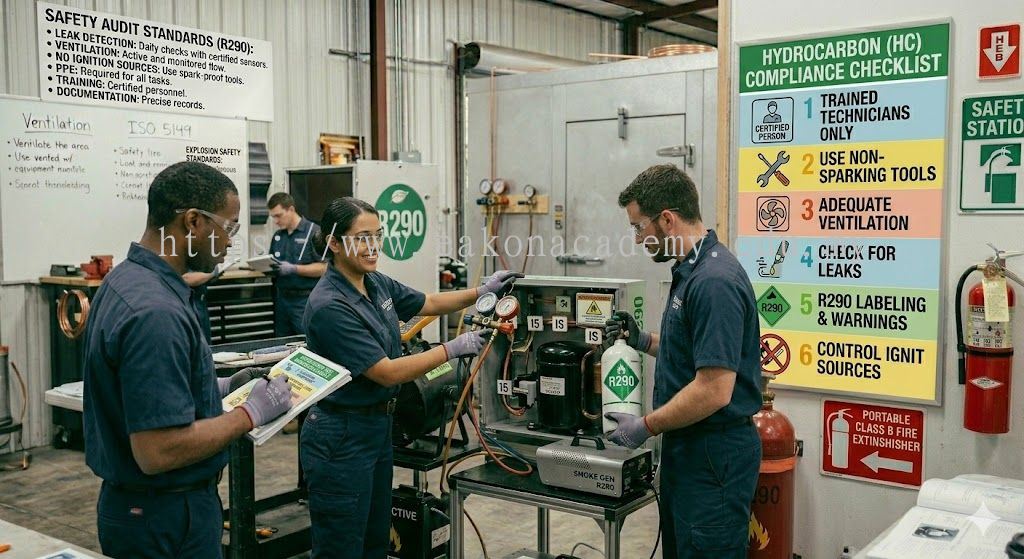
HYDROCARBON REFRIGERANT COMPLIANCE CHECKLIST FOR SAFE, EFFICIENT, AND STANDARDIZED HVAC-R SYSTEM MANAGEMENT
Hydrocarbon refrigerant compliance checklist is an essential reference tool used by HVAC-R professionals to verify that systems using hydrocarbon (HC) refrigerants, such as propane (R290) and isobutane (R600a), are installed, operated, and maintained according to required safety practices and industry standards. As the HVAC industry continues to transition toward environmentally friendly refrigerants with low global warming potential (GWP), hydrocarbon refrigerants have gained significant attention due to their excellent energy efficiency, low environmental impact, and strong cooling performance. However, because HC refrigerants are classified as flammable refrigerants, a detailed compliance checklist is necessary to ensure safe handling, proper installation, and reliable system operation. At eakonacadem.edu.my, we focus on providing professional HVAC education and technical training that supports the correct implementation of hydrocarbon refrigerant compliance checklist procedures for industry professionals.
A hydrocarbon refrigerant compliance checklist begins with system design verification. Before installation, HVAC engineers and technicians must confirm that the system design is suitable for flammable refrigerant applications. This includes checking refrigerant charge limits, equipment compatibility, system capacity, and installation location requirements. Proper design verification ensures that the system meets safety expectations and operates efficiently throughout its service life.
The next important section of the checklist involves equipment selection and inspection. All components used in hydrocarbon refrigerant systems must be suitable for HC refrigerant applications. The checklist should include verification of compressors, condensers, evaporators, valves, sensors, electrical components, and safety devices. Inspecting equipment before installation helps prevent failures and ensures that only approved components are used.
Safety assessment is another critical part of the hydrocarbon refrigerant compliance checklist. Technicians must evaluate potential hazards including refrigerant leakage, ignition sources, ventilation conditions, and electrical risks. A proper risk assessment helps determine the necessary safety controls required before installation or servicing activities begin. This ensures a safer working environment for technicians and system users.
Installation procedure verification is also included in the compliance checklist. Technicians must confirm that refrigerant piping, connections, and components are installed correctly according to manufacturer instructions and safety requirements. Proper brazing techniques, leak prevention methods, and piping support must be checked to ensure long-term system reliability. Accurate installation reduces the possibility of refrigerant leakage and improves system performance.
Ventilation inspection is an essential requirement when using hydrocarbon refrigerants. The checklist should verify that installation areas have adequate airflow to prevent refrigerant accumulation in case of leakage. Proper ventilation systems, equipment placement, and airflow pathways must be inspected to maintain safe operating conditions.
Electrical safety verification is another important element of the checklist. Technicians must inspect electrical wiring, grounding systems, control panels, and protective devices to ensure safe operation. Since HC refrigerants are flammable, preventing electrical sparks and faults is essential for reducing ignition risks.
Leak detection and pressure testing procedures must also be included in the hydrocarbon refrigerant compliance checklist. Technicians should verify that pressure testing has been completed using appropriate methods and that leak detection equipment has been used to confirm system integrity. These checks help identify potential problems before refrigerant charging and system operation.
Refrigerant charging verification is another key checklist item. The correct refrigerant quantity must be confirmed according to manufacturer specifications. Accurate charging ensures efficient operation, prevents unnecessary energy consumption, and maintains safe system performance.
Maintenance and documentation are also important parts of compliance. Technicians should record installation details, testing results, maintenance activities, and safety inspections. Proper documentation helps support future servicing, troubleshooting, and regulatory compliance.
At eakonacadem.edu.my, we emphasize the importance of training HVAC professionals in hydrocarbon refrigerant compliance checklist procedures. Proper education enables technicians to understand safety requirements, inspection methods, and best practices for working with flammable refrigerants. Skilled professionals are essential for ensuring safe and efficient HVAC-R system operation.
In conclusion, a hydrocarbon refrigerant compliance checklist is a valuable tool for maintaining safe, efficient, and compliant HVAC-R systems. By verifying design, equipment, installation, ventilation, electrical safety, leak testing, charging, and maintenance procedures, technicians can ensure reliable system performance while reducing operational risks. This comprehensive approach strengthens HVAC education and makes it a key focus area for training platforms like eakonacadem.edu.my.
更多 EAKON ACADEMY SDN BHD 相关资料 Malaysia