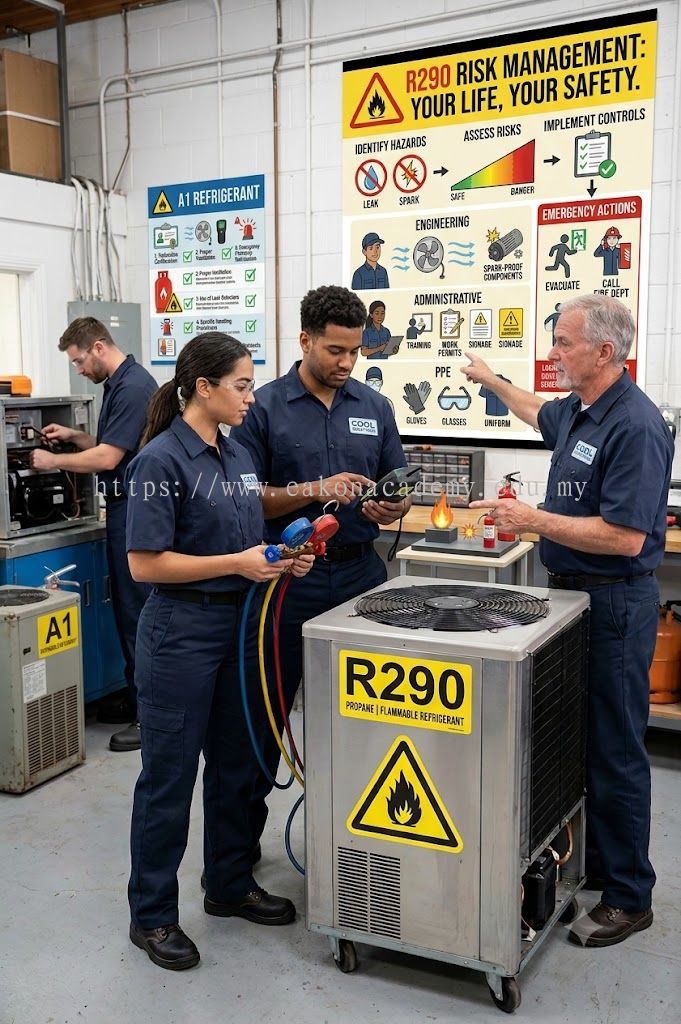
R290 REFRIGERANT RISK MANAGEMENT – HAZARD IDENTIFICATION, SAFETY CONTROL SYSTEMS AND PROFESSIONAL HVAC TRAINING STANDARDS
R290 refrigerant risk management is a critical component of modern refrigeration and air conditioning systems as the industry continues to transition toward environmentally friendly and energy-efficient refrigerants. R290, also known as propane refrigerant, is widely used due to its excellent thermodynamic performance, low global warming potential (GWP), and high energy efficiency. However, because R290 is classified as an A3 highly flammable hydrocarbon refrigerant, effective risk management strategies are essential to ensure safe installation, operation, servicing, storage, and transportation. For HVAC technicians, refrigeration professionals, and organizations seeking technical expertise, eakonacadem.edu.my provides structured training and education focused on refrigerant risk management, safety procedures, and modern HVAC industry standards.
The importance of R290 refrigerant risk management lies in the need to identify, assess, and control hazards associated with flammable refrigerants before they lead to accidents or system failures. Risk management ensures that potential dangers such as leaks, ignition sources, equipment malfunction, and improper handling are systematically evaluated and controlled. This proactive approach helps protect technicians, end users, equipment, and the environment while ensuring compliance with safety regulations.
One of the key aspects of R290 refrigerant risk management is hazard identification. Technicians and engineers must be able to recognize potential risks associated with propane refrigerant systems, including flammability, pressure-related hazards, and leak potential. Identifying risk areas such as poorly ventilated spaces, electrical components, and high-temperature zones is essential for preventing unsafe conditions. A clear understanding of hazard sources allows for effective planning and safety control implementation.
Another important element of risk management is risk assessment and system evaluation. Before installation or servicing begins, a detailed assessment of the working environment must be conducted. This includes evaluating ventilation conditions, proximity to ignition sources, system design limitations, and refrigerant charge levels. Risk assessments help determine the level of control measures required to ensure safe operation of R290 systems.
Control measures are a core component of R290 refrigerant risk management. These include engineering controls such as proper system design, limited refrigerant charge, and the use of compatible components designed for flammable refrigerants. Administrative controls such as safety procedures, work permits, and technician training also play a major role in reducing risk exposure. Personal protective equipment (PPE) further enhances safety by protecting workers from potential hazards.
Leak detection and monitoring systems are also essential in managing refrigerant risks. Regular inspections and continuous monitoring help identify leaks early before they escalate into dangerous situations. Electronic leak detectors and pressure testing methods are commonly used to ensure system integrity. Prompt repair of detected leaks is crucial for maintaining safe operating conditions.
Emergency response planning is another vital part of R290 risk management. Facilities must have clear procedures in place for handling refrigerant leaks, fire incidents, and system failures. Technicians must be trained to respond quickly and effectively to minimize damage and ensure safety. Proper emergency preparedness reduces the impact of unexpected incidents.
Training and professional competency are essential for effective R290 refrigerant risk management. Technicians must understand refrigerant properties, hazard classification, system behavior, and safety protocols. Institutions such as eakonacadem.edu.my provide comprehensive HVAC training programs that focus on natural refrigerants, risk assessment techniques, and modern refrigeration technologies. Through structured education, technicians gain the skills required to manage R290 systems safely and effectively.
For businesses and refrigeration operators, implementing R290 refrigerant risk management offers significant benefits. Proper risk control improves workplace safety, reduces operational hazards, ensures regulatory compliance, and enhances system reliability. Companies that invest in risk management strategies and technician training are better equipped to adopt low-GWP refrigerants while maintaining safe and efficient operations.
In conclusion, R290 refrigerant risk management is essential for ensuring the safe and responsible use of propane-based refrigeration systems. As the HVAC industry continues to move toward sustainable cooling technologies, effective risk management becomes increasingly important. Through hazard identification, risk assessment, control measures, leak detection, emergency planning, and professional training, R290 systems can be operated safely and efficiently. eakonacadem.edu.my supports the development of skilled HVAC professionals by promoting safety education, technical training, and industry best practices, contributing to a safer, more efficient, and environmentally responsible refrigeration industry in Malaysia and beyond.
更多 EAKON ACADEMY SDN BHD 相关资料 Malaysia