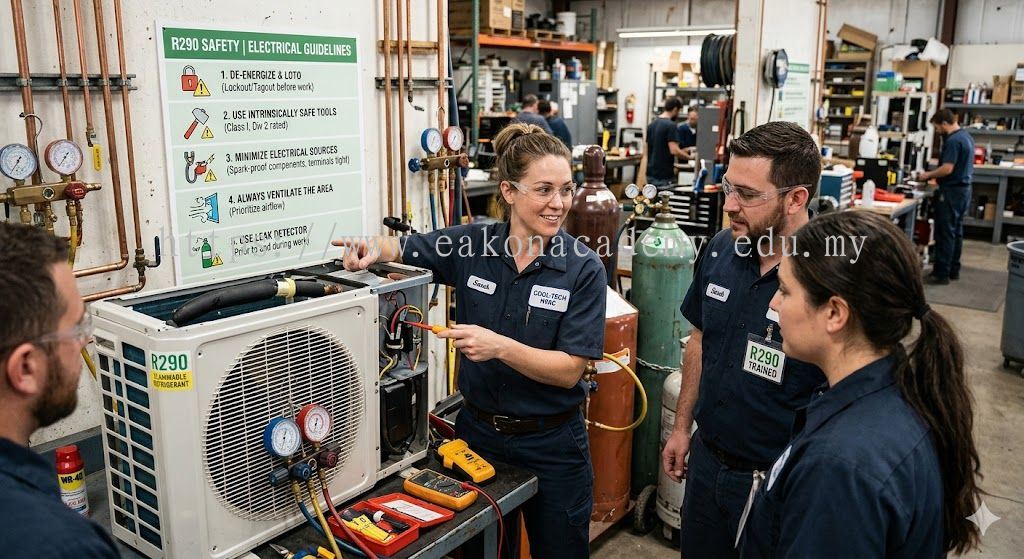
R290 ELECTRICAL SAFETY GUIDELINES – IGNITION RISK PREVENTION, SAFE INSTALLATION PRACTICES AND PROFESSIONAL HVAC TRAINING STANDARDS
R290 electrical safety guidelines are a critical part of modern refrigeration and air conditioning systems as the industry increasingly adopts environmentally friendly refrigerants. R290, also known as propane refrigerant, is widely used due to its excellent energy efficiency, low global warming potential (GWP), and strong cooling performance. However, because R290 is classified as an A3 flammable hydrocarbon refrigerant, electrical safety becomes extremely important to prevent ignition risks during installation, maintenance, and operation. For HVAC technicians, refrigeration professionals, and organizations seeking technical knowledge, eakonacadem.edu.my provides structured training and education focused on refrigerant safety, electrical protection standards, and modern HVAC system best practices.
The importance of R290 electrical safety guidelines lies in the fact that even small electrical sparks or overheating components can ignite propane refrigerant under certain conditions. This makes electrical system design, installation, and maintenance a key safety priority in any R290 refrigeration application. Proper guidelines ensure that all electrical components are selected, installed, and maintained in a way that minimizes ignition risks while maintaining system efficiency and reliability. These safety practices are essential for protecting technicians, equipment, and end users.
One of the key aspects of R290 electrical safety guidelines is the use of explosion-proof or spark-resistant components in refrigeration systems. Electrical devices such as switches, relays, motors, and sensors must be suitable for use in flammable environments. Proper insulation and protection of electrical wiring are also required to prevent short circuits or overheating. Ensuring that all components meet safety standards reduces the likelihood of ignition in case of refrigerant leakage.
Another important element of R290 electrical safety guidelines is proper grounding and bonding of electrical systems. Grounding helps prevent static electricity buildup, which can be a potential ignition source in environments where flammable refrigerants are present. All metal components of the refrigeration system must be properly bonded to ensure electrical continuity and safety. This reduces the risk of static discharge and enhances overall system protection.
Installation practices also play a major role in R290 electrical safety guidelines. Technicians must ensure that electrical wiring is properly routed, secured, and protected from physical damage. Electrical connections must be tight and properly insulated to prevent sparks or overheating. All electrical work must be carried out in accordance with safety standards and manufacturer specifications. Proper installation significantly reduces operational risks and improves long-term system reliability.
Maintenance and inspection are also critical components of electrical safety guidelines. Regular inspections must be conducted to identify worn-out wiring, loose connections, or faulty electrical components. Any damaged parts must be repaired or replaced immediately to prevent safety hazards. Preventive maintenance helps ensure that electrical systems remain safe and functional throughout the lifecycle of the R290 refrigeration system.
Training and professional competency are essential for understanding and applying R290 electrical safety guidelines. Technicians must be knowledgeable about refrigerant flammability, electrical system design, safety classifications, and emergency procedures. Institutions such as eakonacadem.edu.my play a vital role in providing HVAC training programs that focus on natural refrigerants, electrical safety standards, and modern refrigeration technologies. Through structured education, technicians gain the skills needed to safely manage electrical systems in R290 applications.
For businesses and refrigeration operators, following R290 electrical safety guidelines offers significant benefits. Proper electrical safety practices reduce fire risks, improve system reliability, ensure regulatory compliance, and enhance workplace safety. Companies that prioritize electrical safety and technician training are better equipped to adopt low-GWP refrigerants while maintaining safe and efficient operations.
In conclusion, R290 electrical safety guidelines are essential for ensuring the safe operation of propane-based refrigeration systems. As the HVAC industry continues to move toward environmentally friendly refrigerants, electrical safety becomes increasingly important for preventing ignition risks and ensuring system reliability. Through proper component selection, grounding, installation practices, and professional training, R290 systems can operate safely and efficiently. eakonacadem.edu.my supports the development of skilled HVAC professionals by promoting safety education, technical training, and industry best practices, contributing to a safer, more efficient, and sustainable refrigeration industry in Malaysia and beyond.
更多 EAKON ACADEMY SDN BHD 相关资料 Malaysia