
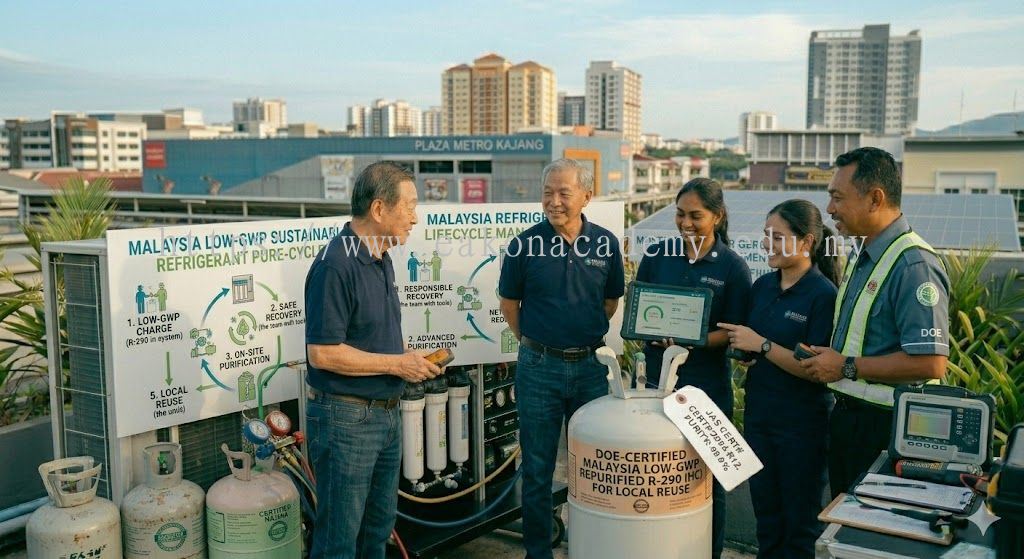
Low GWP Sustainable Refrigerant Management Malaysia: Advancing Climate-Friendly HVACR Systems, Energy Efficiency, and Environmental Protection
Low GWP Sustainable Refrigerant Management Malaysia refers to the environmentally responsible approach of selecting, handling, controlling, and maintaining refrigerants with low Global Warming Potential (GWP) in HVACR (Heating, Ventilation, Air Conditioning, and Refrigeration) systems across Malaysia. As the country strengthens its environmental policies and aligns with global climate change mitigation efforts, the adoption of low-GWP refrigerants has become a key strategy for reducing greenhouse gas emissions and improving sustainability in the HVACR industry. These systems are widely used in commercial buildings, industrial facilities, hospitals, hotels, supermarkets, cold storage warehouses, data centers, and residential applications. Without proper management, refrigerants can significantly contribute to climate change due to their high heat-trapping potential. Therefore, low GWP sustainable refrigerant management Malaysia is essential for achieving long-term environmental goals and improving system efficiency.
Low GWP sustainable refrigerant management focuses on reducing environmental impact by promoting refrigerants that have significantly lower climate effects compared to traditional high-GWP substances. However, sustainability is not only about selecting eco-friendly refrigerants; it also involves proper system design, installation, operation, maintenance, leak prevention, recovery, recycling, and responsible disposal. The combination of low-GWP refrigerants and effective management practices ensures that HVACR systems operate efficiently while minimizing environmental harm.
One of the most critical aspects of low GWP sustainable refrigerant management Malaysia is refrigerant leak prevention and control. Even low-GWP refrigerants can contribute to emissions if not properly contained. Regular system inspections, preventive maintenance, and advanced leak detection technologies such as electronic sensors, infrared detection, and ultrasonic monitoring systems are essential for identifying leaks early. By ensuring refrigerant containment, organizations can maximize environmental benefits while maintaining system performance.
Another important component is the safe handling and recovery of refrigerants. During maintenance, servicing, or system decommissioning, refrigerants must be recovered using certified equipment instead of being released into the atmosphere. Recovered refrigerants can be recycled, reclaimed, or safely stored for reuse, supporting circular economy principles and reducing waste. This ensures that even low-GWP refrigerants are managed responsibly throughout their lifecycle.
Energy efficiency is closely linked to low GWP sustainable refrigerant management Malaysia. HVACR systems operating with correct refrigerant levels and no leaks consume less energy and deliver better cooling performance. Refrigerant leaks can reduce system efficiency, increase compressor workload, and lead to higher electricity consumption. By implementing proper refrigerant management practices, organizations can significantly reduce energy usage, lower operational costs, and minimize indirect carbon emissions.
The adoption of low Global Warming Potential (GWP) refrigerants is a major step toward sustainable HVACR development in Malaysia. These refrigerants are designed to reduce environmental impact while maintaining high cooling efficiency. However, they require proper system compatibility, skilled installation, and regular maintenance to ensure optimal performance. Transitioning to low-GWP refrigerants supports Malaysia’s national climate goals and global sustainability commitments.
Technician training and competency are essential for successful implementation of low GWP sustainable refrigerant management Malaysia. HVACR professionals must be trained in refrigerant properties, system installation, leak detection, recovery procedures, safety protocols, and environmental compliance standards. Continuous training ensures technicians remain updated on DOE regulations, emerging technologies, and global best practices. Skilled technicians play a vital role in ensuring safe and efficient refrigerant management.
Accurate documentation and refrigerant tracking systems are also important for sustainability compliance. Organizations must maintain detailed records of refrigerant usage, leak incidents, maintenance activities, recovery operations, and disposal processes. Proper documentation ensures transparency, supports regulatory compliance, and enables organizations to monitor environmental performance effectively.
At eakonacadem.edu.my, HVACR technicians, engineers, facility managers, and industry professionals can access specialized training programs focused on low GWP sustainable refrigerant management Malaysia, refrigerant handling, leak prevention, HVACR system maintenance, environmental compliance, and sustainable refrigeration technologies. These programs combine theoretical knowledge with practical hands-on training, equipping participants with the skills required to implement environmentally responsible HVACR solutions.
As Malaysia continues to strengthen its environmental regulations and sustainability initiatives, low GWP sustainable refrigerant management Malaysia will remain a key pillar of the HVACR industry. Organizations that adopt these practices can reduce environmental impact, improve energy efficiency, lower operating costs, enhance regulatory compliance, and support national and global climate objectives. Through professional education and industry-focused training provided by eakonacadem.edu.my, HVACR professionals can develop the expertise needed to lead sustainable refrigerant management practices and contribute to a cleaner, greener, and more climate-resilient future.
更多 EAKON ACADEMY SDN BHD 相关资料 Malaysia
