


Thermo Scientific™ Phenom™ Perception GSR Desktop SEM
Dedicated automated gunshot residue analysis on a compact desktop SEM — delivering ASTM E1588-17 compliant results with CeB6 source stability, fully integrated EDS, and unattended 24-hour operation for busy forensic laboratories.
Product Overview
When a firearm is discharged, microscopic residue particles are propelled into a cloud of combustion gases and deposited on the shooter's hands and surrounding surfaces. These GSR particles — typically spherical and sub-micron to micron-scale — carry a characteristic chemical signature that SEM-EDS can positively identify. Because the Phenom Perception GSR automates both particle location and elemental classification, analysts can process multiple case samples in a single unattended run, drastically reducing turnaround time compared to manual SEM workflows.
Why We Detect Pb – Ba – Sb
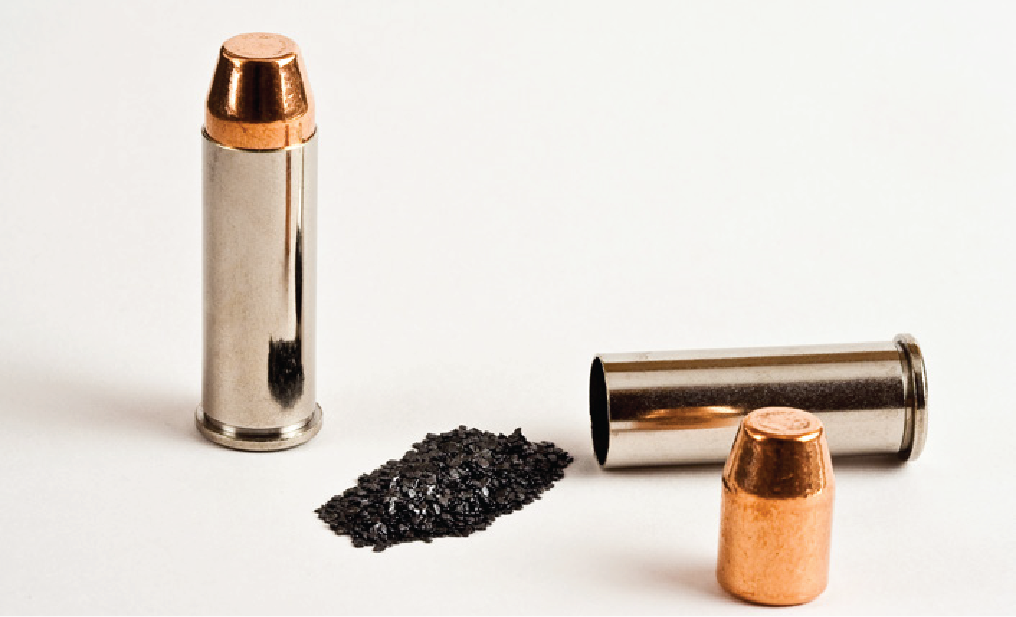
Modern primer compounds undergo an extremely rapid thermochemical reaction upon firing. The three primary elements detected by GSR analysis — lead, barium, and antimony — each originate from a distinct functional component of the primer mixture. Their simultaneous presence in a single spherical particle provides definitive evidence of firearm discharge.
Incident Scenario
Main Features & Capabilities
Intuitive User Interface
Click-and-drag recipe creation guides operators through run setup without specialised SEM training. Pre-installed, application-specific recipes and classification rule files let you execute standardised SOPs in a single button press.
25 mm² Standard / 70 mm² Window EDS Detector
Standard 25 mm² silicon drift detector (SDD) suits routine GSR casework. The optional 70 mm² window delivers significantly higher X-ray count rates, reducing per-particle acquisition time and enabling higher throughput on demanding sample loads.
ASTM E1588-17 Compliant Workflows
All automated analysis, particle classification, and report generation are structured in full conformance with ASTM E1588-17 and ENFSI Best Practice Guidelines 2006 — protecting the integrity of evidence from sample acquisition through to court-ready reporting.
>98% Hit Rate on Artificial GSR Samples
Validated against plano artificial GSR reference samples, the system consistently achieves a hit rate of typically >98%, confirming detection sensitivity and classification accuracy sufficient for high-evidential-value forensic casework.
Extensive Reporting with Customisable Templates
Fully automated report generation produces PDF, Word, Excel, and CSV outputs. Templates include EDS spectra, particle images, morphological data, and classification tables — all customisable to case reference numbers, analyst names, and laboratory branding.
Manual Revisiting & Particle Validation
When forensic protocols require independent confirmation, the high-accuracy motorized stage automatically relocates any flagged particle. Analysts can re-examine EDS spectra, re-acquire data, and document confirmation in a dedicated validation report — all without manually searching the stub.
Description & Key Benefits
System Specifications
| Category | Technical Parameter | Specification Detail |
|---|---|---|
| Imaging | Acceleration Voltages | 4.8 kV and 20.5 kV |
| Electron Source | Filament Type & Lifetime | CeB — >1,500 hours; gradual end-of-life degradation |
| EDS Detector | Active Area | 25 mm² standard; 70 mm² optional (higher count rate) |
| Energy Resolution | Mn Kα >132 eV; Silicon drift detector (SDD); thermoelectrically cooled (LN -free) | |
| Max Input Count Rate | 300,000 cps | |
| Sample Stage | Scan Area & Capacity | 100 × 100 mm motorized; up to 30 × 12 mm GSR pin stubs |
| Classification | Standard Compliance & Hit Rate | ASTM E1588-17 / ENFSI 2006; typically >98% on plano artificial GSR sample |
| System | Power & Facility Requirements | 300 W max; single-phase AC 110–240 V, 50/60 Hz; no LN , compressed air, or cooling water |
| Imaging Module Dimensions & Weight | 316(w) × 587(d) × 625(h) mm; 75 kg |
Forensic GSR Application Focus
Live GSR Particle Analysis
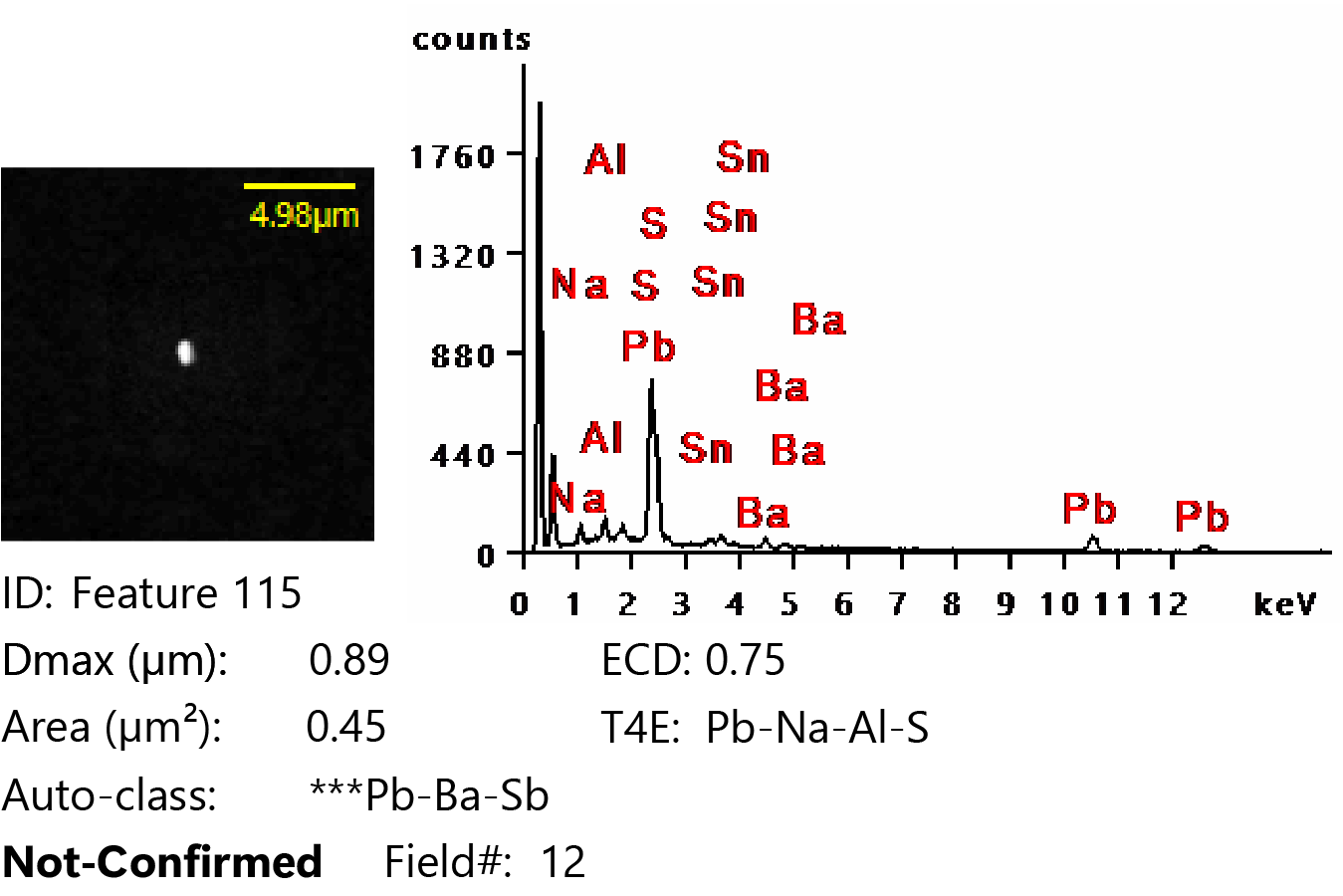
During automated runs, Perception Software provides real-time feedback as the system scans each stub. EDS spectra and the corresponding backscattered electron (BSE) image of each detected particle are displayed simultaneously as data is collected — allowing analysts to monitor progress and intervene if required without halting the run.

Particle Report with EDS Peak & Classification
Each detected suspect particle is documented in the case report with its full EDS spectrum, morphological measurements (Dmax, projected area), and classification result (e.g., Pb–Ba–Sb characteristic GSR). This particle-level traceability satisfies chain-of-custody requirements and allows direct cross-referencing between the report and the raw SEM dataset.
Morphological & Chemical Characterisation
Characteristic GSR particles are spherical — a shape that arises from the rapid solidification of molten primer material in flight. The Perception GSR software classifies particles based on both morphological criteria (sphericity, Dmax, projected area) and chemical content (confirmed co-presence of Pb, Sb, and Ba by EDS), providing a two-dimensional forensic confirmation that satisfies ASTM E1588-17 classification requirements.

