
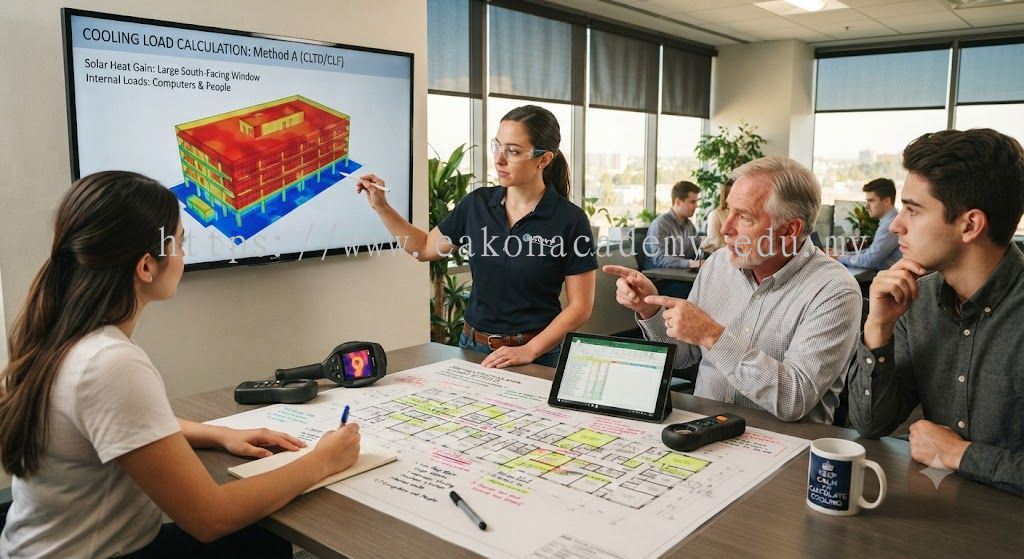
Air Conditioning Cooling Load Calculation Method: A Comprehensive Guide to Accurate HVAC System Design and Energy Efficiency
The air conditioning cooling load calculation method is one of the most important engineering processes in the HVAC (Heating, Ventilation, and Air Conditioning) industry. It is used to determine the exact amount of cooling required to maintain a comfortable indoor environment while ensuring that an air conditioning system operates efficiently and economically. Whether designing a residential home, commercial office, retail outlet, hotel, hospital, factory, or educational facility, using the correct cooling load calculation method is essential for selecting the right air conditioning equipment and achieving optimal system performance. At Eakon Academy (eakonacadem.edu.my), HVAC technicians, engineers, contractors, consultants, and students receive professional training in air conditioning cooling load calculation methods through practical learning, real-world case studies, and industry-recognized engineering practices.
A cooling load calculation method is the process of evaluating every source of heat that enters a building and calculating the amount of heat that must be removed by the air conditioning system. This total cooling requirement is usually expressed in British Thermal Units per hour (BTU/hr), refrigeration tons (TR), or kilowatts (kW). Unlike simple room-size estimates, professional cooling load calculations consider a wide range of variables that influence indoor temperatures. These include room dimensions, ceiling height, building orientation, wall construction, roof insulation, window size, glazing type, solar heat gain, occupancy, lighting systems, electrical equipment, ventilation, outdoor air infiltration, and indoor humidity levels. Every factor contributes to the total sensible and latent cooling loads that determine the required air conditioning capacity.
Using an accurate air conditioning cooling load calculation method provides significant advantages for both HVAC professionals and building owners. Proper calculations ensure that the selected air conditioning system is neither oversized nor undersized. An undersized unit will struggle to cool the space, resulting in continuous operation, excessive electricity consumption, increased compressor wear, and poor occupant comfort. Conversely, an oversized unit will cycle on and off frequently, causing inefficient energy use, inadequate humidity control, unnecessary maintenance, and a shortened equipment lifespan. Accurate cooling load calculations eliminate these problems by matching the system capacity to the building's actual cooling requirements.
Several internationally recognized cooling load calculation methods are widely used throughout the HVAC industry. The Cooling Load Temperature Difference (CLTD) method is commonly applied for estimating heat transfer through walls and roofs. The Cooling Load Factor (CLF) method evaluates internal heat gains from lighting, occupants, and electrical equipment. The Radiant Time Series (RTS) method offers highly accurate analysis by accounting for time-dependent heat transfer effects. The Heat Balance (HB) method is regarded as one of the most comprehensive engineering approaches and serves as the basis for many modern HVAC software applications. For residential buildings, the ACCA Manual J calculation remains one of the industry's most trusted standards for determining cooling loads. Each of these methods enables HVAC engineers to design efficient and reliable air conditioning systems based on scientific engineering principles.
In tropical countries such as Malaysia, applying the correct air conditioning cooling load calculation method is particularly important due to consistently high outdoor temperatures and humidity levels. Buildings are exposed to intense solar radiation throughout the year, increasing the amount of heat entering indoor spaces. Large windows, inadequate insulation, rooftop exposure, high occupancy, and continuous equipment operation further increase cooling demands. HVAC professionals must carefully analyze local climate conditions, building construction, ventilation requirements, occupancy schedules, and internal heat gains to ensure the selected air conditioning system performs efficiently under Malaysia's challenging environmental conditions.
Accurate cooling load calculation methods also contribute to improved energy efficiency and sustainable building design. Correctly sized HVAC systems consume less electricity, reduce greenhouse gas emissions, improve indoor environmental quality, and support green building certifications. Engineers, consultants, architects, and facility managers rely on cooling load calculations when designing energy-efficient buildings that comply with modern construction standards and environmental regulations. As governments and industries continue promoting energy conservation, cooling load calculation has become an increasingly valuable engineering skill.
Today's HVAC professionals frequently use advanced software such as Carrier HAP, Trane TRACE 3D Plus, EnergyPlus, and other engineering design programs to perform detailed cooling load calculations. These applications can analyze thousands of building variables and produce highly accurate reports. However, software should complement—not replace—engineering knowledge. HVAC technicians and engineers must understand heat transfer, psychrometrics, sensible heat, latent heat, ventilation loads, infiltration, thermal insulation, and occupancy effects to verify software results and make informed design decisions. A strong understanding of engineering fundamentals ensures accurate cooling load calculations and successful HVAC system performance.
At Eakon Academy, participants receive hands-on training in air conditioning cooling load calculation methods through practical workshops, engineering calculations, building simulations, and real project applications. Students learn how to evaluate building heat gains, calculate sensible and latent loads, interpret architectural drawings, analyze ventilation requirements, and select appropriate air conditioning equipment for residential, commercial, and industrial buildings. The academy combines classroom theory with field-based practical training to prepare learners for professional careers in HVAC system design, installation, maintenance, and energy management.
As the HVAC industry continues to adopt smarter technologies, higher energy efficiency standards, and environmentally sustainable solutions, expertise in air conditioning cooling load calculation methods has become an essential skill for modern HVAC professionals. Accurate cooling load calculations improve equipment selection, reduce operating costs, enhance indoor comfort, increase system reliability, and support sustainable building practices. By enrolling in professional HVAC training at Eakon Academy (eakonacadem.edu.my), learners can develop advanced technical knowledge, strengthen their engineering capabilities, enhance career opportunities, and gain the practical skills required to design efficient, high-performance air conditioning systems that meet international standards and the evolving needs of the global HVAC industry.
Tingnan ang karagdagang mga detalye tungkol sa EAKON ACADEMY SDN BHD
